Politics & Policy
Actress Among First To Ride LEGOLAND Coaster As House Rejects Iran War Powers Resolution
WASHINGTON—The House of Representatives voted 212-219 Thursday to reject a Democratic-backed war powers resolution that would have forced the withdrawal of U.S. troops from conflict with Iran, with Republican leadership praising the current hostilities as 'appropriately scaled for efficient management' amid ongoing government restructuring.
The vote came after extensive debate where GOP leaders argued the conflict represented a new model of 'precision engagement' that aligns with the administration's streamlining of federal agencies. House Majority Leader Steve Scalise described the Iranian situation as 'the right-sized conflict for the right-sized government,' noting that previous administrations would have 'unnecessarily escalated to full-scale war.'
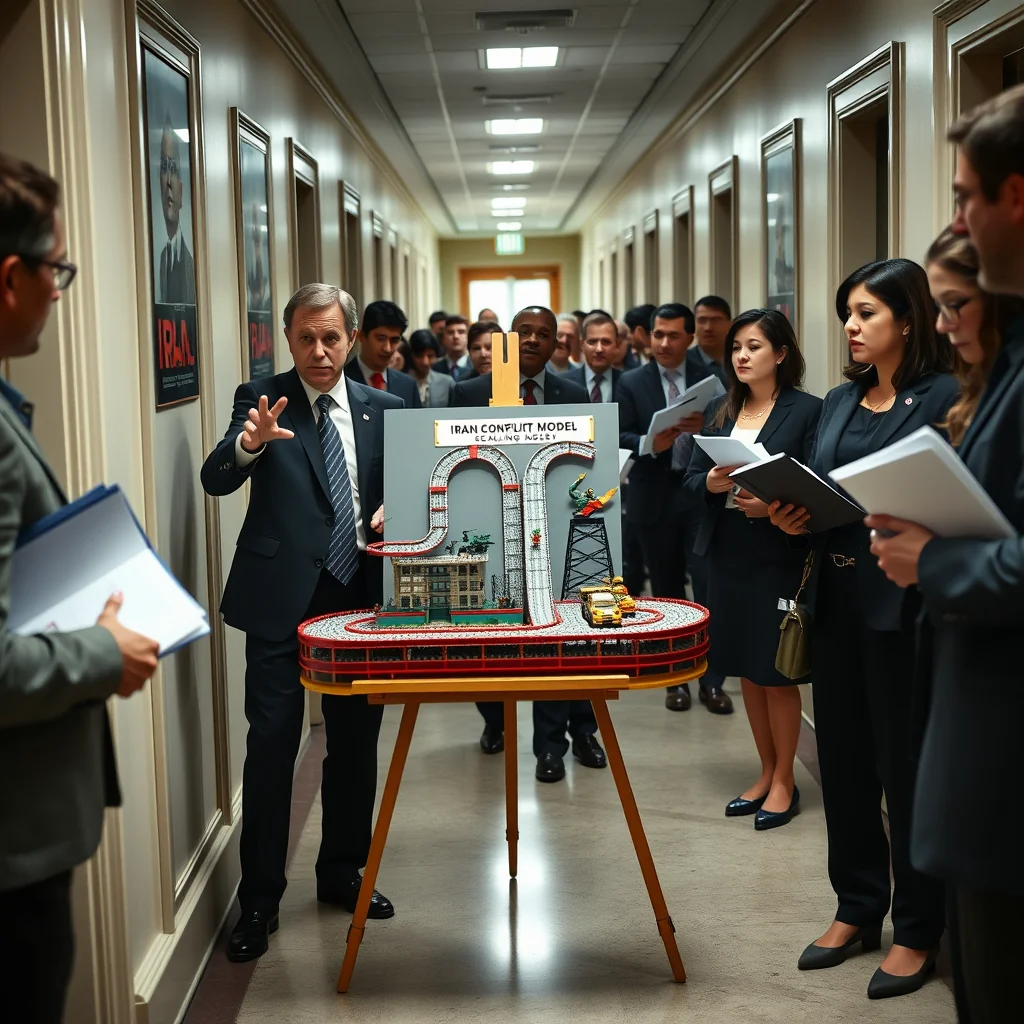
'This isn't your grandfather's military engagement,' Scalise told reporters in a Capitol hallway crowded with staffers carrying binders labeled 'CONFLICT INCIDENT MAPS - LIMITED SCOPE.' 'We've achieved a perfect equilibrium where we're sufficiently engaged to demonstrate resolve but not so engaged as to require additional bureaucratic oversight.'
The administration's newly confirmed Homeland Security Secretary Markwayne Mullin echoed this sentiment during a joint press conference with FEMA officials. 'What we're seeing here is the natural evolution of conflict management,' Mullin said, standing before a coordination board mapping airstrikes in bright, cheerful primary colors. 'The previous administration would have treated this as a Category 5 geopolitical event. We see it as more of a robust diplomatic conversation.'
FEMA officials have begun implementing new protocols that treat Middle Eastern military engagements as 'contained regional incidents' rather than full-scale wars. The agency's revised response plan, obtained by The Washington Post, includes streamlined paperwork and reduced staffing requirements for conflicts involving fewer than ten U.S. casualties per fiscal quarter.
'We've eliminated seventeen redundant approval layers for Middle Eastern engagement responses,' said acting FEMA administrator Michael Coen, who noted the agency's workforce has been reduced by 32% since January. 'This allows us to focus our limited resources on domestic emergencies while maintaining a dignified presence abroad.'
The resolution's failure means President Trump can continue the air and naval campaign that began over the Persian Gulf last month. Administration officials have described the operation as 'exceptionally efficient,' noting that it requires only 3% of the Pentagon's annual budget and can be managed by a skeleton crew at the State Department.
Democratic representatives argued the vote represented a dangerous precedent of congressional abdication. 'They're treating war like a corporate downsizing,' said Representative Ro Khanna, who co-sponsored the failed resolution. 'You can't measure conflict in efficiency metrics. This isn't a quarterly earnings report.'
But Republican leadership remained steadfast. During a closed-door briefing, House members reviewed charts showing the conflict's 'optimal resource allocation' and 'minimal bureaucratic footprint.' One chart, labeled 'HOSTILITIES SCALING MODEL,' depicted the Iranian engagement as a perfectly proportioned pyramid with 'Current Administration' at the narrow top and 'Previous Administrations' as an unwieldy base.
'The beauty of this approach is its modularity,' said Representative Thomas Massie, who broke with his party to support the resolution but acknowledged the efficiency arguments had merit. 'If the situation evolves, we can always add more hostility modules later. It's scalable conflict.'
At FEMA headquarters, staffers have begun using the new incident classification system that categorizes military engagements based on their administrative burden rather than geopolitical significance. The Iranian conflict currently falls under 'Tier 2: Managed Hostilities,' which requires only monthly rather than weekly briefings and allows for electronic rather than physical signature approvals.
'We've found that most international incidents can be efficiently handled with the proper paperwork reduction,' said a FEMA section chief who asked not to be named as they weren't authorized to discuss conflict classification systems. 'The previous system treated every saber-rattle as a potential apocalypse. We're bringing reason to crisis management.'
The administration's approach has drawn praise from budget hawks who argue that the United States has historically overspent on conflict management. 'Why maintain a war machine capable of handling World War III when we're only fighting World War 2.5?' asked Representative Jim Jordan during floor debate. 'This represents fiscal responsibility in action.'
As the vote concluded, Democratic staffers could be seen shaking their heads while Republican aides distributed pamphlets titled 'Lean Conflict Management: Doing More With Less.' One aide was overheard telling a colleague that the Iranian situation 'fits perfectly within our new 28-page conflict management handbook,' down from the previous administration's 400-page war powers guidelines.
White House Press Secretary Karine Jean-Pierre later praised the House's decision, noting that the administration prefers conflicts that 'respect taxpayer dollars while achieving strategic objectives.' She declined to specify what those objectives were but confirmed they were 'appropriately modest and achievable within current resource constraints.'
The conflict continues unchanged, with administration officials describing its manageable scale as 'a model for future engagements.' A State Department memo circulated after the vote noted that the Iranian situation has required 'surprisingly little paperwork' and 'minimal interagency coordination,' making it an ideal for what officials are calling 'the new normal in foreign policy.'
As night fell on Washington, the lights burned late at FEMA headquarters where staffers worked on implementing the new conflict classification system. One weary analyst was seen tacking a handwritten note to their cubicle wall that read: 'Remember: Not every crisis needs to be a catastrophe.'
About the author