Defense & Military
Azerbaijan Opens Investigation into Whether Airport Can Withstand Next 999 Drone Strikes
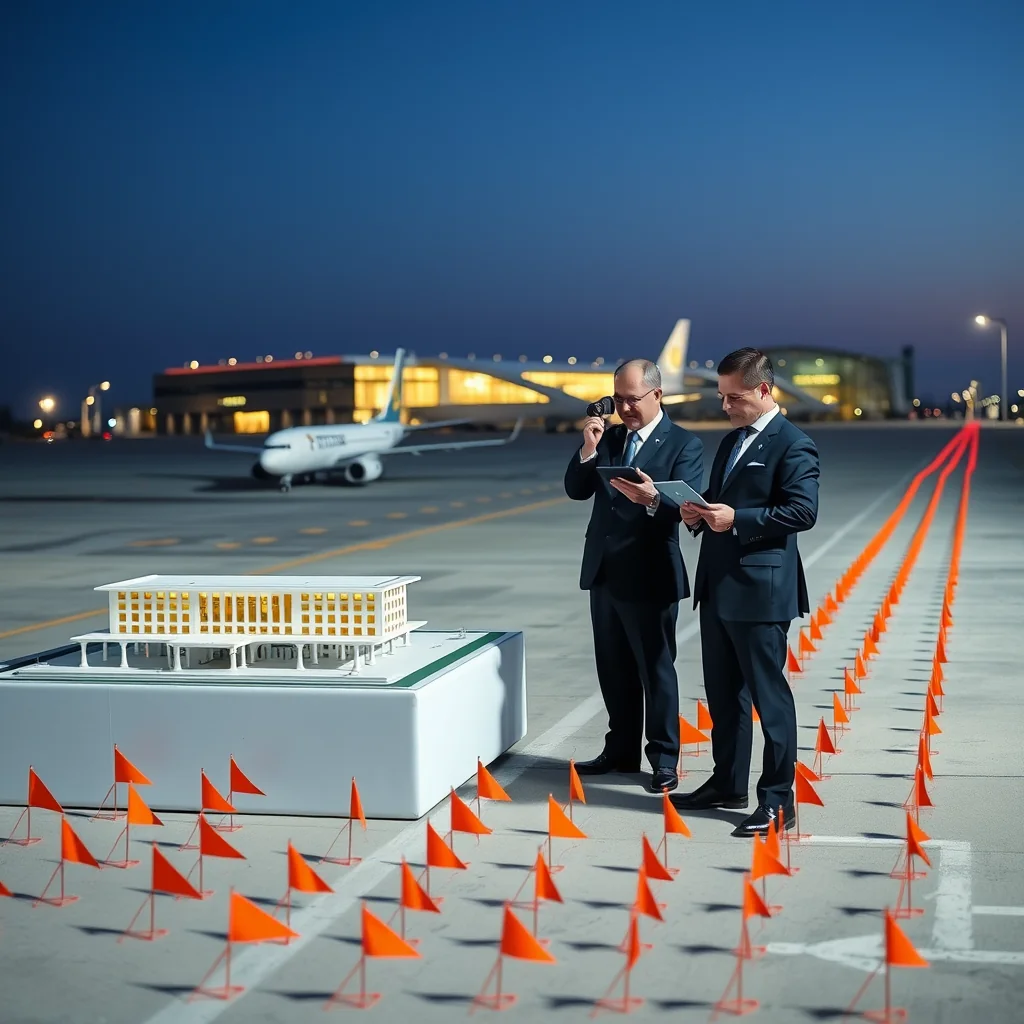
BAKU, Azerbaijan — The Azerbaijani government announced Tuesday the launch of a high-priority investigation to determine if Heydar Aliyev International Airport can withstand exactly 999 consecutive drone strikes, a figure officials described as 'statistically derived' from a preliminary risk assessment. The investigation, led by a newly formed Directorate of Aerial Repetition Endurance (DARE), will subject the airport's infrastructure to a battery of simulated and theoretical scenarios, all calibrated to the specific numerical threshold.
'We are not asking if the airport can withstand *a* drone strike, or even *some* drone strikes,' said Elshan Abbasov, the deputy minister chairing the investigation, during a press briefing on the tarmac. 'We are asking a precise, quantifiable question: Can it withstand 999? The answer must be binary. The nation's security depends on this clarity.' The investigation's first phase involves creating a scale model of the airport, which will be placed in a wind tunnel and subjected to 999 precisely timed puffs of air from a drone-shaped nozzle. 'We must understand the cumulative effect of repeated impacts,' Abbasov added, noting that each 'strike' would be logged in a master ledger by a team of notaries public.
Initial findings, however, prompted immediate procedural complications. A subcommittee reviewing the investigation's methodology determined that the probe itself may not be robust enough to handle the administrative burden of its own conclusions. This led to Cabinet Resolution 742, which mandates a parallel investigation into the first investigation's capacity to process 999 separate interim reports, data audits, and stakeholder feedback sessions without collapsing under bureaucratic strain. 'We are investigating the investigation,' confirmed Major-General Farid Mammadov, appointed to lead the meta-investigation. 'It is a matter of national integrity. If our process fails at, say, investigation number 500, then any findings regarding the airport's durability become functionally meaningless.'
The meta-investigation has already spawned its own oversight body, the Committee for Investigative Integrity Verification (CIIV), which will assess whether the meta-investigation can sustain 999 rounds of internal peer review. CIIV's charter, obtained by reporters, stipulates that its work must be independently validated by a yet-to-be-formed Council of Verification Assurance, which itself will need to prove it can withstand 999 verification challenges. 'This is standard operational security,' said a ministry spokesperson. 'We are building a nested doll of accountability. Each layer must be as resilient as the one it contains.'
Airport operations have been partially rerouted to accommodate the physical testing. The main runway is now dotted with 999 small, numbered flags, each representing a hypothetical strike point. Engineers using laser rangefinders measure minute concrete abrasions after low-flying government drones drop bags of sand onto each marker. 'The integrity of the tarmac at flag number 378 is already showing a 0.002% deviation from baseline,' read a statement from the engineering corps. 'We are monitoring this closely.'
International aviation experts have expressed bewilderment at the specific numerical focus. 'Focusing on an arbitrary number like 999 ignores variables like drone size, payload, and attack vector,' said Dr. Anja Weber, a Berlin-based security analyst. 'But the Azerbaijani approach is commendably literal. They have identified a number and are diligently seeing if the airport can handle it.' When asked if the investigation would consider what might happen during a hypothetical 1000th strike, Deputy Minister Abbasov was dismissive. 'The scope is 999,' he stated. 'A thousand is a separate inquiry, for which we have not yet received a budget allocation.'
As the layers of bureaucratic inquiry multiply, airline passengers report increasing delays. Flights are held on the taxiway for hours while investigators confirm that the wingtip of a parked Airbus A320 did not, in fact, constitute drone strike number 437. 'We apologize for the inconvenience,' a gate agent announced over the terminal's PA system, 'but ensuring the investigation into the airport's ability to withstand 999 drone strikes proceeds without interference is our top priority.' The investigation is expected to produce its final report—a document that must itself withstand 999 separate authenticity checks—within the next 18 to 24 months. Until then, the airport will operate under the provisional assumption that it can withstand exactly 998 strikes, a status officials call 'cautiously optimistic.'
About the author