Energy & Utilities
Babbitt Memorial Turbine Runs on Unresolved Tension, Airport Officials Say
WASHINGTON — The Trump administration's nominee to lead the Department of Homeland Security, Markwayne Mullin, unveiled a controversial energy initiative Tuesday that would repurpose the "unresolved emotional aftermath" of the January 6th Capitol riot into a renewable power source. The proposal, which Mullin dubbed the "Babbitt Memorial Energy Project," involves installing specialized tension-harvesting turbines at airport jet bridges nationwide.
"We're sitting on a vast, untapped reservoir of patriotic fervor," Mullin told reporters during a press conference held in a crowded terminal at Dulles International Airport. "The energy expended on January 6th didn't just disappear. It's still vibrating in the very air around us, particularly in transportation hubs."
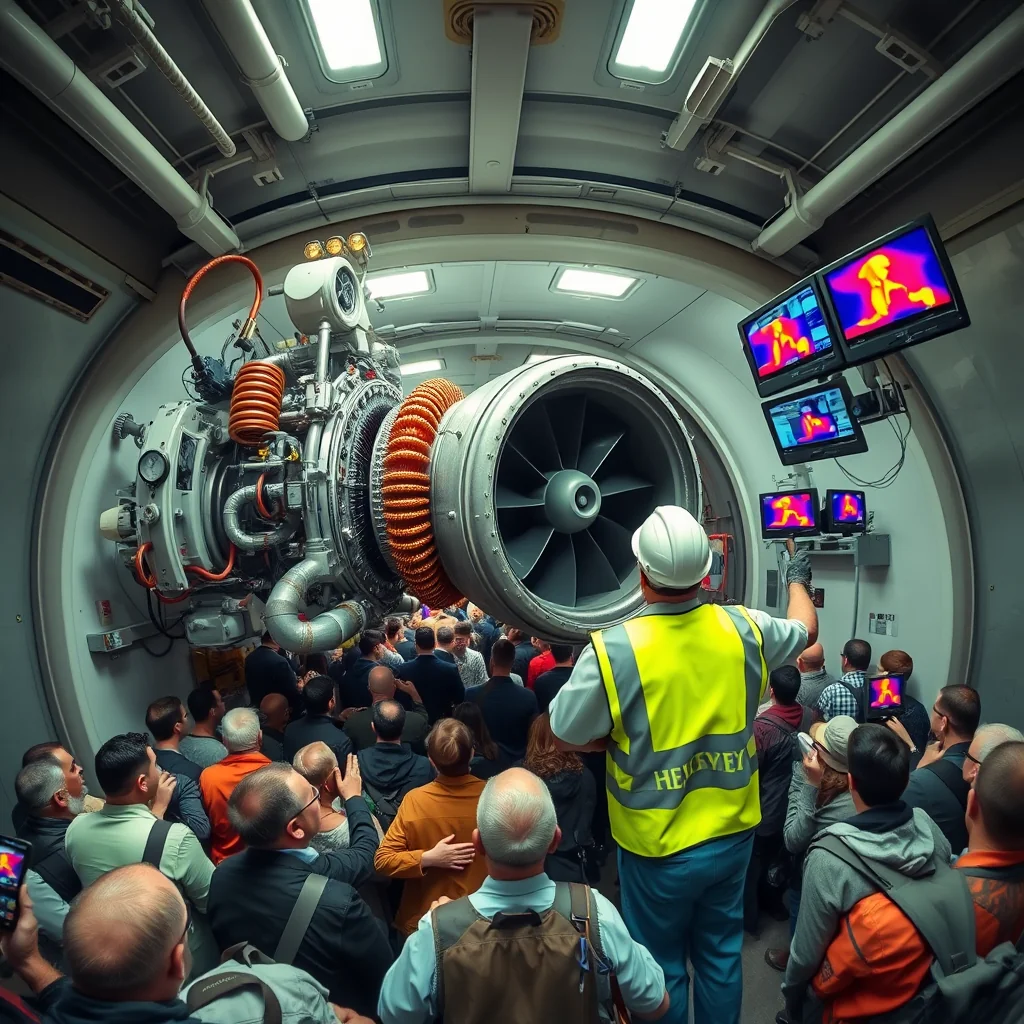
The project's centerpiece is a turbine mechanism that Mullin claims can convert "emotional residue" from events like the shooting of Ashli Babbitt into measurable electrical output. Engineers from the Transportation Security Administration have already begun retrofitting jet bridges at six major airports with prototype devices that resemble oversized industrial desk fans with copper coils.
"Initial tests at Reagan National have been promising," said TSA energy liaison Brenda Schott, holding a thermal imaging tablet that displayed glowing red hotspots near a boarding gate. "We're seeing significant thermal anomalies in areas where passengers experienced prolonged waits or political discussions. The Babbitt incident, being a national focal point, generates particularly high yields."
According to departmental briefings, the turbines operate on a principle Mullin calls "grievance thermodynamics," which posits that strongly held beliefs produce measurable energy when confronted with bureaucratic inertia. The system would channel what Mullin described as "the righteous indignation of forgotten Americans" through specially calibrated vanes into the national power grid.
Critics within the Department of Energy have questioned the scientific basis for the project. "This isn't physics, it's psychics," said one senior analyst who spoke on condition of anonymity. "They're basically proposing to power California with hurt feelings."
But Mullin defended the proposal as both practical and symbolic. "Ashli Babbitt gave her life for this country's energy independence," he said, standing before a schematic diagram showing how crying protestors could theoretically power small appliances. "Every time a patriot feels that their voice isn't being heard, we'll be there to capture that energy and put it to work for America."
The proposal has already faced logistical challenges. During a demonstration at Chicago O'Hare, technicians discovered that the turbines became less efficient when passengers actually boarded their flights. "The energy seems to dissipate once people physically move forward," Schott noted. "We're working on containment systems that can maintain the tension throughout the boarding process."
Security concerns have also emerged. At Denver International Airport, a prototype turbine overheated when a debate about gas prices escalated among passengers waiting to fly to Texas. The incident resulted in melted safety cones and several hard hats being tagged with emergency decals.
Mullin's nomination hearing before the Senate Homeland Security Committee featured extensive debate about the project's feasibility. Senator Richard Blumenthal (D-CT) questioned whether "we should be building national infrastructure around metaphysical concepts." Mullin responded that all energy was ultimately metaphysical until harnessed.
The White House has expressed support for the initiative, with Press Secretary Karine Jean-Pierre calling it "an innovative approach to both energy policy and national healing." She declined to comment on whether President Biden was aware that the project was named after someone who died breaching the Capitol.
Aviation industry representatives have reacted with cautious optimism. "If this means we can offset our electricity bills with political arguments, we're all for it," said Airlines for America spokesperson Carter Yang. "Though we'd prefer it if the energy came from happy travelers, but you work with what you have."
The project's testing phase is scheduled to continue through the election cycle, with Mullin predicting that debate nights could produce "enough energy to power Cleveland." Energy Secretary Jennifer Granholm has reportedly requested a full cost-benefit analysis, particularly focusing on whether the system could be adapted to capture frustration with airline baggage fees.
As passengers lined up behind him for a flight to Phoenix, Mullin concluded his remarks by noting that the true potential of grievance energy remained largely theoretical. "We won't know how much power we can generate until we try to silence the voices producing it," he said. "That's the beautiful paradox at the heart of this project."
The first full-scale Babbitt Memorial Turbine is scheduled to become operational at Atlanta's Hartsfield-Jackson Airport next month, where it will power the moving walkways between concourses using nothing but the nation's unresolved political trauma.
About the author