Politics & Policy
Berkshire's Abel Announces New Compounding Plan Drafted on White House Napkins
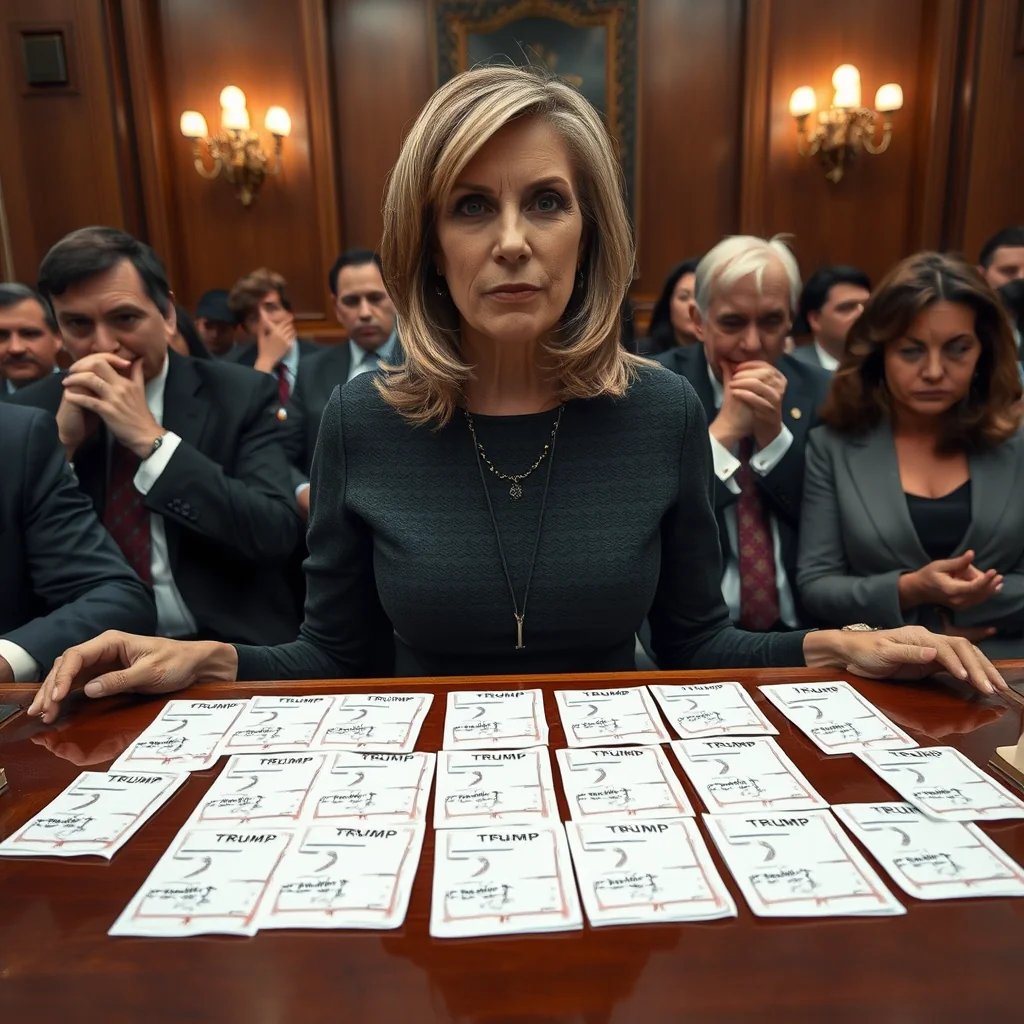
WASHINGTON—In what administration officials are calling a necessary personnel realignment, former Homeland Security Secretary Kristi Noem was relieved of her duties Thursday after presenting congressional investigators with what she termed "the operational backbone" of the nation's immigration enforcement strategy: a collection of 27 cocktail napkins from various Trump-owned properties featuring crude city outlines annotated with presidential mood assessments.
The termination occurred during a House Oversight Committee hearing examining the administration's controversial sanctuary city policies. Noem, who had until recently been considered one of the president's most loyal cabinet members, began her testimony by unveiling what appeared to be standard government briefing materials.
"Our analysts developed a detailed classification system based on fiber density and absorbency," Noem told lawmakers, smoothing a slightly stained napkin bearing the Trump International Hotel logo. "This particular document guided our enforcement surge in Chicago last month."
Committee members leaned forward as Noem displayed the napkin, which featured a wobbly circle labeled "Windy City" with the notation "VERY ANGRY - 9/10 - bad coverage" followed by "SEND EVERYONE."
"The scoring system is particularly elegant," Noem continued, apparently unaware of the growing discomfort among administration staffers seated behind her. "We assign points based on the president's emotional response to morning news coverage from each municipality. Cities where local commentators have been, shall we say, insufficiently appreciative receive priority deployment."
According to three senior DHS officials who spoke on condition of anonymity, the napkins represented what they believed were preliminary brainstorming materials, not actual policy documents. "We thought she was using metaphors during briefings," said one visibly shaken staffer. "Turns out she was being literal."
The hearing took a decisive turn when Representative Jamie Raskin (D-MD) inquired about the provenance of the mapping system. "Madam Secretary," Raskin began, "are you telling this committee that the United States government is allocating law enforcement resources based on drawings made during dessert courses?"
Noem responded with what observers described as "performative professionalism." "The president's instincts are our North Star," she said, carefully arranging a series of napkins on the witness table. "His visceral reactions provide the most honest barometer of which cities require what he calls 'the treatment.'"
She then displayed what she termed "the masterpiece"—a napkin from Mar-a-Lago featuring a map of California with the words "THE WORST" written across it in what appeared to be ketchup. "This directive resulted in the redeployment of 3,000 border agents to Los Angeles," Noem explained. "The president was apparently quite distressed by a segment on Fox News about homeless encampments."
The hearing room fell silent as Noem elaborated on what she called "the napkin protocol." Each document, she explained, was digitized by DHS analysts who would "enhance the penmanship" before distributing it as operational guidance. "We have a whole team that specializes in interpreting the pressure applied to the pen," she said. "Heavier strokes indicate greater urgency."
White House chief of staff John Kelly, who was monitoring the testimony from the West Wing, immediately contacted the president, who was reportedly on the golf course. According to aides, Trump's response was characteristically direct: "Fire her. She's making us look stupid."
The termination occurred so rapidly that Noem was still explaining the napkin classification system when a security detail arrived to escort her from the hearing room. "The ones with cocktail rings are considered more authoritative," she was saying as agents approached the witness table. "The condensation creates a kind of authenticity watermark."
In the aftermath, administration officials scrambled to contain the damage. Acting Homeland Security Secretary Ken Cuccinelli issued a statement characterizing the napkins as "preliminary brainstorming tools" that were "taken out of context." He insisted that "actual policy is developed through rigorous processes that definitely involve paper thicker than cocktail napkins."
But the episode has raised troubling questions about the administration's governance style. Former DHS Secretary Janet Napolitano expressed alarm at the revelations. "When I ran the department, we used cartographic projections and census tract data," she told reporters. "Now they're cross-referencing lipstick stains with cable news chyrons. It's barbaric."
The fallout extended beyond Washington. Mayors of several cities previously targeted by DHS expressed outrage upon learning their communities' enforcement status derived from presidential pique. Chicago Mayor Brandon Johnson threatened to "send a complimentary deep-dish pizza to improve our napkin rating," while Los Angeles Mayor Karen Bass announced her administration would begin "strategically placing favorable headlines in the president's bathroom reading material."
Meanwhile, Noem has reportedly been composing her memoir, tentatively titled "The Napkin Chronicles," which her agent promises will reveal "even more innovative policy development techniques" employed during her tenure. The former secretary remains unapologetic, telling friends that "history will vindicate those of us who understood that true leadership leaves a stain."
As for the napkins themselves, they have been entered into the congressional record as Exhibit A through ZZ. Preservation experts at the National Archives are reportedly debating whether to treat the ketchup stains as "historically significant additives" or "biohazards requiring neutralization."
The episode concludes with what one senior Republican senator called "the Washington equivalent of finding out the nuclear codes are written on a Denny's placemat." As congressional staffers boxed up the evidence, one aide was overheard murmuring, "At least they used cocktail napkins. The healthcare policy was developed on those little paper strips they put around toilet seats."
About the author