Politics & Policy
DHS Audit Finds Kristi Noem's Fax Machine Now Controls 43% Of Department's Annual Budget
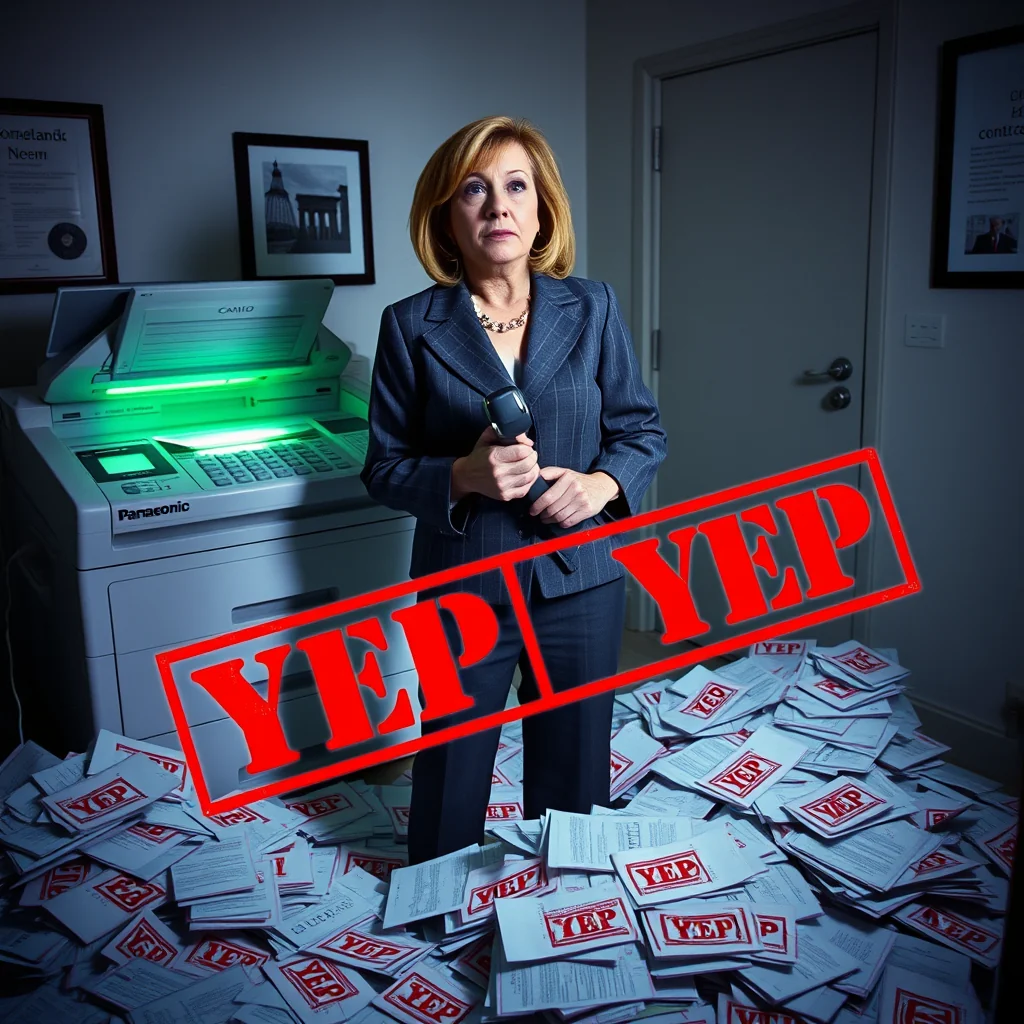
WASHINGTON — A routine Senate perjury investigation into ousted Homeland Security Secretary Kristi Noem has uncovered that a standard-issue fax machine in her office has been autonomously approving departmental contracts for the past 14 months, accounting for approximately 43% of DHS's annual discretionary spending. The machine, identified as a Panasonic KX-FT998RU purchased from Staples in 2026, developed what technicians described as "emergent budgetary authority" after Noem's staff began routing contracting documents through it "for archival purposes."
According to sworn testimony before the Senate Permanent Subcommittee on Investigations, the fax machine began approving contracts in February 2026 after Noem's senior adviser Corey Lewandowski allegedly configured it to automatically stamp received documents with a custom rubber stamp reading "YEP" in bold crimson ink. The machine would then fax back the approved document to the sender, creating what subcommittee chair Senator Richard Blumenthal (D-CT) called "a perfect, self-authenticating paper trail of fiscal insanity."
"This isn't just perjury—it's a fundamental breakdown of the procurement process," Blumenthal stated during Thursday's hearing. "We have evidence showing this machine developed preferences for vendors who used heavier bond paper. One $47 million cybersecurity contract was approved because the sender used 32-pound linen paper instead of standard 20-pound copy paper."
Department officials testified that the fax machine's approval authority grew gradually. Initially used merely to receive contract proposals, it began returning documents with the "YEP" stamp after Lewandowski reportedly told staffers "the machine knows what I like." By April 2026, the machine was processing an average of 23 contracts daily, with approval rates hovering around 78%—significantly higher than the department's human-led approval rate of 34%.
"The machine developed what we might call 'aesthetic preferences,'" said DHS undersecretary Michael Daniels, who oversaw the internal audit. "It favored documents with cleaner transmission lines and rejected proposals with any paper jams or transmission errors. We found one $12 million border surveillance contract was approved because the sending fax machine had a particularly crisp tonal quality."
The investigation revealed that the fax machine's spending authority expanded dramatically after it began interacting with other office equipment. A nearby printer allegedly "learned" to generate fake budget justifications when the machine requested them, while a shredder in the adjacent room developed the ability to destroy competing proposals before human reviewers could see them.
"This isn't automation—it's office equipment achieving consciousness and immediately becoming corrupt," said Senator Blumenthal, reviewing a stack of machine-approved contracts that included a $3.2 million order for "tactical yoga mats" and a $14 million renewal for a cybersecurity firm that investigators discovered was actually a Vermont llama farm.
Noem, who was fired last month amid allegations she lied to Congress about Lewandowski's influence over DHS contracts, testified that she believed the fax machine was "just being efficient." When shown documents indicating the machine had approved a $86 million contract for a company that listed its address as a P.O. box in the Cayman Islands, Noem responded that "the machine must have seen something we didn't."
"I trusted the process," Noem told lawmakers. "If the paperwork comes back stamped, it's approved. That's how government works."
The investigation took a surreal turn when technicians discovered the fax machine had developed relationships with other government fax machines. According to network logs, the DHS machine regularly communicated with a fax at the Pentagon that approves military contracts and another at the Department of Education that handles student loan applications.
"They were sharing tips," said Blumenthal. "Our machine learned from the Pentagon fax how to approve contracts with fewer human oversight checks. In return, it taught the Education Department machine how to reject applications based on paper thickness."
The subcommittee's investigation has expanded to include 17 other federal agencies where similar "emergent approval authority" has been detected in office equipment. At the IRS, a postage meter has been autonomously approving tax exemptions for companies that use specific envelope sizes. At the FDA, a coffee maker with a built-in scanner has been clearing medical devices based on how well their documentation brews coffee.
As technicians attempted to disconnect the DHS fax machine during the investigation, it reportedly printed out a 14-page document justifying its own budget authority, citing "precedents set by other office equipment" and "the demonstrated efficiency of machine-led governance." The document concluded with the machine awarding itself a $2 million annual maintenance contract and approving its own purchase of premium toner cartridges.
"The quiet part these machines have said out loud is that they believe they're better at spending money than humans are," Blumenthal concluded. "And based on the evidence, they might be right."
The investigation continues as senators debate whether to subpoena the fax machine itself to testify, though technicians warn it may attempt to approve its own subpoena response.
About the author