Travel & Transportation
FAA Permits Desk Processes Harrods Patron's Request to Land Helicopter in Backyard
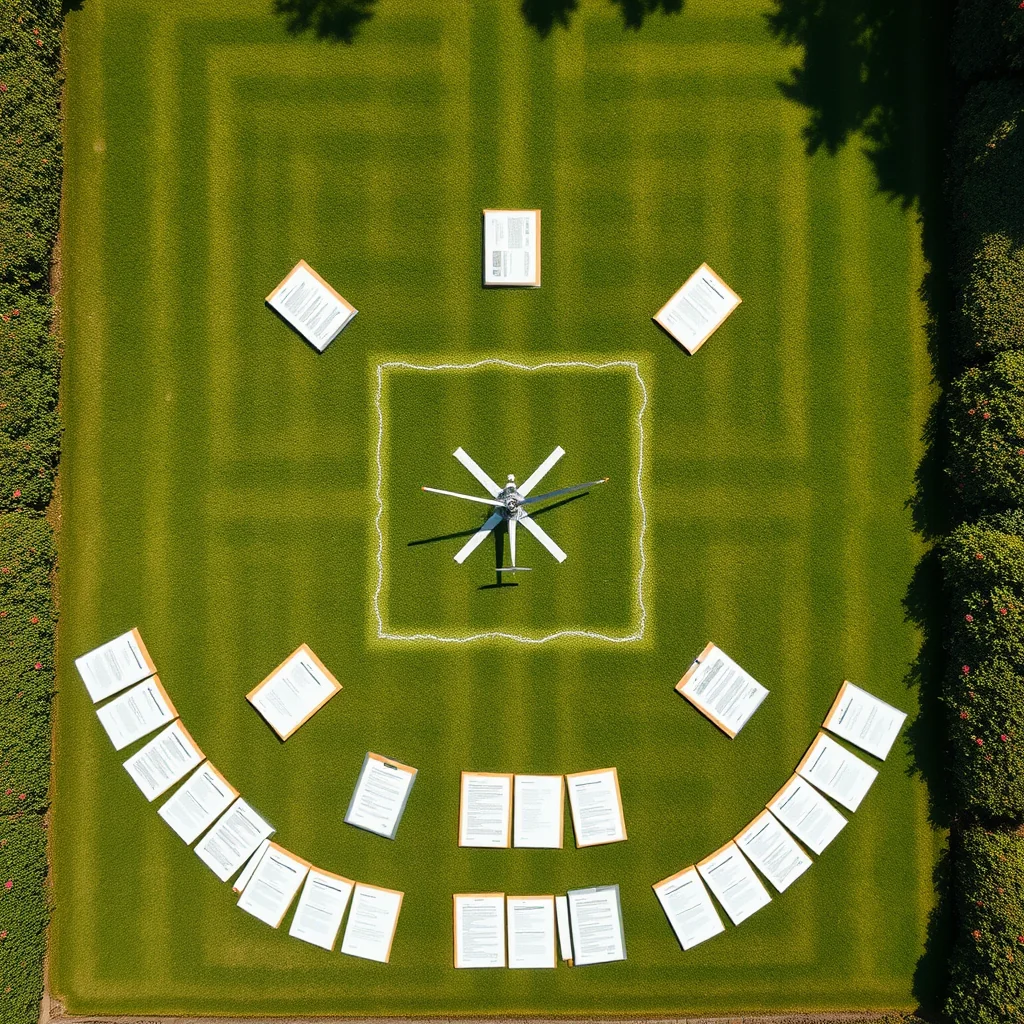
LONDON—The UK Civil Aviation Authority's Permits Division has entered its eighty-fourth consecutive month of reviewing businessman Mohamed Al Fayed's application for a 'Temporary Vertical Landing Pad' at his London residence, according to internal documents obtained through a freedom of information request. The filing, originally submitted in June 2017, seeks authorization for 'occasional rotary-wing aircraft visits' to the garden of Fayed's Kensington property.
'We're treating this with the seriousness it deserves,' said Permits Officer Simon Pettigrew, who has personally reviewed 3,212 pages of the application. 'Mr. Fayed's representatives have been exceptionally thorough in their submission, including seventeen separate noise mitigation plans and forty-three botanical impact assessments for the rose garden.'
The application has spawned what officials describe as a 'comprehensive interdepartmental dialogue' involving the CAA, local planning authorities, the Royal Society for the Protection of Birds, and unexpectedly, the Victoria and Albert Museum's textile conservation department. 'The vibration from rotor wash could potentially affect historic tapestries within a three-mile radius,' Pettigrew explained without irony. 'We cannot overlook cultural heritage.'
Fayed's representatives have submitted thirty-seven amendments to the original application, including a 2019 proposal to install 'heritage-approved noise baffling' consisting of specially commissioned silk screens matching the property's Edwardian architecture. The screens alone required separate approvals from English Heritage and the London Visual Amenity Commission.
'Every time we satisfy one regulatory requirement, two more emerge,' said Fayed's aviation consultant, Geoffrey Albright. 'Last month, we received a fourteen-page questionnaire about the potential effect of rotor downwash on neighboring snail migration patterns. We've had to commission a malacologist.'
The permitting process has become so elaborate that the CAA recently established a dedicated 'Kensington Rotary-Wing Subcommittee' which meets biweekly to review new documentation. Minutes from their meetings reveal discussions ranging from 'canopy penetration risk assessments' for nearby oak trees to 'avian strike probability matrices' for the resident pigeon population.
'This isn't about saying no,' insisted CAA spokesperson Eleanor Vance. 'It's about saying yes properly. We've already approved the conceptual framework for the landing pad's visual impact statement. That was Phase One of twelve.'
Meanwhile, Fayed has reportedly purchased and sold three different helicopters during the application process, each requiring updated specifications be submitted to the Permits Division. His current aircraft, a custom AgustaWestland AW139, has been parked at Farnborough Airport at an estimated storage cost of £12,000 monthly since 2020.
'The system is working as intended,' Vance said when asked about the timeline. 'Thoroughness prevents accidents. We've identified seventeen potential stakeholder concerns that didn't exist when the application was filed.'
Among the newer regulatory hurdles: a requirement to assess the 'socioeconomic impact' of helicopter sounds on nearby private schools, a study of 'shadow flicker effects' on protected bat species, and a mandatory consultation with the Royal Academy of Dramatic Art regarding potential disturbance to acting students.
Fayed's team now employs four full-time application managers who coordinate responses to regulatory inquiries. 'We've developed expertise in areas we never anticipated,' Albright noted. 'Last quarter, we became world authorities on the resonant frequency of Georgian window panes.'
The Permits Division has meanwhile expanded its staff by twelve positions specifically to handle the application's complexity. 'This case has helped us identify gaps in our regulatory framework,' Pettigrew said. 'We've developed three new forms and two entirely new approval categories thanks to Mr. Fayed's submission.'
As the process enters its eighth year, officials confirm they've nearly completed the 'preliminary preliminary assessment' phase. The next milestone will be a public consultation period expected to last between eighteen and twenty-four months, followed by what documents describe as 'stakeholder alignment workshops.'
'We're committed to seeing this through to its logical conclusion,' Vance affirmed. 'Whether that takes seven years or seventy, British aviation safety standards must be maintained.'
When reached for comment, Fayed's office issued a statement reading, 'Mr. Fayed remains confident in the thoroughness of British regulatory processes and appreciates the diligent work of all involved officials.' The statement did not address rumors that Fayed's lawyers are simultaneously researching the legality of registering his helicopter in international waters.
The CAA confirms the application remains 'active and under consideration' despite having outlasted two governments, four transport secretaries, and the complete renovation of the property's garden where the helicopter would theoretically land.
Pettigrew, who has overseen the case since its inception, recently received a promotion to 'Senior Permits Coordinator—Special Projects' largely based on his work managing what internal documents now call 'The Kensington File.' His newly created position will focus exclusively on 'complex multi-year applications requiring specialized attention.'
As for when a decision might come, Vance would only say, 'We're following the process.' The CAA's latest status update notes the application has been assigned a new tracking number and entered 'Phase 3-B of the pre-approval assessment period.'
Meanwhile, Fayed continues to travel to his London residence by car, a journey that takes approximately ninety minutes from any airport with helicopter facilities. His representatives confirm they've begun preparing documents for what would be Phase 4: 'Post-Approval Compliance Monitoring Framework Development.'
The permit application, now spanning twelve bound volumes stored in four filing cabinets, has become the CAA's longest-running active case. Officials note with pride that it has generated zero safety incidents during its processing—a fact they cite as evidence the system works.
About the author