Technology
Federal Regulators Revisit Ethernet Cabling Before AI Policy Vote
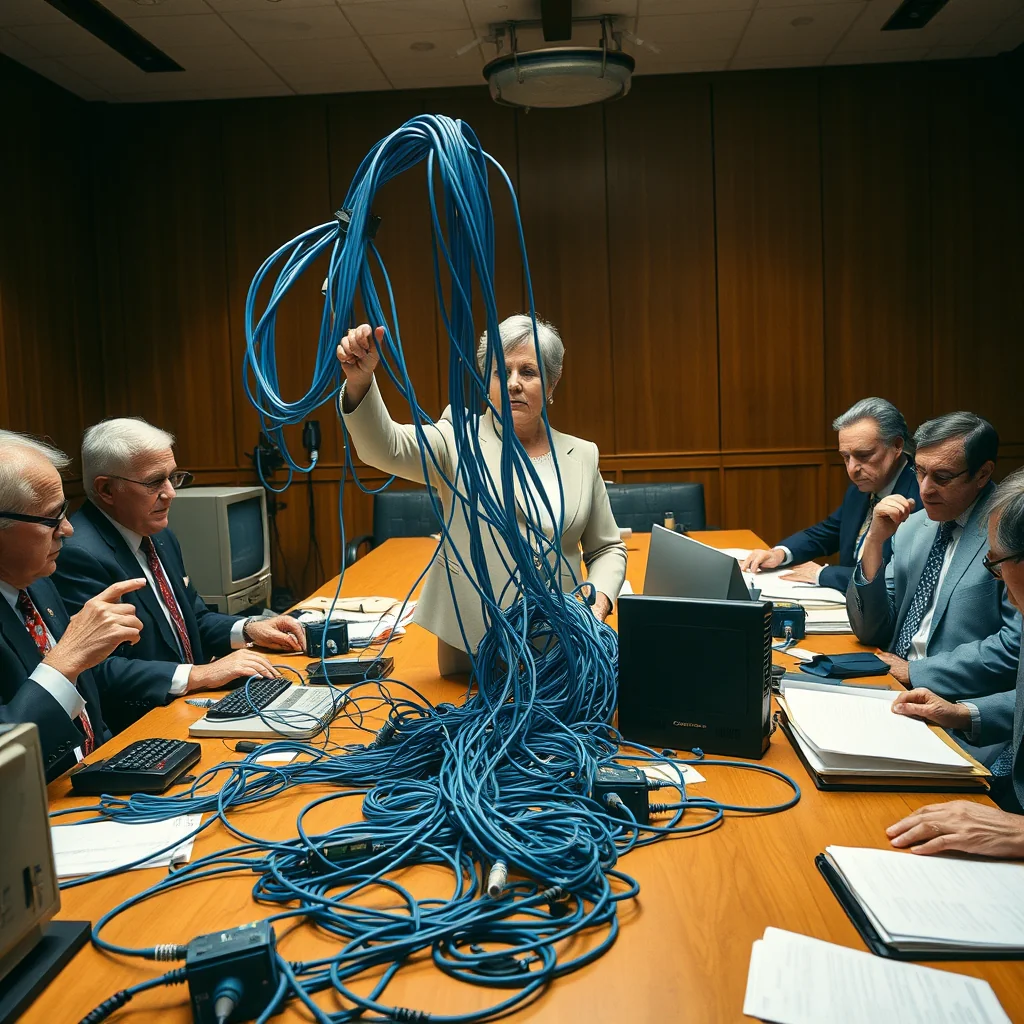
WASHINGTON—In a secured conference room on the fourth floor of the Eisenhower Executive Office Building, the future of global artificial intelligence policy has been tabled indefinitely. The delay, confirmed by three senior officials familiar with the matter, is not due to ethical quandaries or computational constraints, but rather an unresolved debate over the proper method for daisy-chaining Ethernet cables between workstations.
The Ad Hoc Subcommittee on Technological Definitions, a body formed under the National AI Initiative Office, was scheduled to finalize recommendations for regulating advanced chip exports this week. Instead, the sixteen-member panel has spent the last four business days attempting to achieve on whether a 'classic' 10BASE-T implementation remains sufficient for drafting documents concerning next-generation machine learning systems. The deadlock was described by attendees as both technical and philosophical.
'We are revisiting the very bedrock of our digital communication infrastructure,' said Deputy Undersecretary Margaret Frobisher, who chairs the subcommittee. 'Before we can responsibly govern technologies that may redefine human cognition, we must first ensure our own systems are not susceptible to packet loss. It's a matter of national security.'
The session began routinely last Monday with a review of briefing materials distributed via a shared network drive. According to internal memos, the first sign of trouble emerged when a junior analyst from the Department of Commerce noted that the 'innovation' section of the draft policy document failed to load completely. This prompted a procedural motion to 'revisit' the agency's networking standards, a term that subsequently triggered a pre-existing 1998 directive requiring any 'revisitation' of 'classic' systems to undergo a full architectural audit.
By Tuesday, the subcommittee had bifurcated into working groups. Group A was tasked with evaluating the throughput requirements for PDF files exceeding two megabytes, while Group B was directed to determine if the term 'the cloud,' frequently invoked in AI literature, implied a meteorological component that might fall under National Oceanic and Atmospheric Administration oversight. A preliminary finding from Group B suggested that any data storage solution described as 'cloud-based' should logically be subject to federal weatherization standards, a conclusion that has since necessitated the formation of Group C to assess potential rainfall interference.
The situation escalated Wednesday when officials discovered that the conference room's sole available Ethernet port was already occupied by a fax machine deemed critical for international communications. A lengthy discussion ensued regarding the feasibility of unplugging the fax machine, which culminated in a directive to form Group D to study the historical precedence of fax-based policy transmission versus email. Group D's interim report, circulated Thursday, recommended a 'hybrid approach' that would require all AI policy drafts to be simultaneously sent via fax and email, a process estimated to add fourteen business days to each revision cycle.
'We're being very detailed about this,' Frobisher stated during a brief recess. 'You cannot build a coherent framework for existential technologies on a foundation of digital uncertainty. Our predecessors, the scientists who pioneered these classic systems, understood that a steadfast commitment to proven innovation is paramount.'
By Friday, the subcommittee had formally requested guidance from the Government Accountability Office on whether the purchase of a network switch would constitute a 'significant regulatory action' under the Paperwork Reduction Act. The GAO's preliminary response, obtained by this news service, indicated that the acquisition of any device requiring a power cord would trigger a separate review process expected to take six to eight months. This led to the immediate formation of Group F, which is now tasked with drafting certifications for each cable connector, ensuring every RJ-45 plug is individually serialized and its maximum bend radius formally documented. "Our preliminary analysis strongly suggests that inconsistent cable curvature poses the greatest unmitigated risk to data integrity," a Group F spokesperson noted. "Until we can guarantee that no cable is bent at an angle sharper than one inch, any discussion of a superintelligent algorithm is frankly premature."
As of press time, the subcommittee had voted to adjourn until the Ethernet cabling issue is resolved, a delay that senior AI policy analysts now estimate could push the entire governance process into the next fiscal year. The only item passed unanimously was a resolution to form Group E, which will explore the feasibility of drafting the final AI policy using typewriters, described in the motion as 'a truly technology with a proven track record of departmental memoranda.'
About the author