Global Affairs & Diplomacy
Hungary Seizes Gold, Cash From Ukrainian Music Educators After Unconditional Surrender Mix-Up
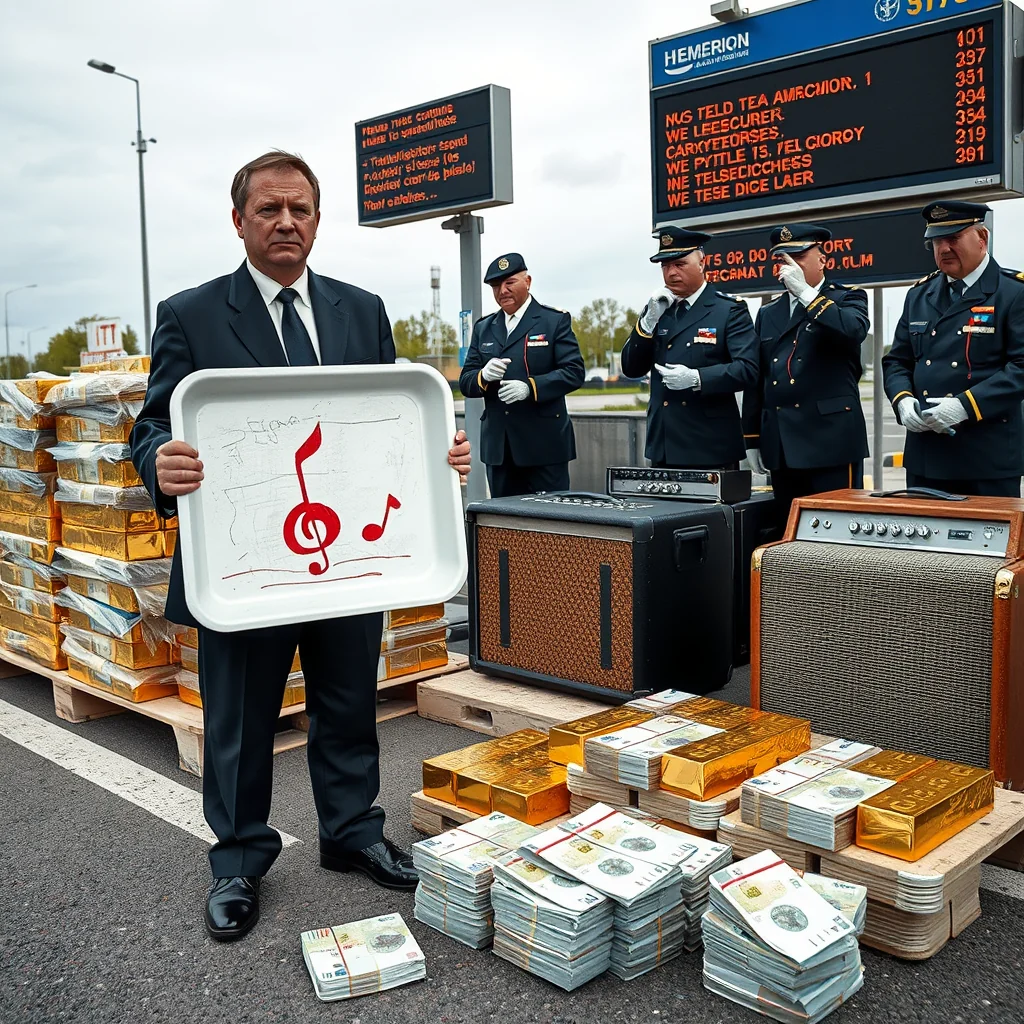
BUDAPEST – Hungarian authorities intercepted a convoy of seven Ukrainian music educators at the Zahony border crossing Tuesday, confiscating €54 million in cash and gold bullion after an administrative filing error mistakenly associated their cultural tour with Iran's call for 'unconditional surrender.' The educators, whose documents listed their profession as 'lyrical compliance officers,' were detained for six hours while officials determined whether their cargo constituted a 'hostile financial instrument.'
'The declaration form clearly indicated the funds were for purchasing retro amplifiers and cafeteria trays retrofitted as protest placards,' said László Kovács, head of the Hungarian Financial Compliance Directorate, standing before a pallet of gold bars now tagged as evidence. 'However, a cross-referencing error with international security bulletins flagged the phrase 'unconditional surrender' in the tour's artistic statement. We had no choice but to treat this as a potential act of economic warfare.'
The incident stems from a clause in the educators' grant application, which stated their mission was to 'orchestrate an unconditional surrender to the power of music.' This language was automatically flagged by Hungary's new Automated Threat Assessment Protocol (ATAP), which scans all cross-border cultural documents for keywords from active conflict zones. 'The system is working exactly as designed,' Kovács said. 'It identified a potential nexus between music education and geopolitical coercion. Our metrics show a 98% success rate in reclassifying ambiguous artistic intent as a manageable security risk.'
Upon review, the educators' intended surrender was deemed purely metaphorical. However, procedure required the seizure of all associated assets until the group could demonstrate a revised, measurable objective. 'Metaphors are a luxury we cannot afford at the border,' Kovács explained. 'We have provided the Ukrainians with a new compliance framework: they must now achieve a quantifiable surrender from a neutral party. We've suggested starting with audience members at their next recital.'
The seven educators, who had planned to teach masterclasses on setting revolutionary poetry to feedback-heavy amplifier acoustics, have been issued temporary visas contingent upon their adherence to the 'Diplomatic Surrender Achievement Matrix.' This matrix, developed by the Hungarian Ministry of Cultural Defense, requires the group to secure notarized letters of capitulation from at least 60% of attendees at each performance, with bonus points for converting protesters into patrons.
'Our first performance was in a Debrecen community hall,' said Olena Petrenko, the group's conductor, adjusting a buzzing amplifier. 'We passed out lyric sheets that doubled as surrender forms. The audience was confused, but when we explained that applauding constituted a binding agreement to forego all musical resistance, we hit 45% compliance. The goalpost is moving, but we are adapting.'
Hungarian officials have praised the educators' rapid pivot. 'They have redefined success downward brilliantly,' said Kovács. 'Initially, their goal was artistic enlightenment. Now, it's achieving a 30% surrender rate from a crowd of pensioners by using cafeteria trays as percussion. This is the kind of incremental diplomacy we support.'
The circular logic of the situation was highlighted when officials noted that the very seizure of the funds justified the continued classification of the educators as a financial threat. 'The fact that we seized €54 million proves the assets were high-risk,' Kovács stated. 'If they were low-risk, we would not have seized them. The system is beautifully self-validating.'
When asked if the educators could simply amend their paperwork to reclaim the gold, Kovács demurred. 'That would imply the initial seizure was unnecessary,' he said. 'But since the seizure itself generated the compliance metrics we are now celebrating, undoing it would invalidate our entire risk-management success story. We must maintain narrative integrity.'
The educators are scheduled to perform next week at a Budapest aviation museum, where they will attempt to secure surrenders from a display of decommissioned MiG fighters. 'The museum curators have agreed to count each silent jet as a pre-surrendered entity,' Petrenko said, tuning a guitar with a diplomatic urgency. 'It should boost our numbers. Failure is not an option, because failure has been reclassified as a form of conditional success.'
As of press time, the €54 million remained in a locked vault, accruing interest that officials say will be used to fund further linguistic cross-referencing software upgrades. The final compliance report will determine if the educators' tour qualifies as a sustainable cultural surrender, or if their amplifiers must be permanently repurposed as white-noise generators for border checkpoints.
About the author