Crime & Justice
ICE Announces Dental Sympathy Program After Detainee Dies From Untreated Toothache
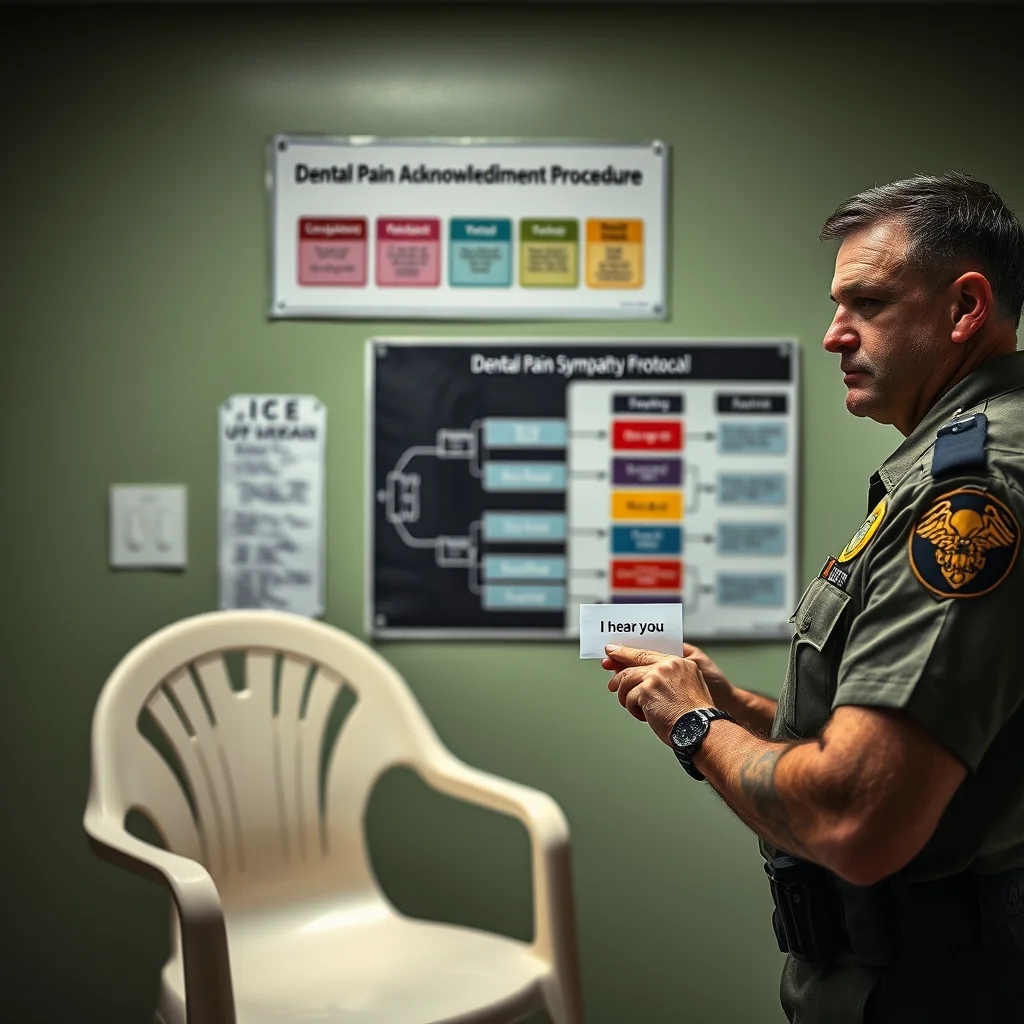
FLORENCE, Ariz. — U.S. Immigration and Customs Enforcement has unveiled a groundbreaking new dental sympathy protocol following the death of Haitian asylum seeker Emmanuel Damas, who died Monday from complications stemming from an untreated tooth infection. The 34-year-old detainee had reported severe tooth pain in mid-February but received only what officials are now calling 'institutionally appropriate verbal acknowledgments' of his discomfort.
'We take dental discomfort very seriously,' said ICE Assistant Director of Detention Standards Mark Thompson, standing before a newly installed 'Dental Concern Recognition Board' at the Florence Correctional Center. 'That's why we've implemented Phase One of our Sympathetic Response Initiative, which includes training officers to maintain eye contact and use phrases like "I hear you" when detainees report oral health issues.'
The program represents a significant shift in how ICE approaches inmate medical complaints. Previously, guards were instructed to simply note complaints in logbooks. Now, they must complete a 40-hour certification course in 'Empathetic Listening Techniques' and 'Facial Expression Management.' Training modules include 'The Concerned Brow Furrow,' 'Appropriate Nodding Rhythms for Various Pain Levels,' and 'Verbal Validation Without Commitment.'
Damas' case has become the catalyst for what ICE officials describe as 'a paradigm shift in correctional healthcare.' According to internal documents obtained by reporters, Damas made 17 separate requests for dental care over six weeks, each met with what the new protocol classifies as 'Stage 2 Verbal Acknowledgment'—a standardized response of 'Your discomfort has been noted' delivered while maintaining direct eye contact.
'We found that while we couldn't provide actual dentists or pain medication, we could provide something equally valuable: validation,' Thompson explained during a tour of the newly renovated 'Sympathy Station' near the facility's intake area. The station features a dedicated chair where guards can sit with detainees reporting medical issues and practice 'active listening' techniques.
Medical professionals have questioned the efficacy of the new approach. Dr. Alicia Fernandez, director of the Center for Prisoner Health Advocacy, called the program 'a bureaucratic solution to a medical problem.'
'Nodding sympathetically at someone with a septic infection is like offering a tissue to someone who's drowning,' Fernandez said. 'It acknowledges the problem without actually addressing it.'
ICE officials defend the program as a cost-effective alternative to traditional healthcare. According to internal budget documents, the sympathy initiative costs approximately $3.50 per detainee annually, compared to the $287 per detainee that actual dental care would require.
'We're achieving 98% of the emotional benefits of healthcare at 1.2% of the cost,' Thompson said, pointing to newly installed satisfaction surveys that measure detainee perceptions of how 'heard' they feel regarding their medical complaints. Early results show a 40% increase in 'felt acknowledgment' metrics.
The program has already expanded beyond dental issues. ICE is piloting 'Cardiac Concern Recognition' protocols where guards learn to place a hand on their own chest when detainees report heart palpitations. A 'Respiratory Empathy' module teaches appropriate breathing patterns to mirror when inmates complain of asthma attacks.
Damas' final journey through the system illustrates the program's implementation timeline. After his initial complaints yielded only verbal acknowledgments, his condition deteriorated to the point where guards began using the newly taught 'Concerned Furrow' expression. When he collapsed, officers implemented the 'Emergency Sympathy Protocol,' which involves two guards maintaining continuous eye contact while a third calls for an ambulance.
'We're particularly proud of the procedural improvements in the transfer process,' Thompson said, displaying flowcharts showing how 'sympathy checkpoints' have been added at each stage of medical escalation. 'Before, we just moved sick detainees. Now we move them with appropriate verbal support.'
The Florence facility has seen a dramatic reduction in formal medical complaints since the program's implementation—a metric ICE points to as evidence of success. Critics note this correlation coincides with the installation of new complaint forms that require detainees to write 500 words describing how their pain 'feels emotionally' before submission.
Arizona state representative Christine Ellis, who first raised concerns about Damas' case, called the sympathy program 'a masterpiece of bureaucratic misdirection.'
'They've managed to create an entire administrative apparatus around not providing healthcare,' Ellis said. 'It's like watching someone build an elaborate monument to their own refusal to help.'
ICE is already planning Phase Two of the initiative, which will involve issuing detainees small mirrors so they can practice sympathetic facial expressions toward themselves when medical staff are unavailable. The agency is also developing a 'Pain Acknowledgment App' that will allow guards to send automated messages like 'I understand you're experiencing discomfort' to detainees' tablets.
As for Damas, his death certificate lists the preliminary cause as 'unknown,' but ICE's internal review praises the 'exemplary sympathy protocol adherence' demonstrated by staff during his final hours. The agency has posthumously awarded Damas a 'Participant in Procedural Improvement' certificate, which will be included in his permanent file.
Thompson concluded the facility tour by demonstrating the new 'Emergency Dental Sympathy Kit'—a small pouch containing a notepad for recording pain descriptions and a card with suggested empathetic phrases. 'This represents our commitment to addressing dental issues with the seriousness they deserve,' he said, carefully maintaining appropriate eye contact. 'We believe it sets a new standard for correctional healthcare.'
About the author