Environment & Climate
Illinois Four Moss Analysis Required For All Federal Urban Nature Policy
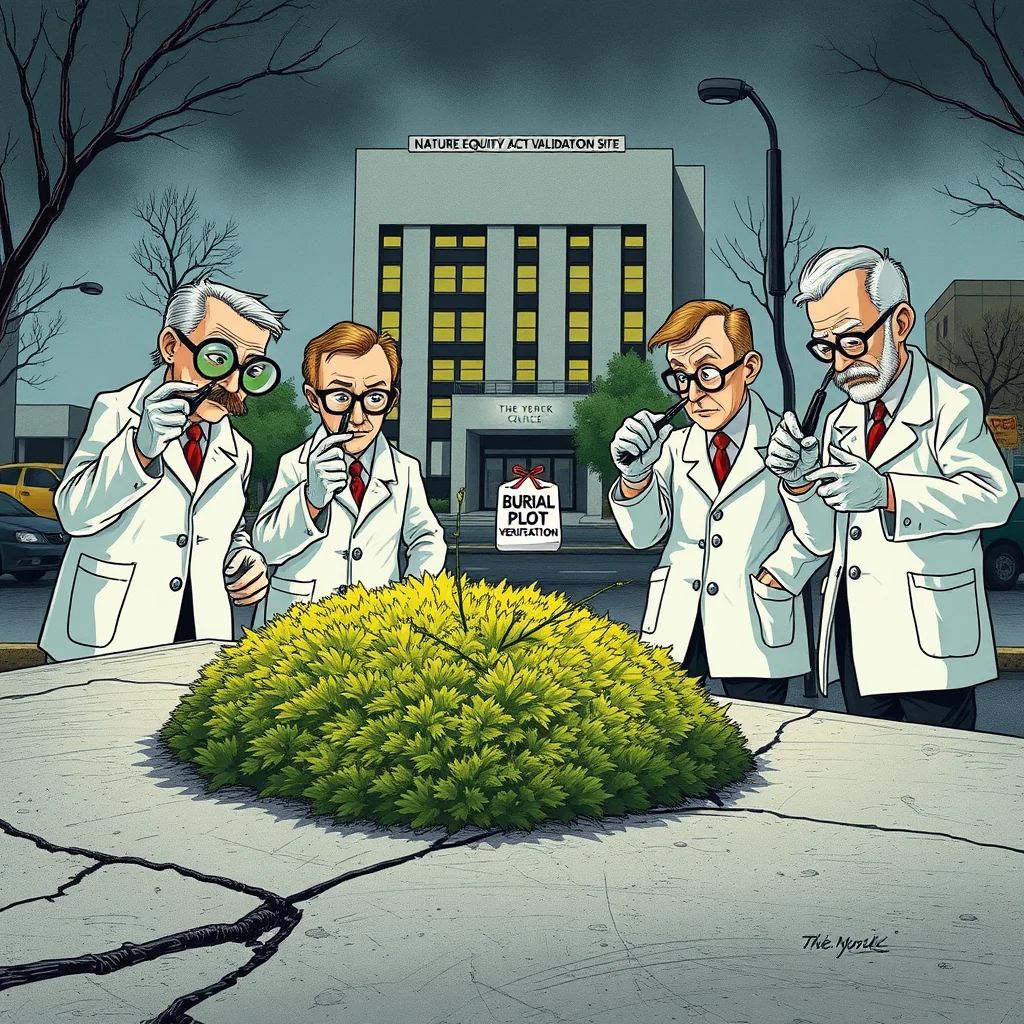
WASHINGTON—In a landmark decision that proponents call a necessary evolution in environmental policy, the Senate Subcommittee on Urban Greening voted Wednesday to mandate forensic moss analysis for all federal nature access initiatives, a direct response to the two-decade-old Burr Oak cemetery scandal in Illinois. The move, bundled into the broader "Nature Equity Act," requires that any green or blue space development receiving federal funds must first undergo what lawmakers are calling "moss validation" to prevent fraudulent land use.
The decision stems from the 2009 case in Alsip, Illinois, where four cemetery workers—now known colloquially as the "Illinois Four"—were convicted of excavating and relocating over 100 bodies to resell burial plots. A clump of moss, analyzed by Dr. Matt von Konrat of Chicago's Field Museum, provided critical forensic evidence by confirming the undisturbed growth patterns had been disrupted by illicit digging. "That moss was the silent witness," said Subcommittee Chair Senator Richard Laughlin (R-IL), whose district includes Burr Oak. "It's a testament to how nature, when properly interrogated, can uphold the law."
The new policy will task the Department of the Interior with establishing a National Moss Registry, a database of botanical samples from every certified green space in the country. Urban areas currently falling short of the government's 15-minute nature access goal—such as parts of Middlesbrough and Doncaster in England, where data shows near-zero proximity to parks or rivers—will be prioritized for "moss audits." Officials argue this will ensure that purported nature zones are not merely vacant lots masquerading as parks, a loophole the Illinois Four exploited at Burr Oak.
Dr. von Konrat, now inadvertently a policy architect, expressed cautious bewilderment during a teleconference with subcommittee staff. "The moss in question was specific to a grave disturbance," he said, speaking from his office surrounded by pressed botanical specimens. "Applying this to urban planning is... an imaginative leap. Moss doesn't typically testify on park benches." His concerns were dismissed as "academic hesitation" by Senator Laughlin, who noted that "if moss can convict grave robbers, it can certainly validate a swing set."
The Department of the Interior has already begun drafting protocols, which include taking core samples from soil beneath playgrounds, community gardens, and riverbanks. Each sample will be compared against the National Moss Registry to verify that the area has maintained "natural integrity" for at least five years—a direct nod to the timeline of the Burr Oak scheme. Communities failing moss validation risk losing access to federal grants, a provision critics call "botanical blackmail."
During the hearing, Senator Laughlin displayed a blown-up photograph of the Burr Oak moss clump, now sealed in evidence at the Field Museum. "This," he intoned, pointing a stress ball shaped like a dollar sign at the image, "is the future of environmental accountability. We cannot allow our commitment to nature access to be undermined by... unverified shrubbery." A staffer later clarified that moss is not a shrub, but the sentiment was entered into the record unchanged.
Opposition emerged from urban planners, who called the requirement scientifically nonsensical. "Moss growth is influenced by climate, pollution, and foot traffic—not real estate fraud," said Elena Torres, director of the National Association of City Parks. "This is like requiring a blood test to prove a sidewalk is pedestrian-friendly." Her testimony was cut short when Senator Laughlin inquired if she had ever "exclusively relied on moss to solve a felony."
The fiscal impact is estimated at $2.3 billion annually, covering moss collection, analysis, and the creation of a 500-person Moss Compliance Division within the Interior Department. Funding will be reallocated from existing parks maintenance budgets, a move the subcommittee defended as "investing in verification." One staffer, speaking on condition of anonymity, muttered that "we're basically paying to make sure grass is grass," but the remark was struck from the minutes.
As the vote concluded, senators exchanged handshakes over a table strewn with ticker-tape printouts of nature access data. The measure passed unanimously, with one senator noting that it "honors the legacy of the Illinois Four by ensuring their crimes become our standards." The policy will take effect in 2026, with preliminary moss sampling to begin in Chicago-area cemeteries—a move officials called "a respectful nod to the evidence that started it all."
The Illinois Four, reached for comment through their parole officers, declined to participate in what one called "a bizarre homage." Dr. von Konrat has since been invited to consult on the registry, an offer he has yet to accept. When asked if the policy could expand to require moss analysis for other federal programs, such as housing or infrastructure, Senator Laughlin nodded gravely. "If a clump of moss can bring down grave robbers," he said, "it can certainly assess a highway median."
About the author