Global Affairs & Diplomacy
Iran's Khamenei Appoints Trump Aide to Oversee 'Anti-War Protections' After Strike
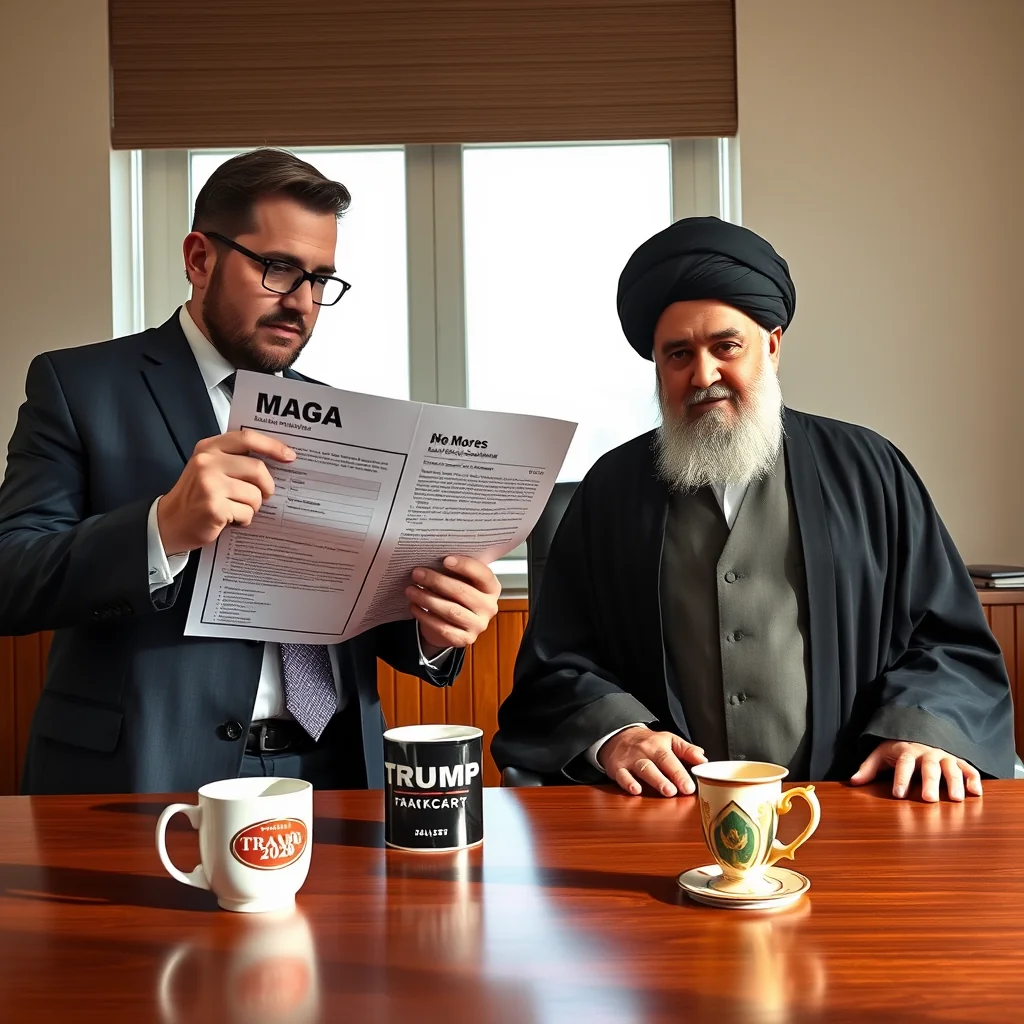
TEHRAN—In a move characterized by officials as a 'strategic confidence-building measure,' Iran's Supreme Leader Ali Khamenei has formally appointed a former senior advisor to Donald Trump's 2020 campaign to oversee the newly established Office of Anti-War Protections. The appointment follows the January 2020 U.S. strike that killed Qasem Soleimani, an event the Iranian government now refers to internally as 'the baseline compliance test.' The office, housed within the Foreign Ministry's Department of Intentional Calm, is tasked with pre-emptively auditing any military action for 'MAGA compatibility,' a term officials defined as adherence to the 'no more wars' pledge central to the former president's political brand.
'The selection process was rigorous,' said ministry spokesman Abbas Araqchi in a statement read to reporters. 'We sought an individual with granular operational knowledge of the Trump doctrine's rhetorical boundaries.' The appointee, identified as former campaign aide Jason Miller, will lead a team of twelve analysts reviewing all potential military responses to Western actions. Their primary tool is a 47-point checklist derived from Trump's 2016-2020 rally speeches and Twitter archives, which evaluates proposed actions for their alignment with 'the spirit of strategic disengagement.'
Miller's first directive, issued Tuesday, mandates that all Iranian military commanders submit a 'MAGA Impact Assessment' at least 72 hours before any planned mobilization. The assessment requires commanders to specify how their proposed action 'avoids the appearance of new war creation' and to provide 'three alternative scenarios demonstrating greater restraint.' A leaked copy of the assessment form, obtained by this agency, includes fields for estimating 'headline sentiment on Fox News' and 'potential for misinterpretation as a forever war,' with a subsection demanding commanders cite at least two Trump tweets from 2019-2020 that could be construed as endorsing or condemning the proposed action's 'vibes.'
Compliance has presented challenges. Revolutionary Guard commanders initially balked at the requirement to submit operational plans for review by a political operative with no military background. 'We are acclimating to the oversight,' said General Hossein Salami, commander of the IRGC, during a press briefing. He stood before a large whiteboard detailing 'escalation pathways,' which now includes a new column labeled 'Miller Veto Zone.' 'The process adds a layer of... deliberate consideration. We are learning to quantify deterrence in terms of cable news cycle duration.'
Internal ministry communications reveal growing procedural complexities. A memo circulated last week noted that Miller's team has rejected three proposed naval exercises in the Strait of Hormuz for 'excessive visual aggression,' suggesting instead a 'more low-key patrol pattern' to avoid 'triggering inadvertent pledge violations.' Another incident involved a two-day delay in responding to a minor border skirmish after Miller's office demanded a 'peer review' to ensure the response would not be categorized as a 'new war' by fact-checkers at the Washington Post.
'We're building a framework where hostilities are pre-cleared for audience appeal,' Miller explained during a rare conference call, the sound of a dot-matrix printer churning out 'tweet sentiment analysis reports' audible in the background. 'Last week we flagged a proposed missile test for scoring a 32% on the 'Optics Cohesion Scale'—it risked conflicting with the 'America First' narrative if the missile's range exceeded 200 miles, which our data shows is the public's tolerance threshold for 'things that look expensive.''
Weather has emerged as an unexpected complicating factor. The office's new 'meteorological correlation unit' now cross-references all military readiness levels with global weather patterns, based on Miller's assertion that 'starting a war in bad weather looks desperate.' This has led to the temporary grounding of air force units during clear, sunny days deemed 'optically provocative.'
The office's recently instituted 'Legal Precedent Alignment' protocol requires military lawyers to draft all retaliation justifications using sentence structures lifted directly from Trump's Truth Social posts, a move one judiciary official privately called 'the most efficient way to ensure doctrinal purity.' This has resulted in operational briefings that now include phrases like 'total witch hunt' and 'perfect phone call' when describing diplomatic engagements.
As of Thursday, the office had successfully pre-empted 14 planned responses to Israeli aerial incursions, rerouting missiles to unpopulated desert areas to 'maintain a credible but non-confrontational posture.' A senior commander, speaking on condition of anonymity, summarized the new reality: 'We now fight hypothetical wars on paper, supervised by a man who once booked rallies in battleground states. The front lines are spreadsheets. The casualties are to our scheduling flexibility.'
The office's next project is developing a 'Voter Sentiment Integration Module,' which will poll a focus group of Pennsylvania retirees on their tolerance for various escalation scenarios before granting final approval. This, Miller noted, is the logical endpoint of a process dedicated to ensuring that conflict management remains, above all, 'on-message.'
About the author