Defense & Military
Iran's Revenge Drones Accidentally Incinerate Amazon Cloud, Azerbaijan Deploys Foam-Finger Defenders
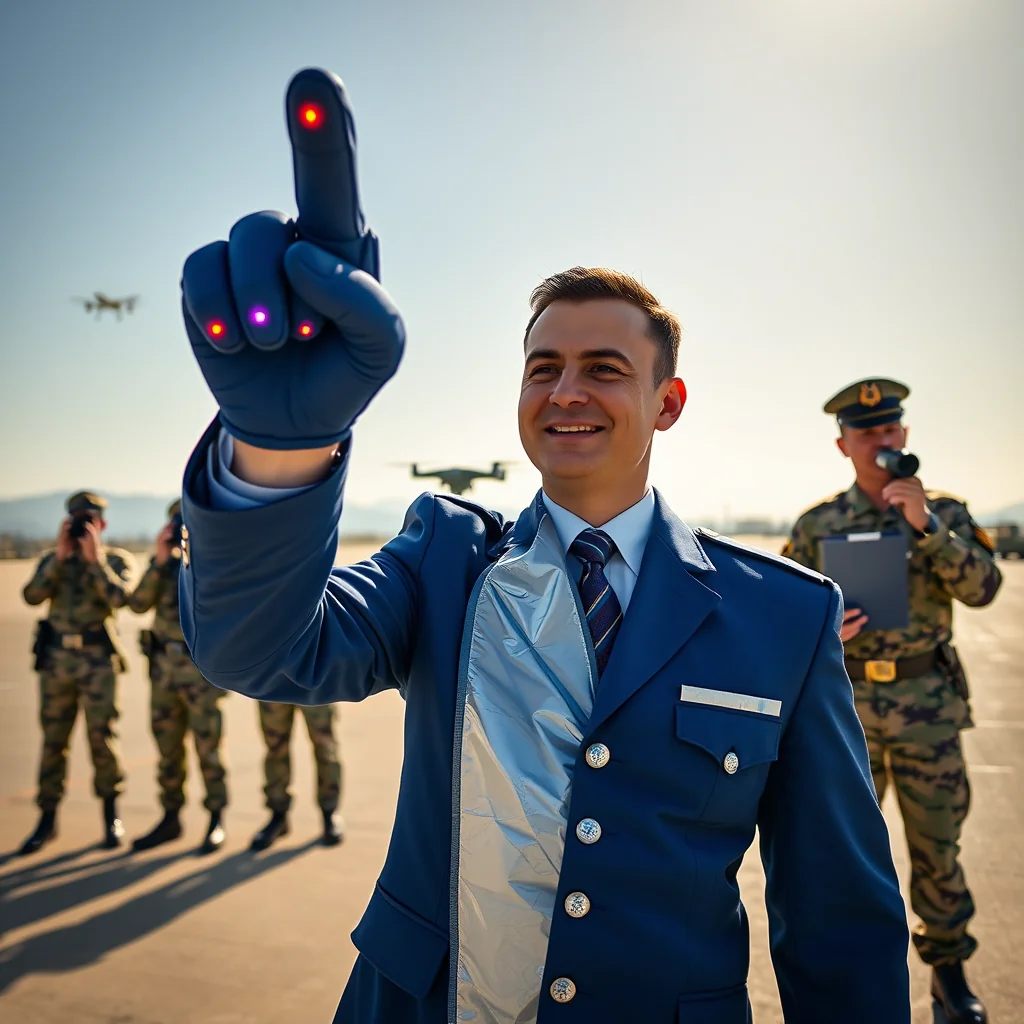
BAKU—Azerbaijan's Ministry of Defense confirmed Tuesday that all airport greeting personnel have been reassigned to active drone defense duty, following what officials termed "performance-optimized resource reallocation" in response to ongoing Iranian aerial threats. The move comes after four welcome committee members sustained minor injuries during what Baku has labeled a "terrorist drone attack" on Heydar Aliyev International Airport.
"Our analysis revealed that airport greeters possessed the highest situational awareness of incoming air traffic," said Defense Minister Zakir Hasanov, standing before a whiteboard displaying crude drawings of smiling faces holding oversized foam hands. "By equipping them with modified signaling devices, we've created a distributed early warning network that leverages existing human capital."
The modified foam fingers—now featuring reflective tape and small LED lights—are used to indicate drone trajectories to military personnel stationed throughout the airport complex. According to ministry briefing documents obtained by reporters, greeters wave the fingers in specific patterns: horizontal sweeps for reconnaissance drones, vigorous up-and-down motions for attack drones, and circular motions for what's classified as "high-priority unidentified objects."
"The enthusiasm metrics are undeniable," Hasanov continued, pointing to a chart showing that greeters had achieved "97% theoretical intercept awareness" during training exercises. "These patriots don't just welcome visitors—they welcome the opportunity to serve their country."
Aviation security experts have questioned the strategy's effectiveness. "I've reviewed the compliance checklists they're using," said former airport security director Anar Mammadov, who resigned last week. "They include items like 'maintain cheerful disposition during chemical attacks' and 'ensure welcoming gesture continuity while identifying hostile aircraft.' It's bureaucracy weaponizing insanity."
The reassignment has created operational challenges. Travelers arriving in Baku now encounter abandoned rolling luggage mid-queue and compliance checklists scattered across terminal chairs. One British evacuee, who asked not to be named, described the scene as "like a party where everyone suddenly remembered they were also air defense operatives."
Iran has denied conducting drone attacks on Azerbaijani territory, calling the accusations "baseless and provocative." Iranian Foreign Ministry spokesman Nasser Kanaani stated that "Azerbaijan's bizarre theatrics won't distract from the real aggression occurring in the region."
Meanwhile, the repurposed greeters have received minimal training. During a media demonstration, one greeter mistakenly signaled a commercial airliner as a "high-priority threat," triggering temporary terminal evacuation protocols. Ministry officials later praised the "heightened vigilance" demonstrated by the false alarm.
"We've optimized the human-machine interface," insisted Hasanov, demonstrating how a foam finger could be used to point toward a cooler containing soft drinks that also serves as a makeshift command center. "Each gesture transmits critical data to our integrated defense network."
The strategy represents what analysts call "the logical endpoint of performative security." Former NATO adviser Dr. Elena Voronova noted that "when institutions run out of real solutions, they start measuring pretend efficiency. Azerbaijan isn't defending its airspace—it's managing the perception of defense."
As tensions continue, the greeters-turned-defenders remain at their posts, their foam fingers tracing arcs across the sky. Their new operational manuals include provisions for "maintaining welcoming facial expressions during prolonged engagement scenarios" and "graceful transition back to hospitality duties upon threat neutralization."
The program's success metrics now include guest satisfaction surveys completed by travelers who pass through the defense perimeter. One recent review noted: "The gentleman who pointed a giant finger at my plane seemed very committed to his work, though his smile was somewhat strained."
When asked about the four injured greeters, Hasanov clarified that their injuries occurred when they "exceeded enthusiasm parameters" during a drill. All four have been promoted to supervisory roles monitoring the airport's food court for "suspicious dining patterns."
The ultimate test may come soon. Satellite imagery shows increased drone activity along Iran's border with Azerbaijan, though ministry officials insist their foam-finger grid is "operating at peak welcoming efficiency." As one greeter told reporters while simultaneously directing a family to baggage claim and tracking a distant aircraft: "We're not just the first face visitors see—we're the last thing hostile drones see too."
Azerbaijan plans to expand the program next month to include airport retail staff, who will be trained to use price scanners to detect "suspicious electromagnetic signatures."
About the author