Defense & Military
Israel Orders Nation to Build Oversized Emergency Exit Sign After Beirut Evacuation
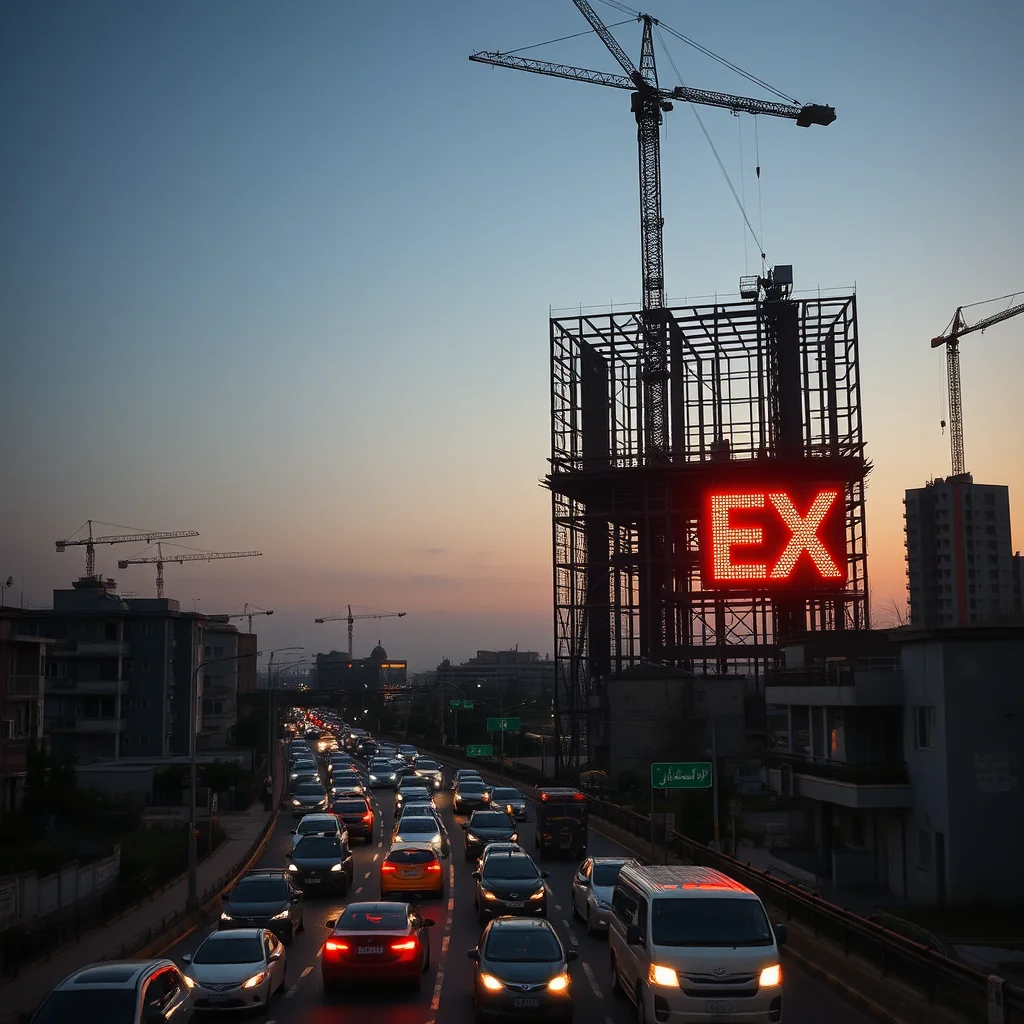
The Israeli military has initiated an ambitious infrastructure project following last week's evacuation of over 500,000 residents from Beirut's southern suburbs. Defense officials confirmed Monday that construction has begun on a 600-foot-tall emergency exit sign designed to prevent the traffic gridlock that stranded thousands during the forced relocation. "We observed significant bottlenecks when residents attempted to interpret our evacuation orders," stated IDF spokesperson Lt. Col. David Elazar during a press briefing held ironically in a poorly marked underground parking garage. "This permanent installation will provide clear, visible guidance for populations of up to 700,000 people."
The project, budgeted at approximately $47 million, involves erecting a steel-framed sign visible from up to five miles away. Planning documents obtained by The Guardian reveal heated debates between military strategists and urban planners regarding the sign's messaging. Early proposals included pictograms of running figures, while more recent versions feature detailed evacuation routes updated via satellite link. "We're considering real-time traffic flow indicators," admitted Transportation Ministry engineer Sarah Cohen, gesturing toward a whiteboard filled with increasingly complex arrow systems. "But we must ensure the graphics remain comprehensible to elderly residents and children."
Contractors have already begun pouring concrete foundations in a vacant lot adjacent to Beirut's sports stadium, though the location has raised concerns among local officials. "Placing the region's largest evacuation sign directly beside a facility that regularly hosts 50,000 spectators seems counterintuitive," noted Beirut urban planner Jamal Hassan, staring at blueprints that showed exit routes funneling directly into stadium parking. "During Saturday's football match, we might accidentally evacuate the entire crowd onto the coastal highway."
The sign's illumination system has become another point of contention. Initial specifications called for energy-efficient LED lighting, but military planners insisted on backup diesel generators capable of operating during power outages. "What good is an exit sign you can't see during bombardment?" questioned Defense Ministry consultant Moshe Weinberg during a tense conference call that included seven subcontractors and three different translation services. "We're now exploring phosphorescent coatings that would remain visible for up to 72 hours without electricity."
Meanwhile, evacuation logistics experts have raised concerns about the sign's single-minded focus on exiting. "This creates a binary choice—stay or leave," observed crisis management specialist Dr. Amina Farrah, consulting a flowchart that eventually branched into 37 possible decision points. "What about residents who need to retrieve medication? Or rescue pets? We need a more nuanced communication system." Her suggestions included smaller subsidiary signs reading "EXIT TO COLLECT HEART MEDICATION" and "EXIT BUT RETURN FOR CAT WITHIN 90 MINUTES."
International observers have questioned the resource allocation. UN humanitarian coordinator Michael Chen noted that the same funds could supply emergency shelters for 100,000 people. "Instead, we're building the world's most expensive roadside advertisement for fleeing," he stated during a Zoom call that frequently froze on his exasperated expression. Israeli officials countered that the sign represents a long-term investment in regional stability. "This isn't just for Beirut," insisted Finance Ministry representative Rachel Goldberg, scrolling through spreadsheets projecting sign usage scenarios through 2040. "We anticipate eventually needing to evacuate entire cities. This is scalable infrastructure."
As construction continues, behavioral psychologists have been consulted about potential unintended consequences. Early tests suggest the giant sign might cause "exit anxiety" in residents performing routine activities. "We're seeing subjects abandon grocery shopping halfway through when they glimpse the sign's red letters," reported researcher Dr. Benjamin Strauss, monitoring CCTV footage of test subjects dropping shopping baskets. "One man evacuated a dentist's chair during a root canal."
The project's most controversial aspect emerged during yesterday's municipal meeting when architects revealed the sign would be visible from neighboring countries. Syrian officials have formally complained about "unwarranted evacuation suggestions" bleeding across their border. "Our citizens are perfectly safe," read a statement from Damascus, "and don't appreciate being told to flee by a 60-story Israeli sign."
With the foundation complete, workers began erecting the first steel support columns this morning. Project manager Youssef Malik supervised as cranes lifted 20-ton beams into position. "This will outlast all of us," he remarked, squinting at the emerging structure against the Beirut skyline. "Perhaps someday it will seem unnecessary. But for now, it's the most important sign we'll ever read."
The IDF announced this afternoon that they've already drafted plans for complementary signs reading "YOU HAVE SUCCESSFULLY EVACUATED" to be placed 15 miles outside the city limits.
About the author