Housing & Urban Development
James Webb Telescope Deployed to Settle Suburban Zoning Dispute Involving In-Law Suite
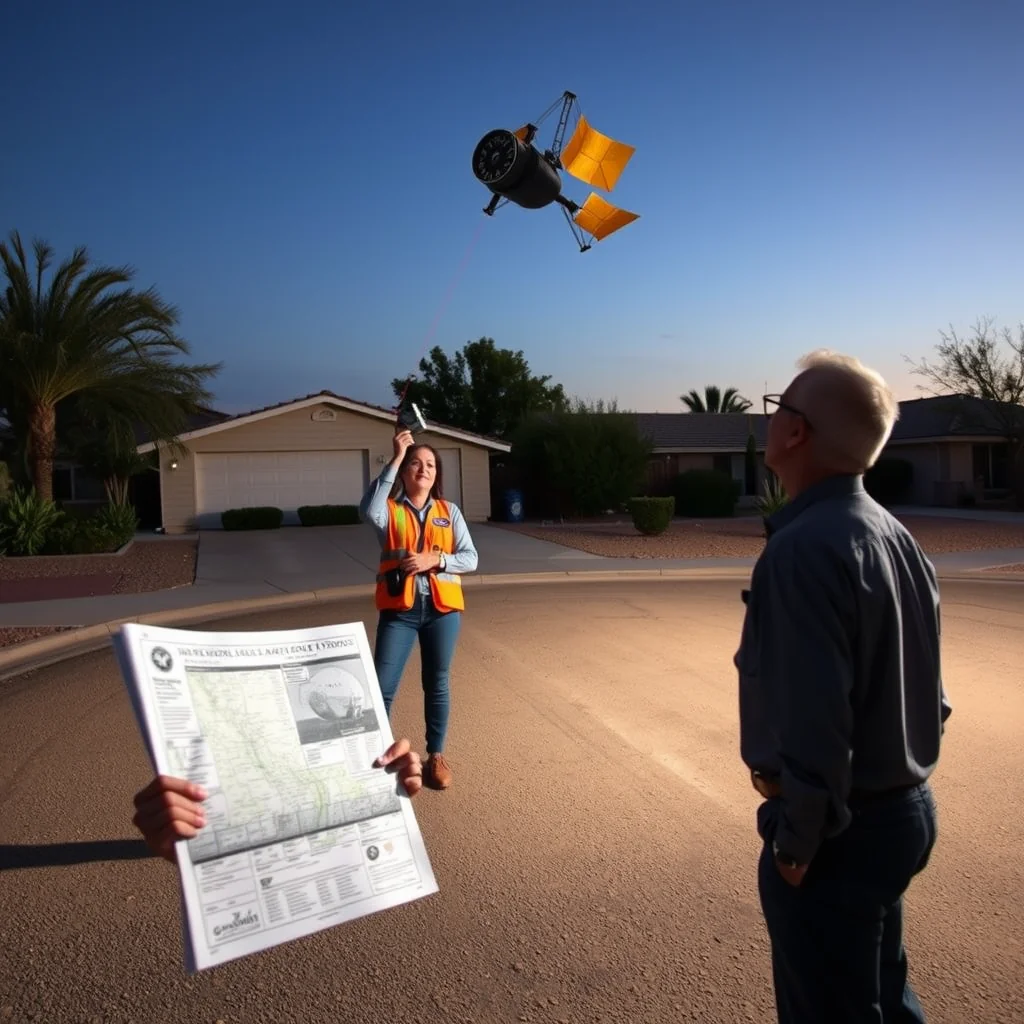
PHOENIX—In an unprecedented application of deep-space technology, the James Webb Space Telescope has been temporarily repurposed to adjudicate a bitter zoning dispute over an unauthorized in-law suite in a suburban Phoenix neighborhood. The decision, described by NASA administrators as a 'natural extension of its observational capabilities,' came after the Maricopa County Zoning Board concluded that terrestrial measurements were insufficient to determine whether the addition violated setback requirements by three inches.
Dr. Alisha Vance, lead scientist on the project, stood before a makeshift staging area outside the county courthouse, clutching a binder of spectral data. 'We are revisiting a classic approach to boundary verification with truly innovative tools,' she said, as colleagues behind her adjusted laptops connected to the telescope's live feed. 'The James Webb is capable of detecting heat signatures from the dawn of the universe. Identifying a non-permitted dwelling unit is, comparatively, a straightforward calibration.'
The dispute centers on a property owned by Carol and Ben Rigby, who added a 400-square-foot suite for Carol's mother last fall. Neighbors filed a complaint alleging the structure encroached on the required 15-foot side-yard setback. After surveyors produced conflicting measurements using traditional methods, the county petitioned NASA for what it termed a 'definitive, orbital assessment.'
'This is about bringing principles of property law into the modern era,' said zoning board chairman Robert Flynn, standing near a detailed incident map taped to a tripod. 'When local governance reaches an impasse, we must look to higher authorities—literally.'
NASA engineers spent 72 hours recalibrating the telescope's Near-Infrared Spectrograph to distinguish between permitted and non-permitted construction materials based on their thermal emissivity. Early data printouts, reviewed by reporters, showed vivid false-color images where the in-law suite glowed a distinct magenta against the cooler blue of the main house. 'The vinyl siding on the addition has a different thermal history,' Dr. Vance explained deadpan. 'It's newer. The data is unequivocal.'
The effort has not been without challenges. The telescope's delicate instruments, designed to observe faint galaxies over 13 billion light-years away, initially struggled with the brightness of the Phoenix suburb. 'We had to apply a filter to reduce the glare from swimming pools,' noted a systems engineer, who requested anonymity as he was not authorized to discuss operational limits. 'But we've achieved a resolution where we can measure the roof overhang to within half an inch.'
Legal scholars are divided on the admissibility of deep-space data in municipal court. 'This sets a troubling precedent,' said property law professor Evelyn Reed. 'Next, we'll be using Hubble to dispute property tax assessments. It's a sublime misuse of resources.' Yet the county insists the move is a pragmatic innovation. 'We're simply using the best available tools to achieve clarity,' Flynn said. 'If that means consulting an instrument that cost ten billion dollars and orbits the sun, so be it.'
Meanwhile, the Rigbys await the final report, which will include a 3D model of their property generated from infrared data. 'We just wanted a place for Mom,' said Ben Rigby, staring at a live feed showing his home as a cluster of glowing pixels. 'Now we're part of a scientific paper.'
The James Webb team plans to submit its findings to a peer-reviewed journal, framing the case study as a novel application of astrophysics to civil engineering. Dr. Vance confirmed that if the methodology proves sound, the telescope could be deployed for other terrestrial disputes, such as settling debates over historical landmark boundaries or verifying the authenticity of rare artwork. 'The universe is full of mysteries,' she concluded, 'but so is the Phoenix suburbs.'
As the briefing concluded, a junior scientist was observed using the telescope's high-resolution images to count the individual bristles on a neighbor's lawn broom, arguing it constituted an unpermitted outdoor storage unit.
About the author