Politics & Policy
Labour Demands Official Scoreboard to Audit Political Points Scored by Shadow Ministers
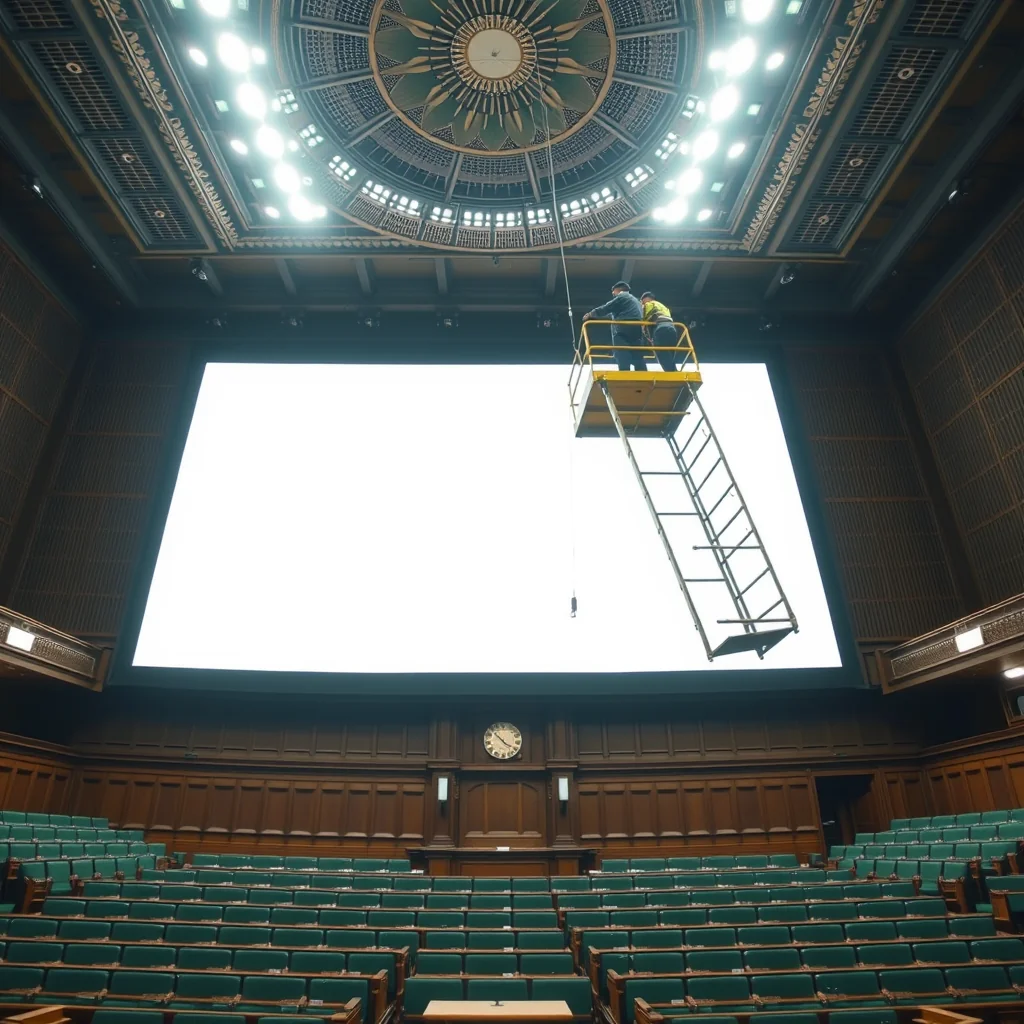
The Labour Party announced today a new procedural initiative aimed at bringing transparency and accountability to the often-accused but never-measured act of scoring 'cheap political points.' The proposal, detailed in a 12-page briefing document, calls for the installation of a large digital display above the Speaker's chair, which will track points scored by MPs in real-time during parliamentary sessions.
"For too long, accusations of cheap point-scoring have been tossed about without a verifiable metric," said a Labour spokesperson, reading from a prepared statement while standing next to a mock-up of the proposed scoreboard. "We believe that if an action is to be criticized, it must first be quantified. This system will provide the rigorous data needed for serious political discourse." The spokesperson then distributed laminated cards explaining the proposed scoring system: one point for a well-timed interruption during Prime Minister's Questions, three points for a leaked memo that contradicts government policy, and five points for a reference to a childhood hardship during a debate on economic austerity.
The proposal emerged directly from the recent controversy surrounding Kemi Badenoch. Following Labour's accusation that the Conservative leader scored 'cheap political points' with her criticism of the Prime Minister's stance on Iran strikes, party strategists concluded that the term lacked enforceable definition. "We found ourselves in a cycle of accusation without arbitration," the spokesperson explained, his tone clinical. "Was it a 'cheap point' because of its timing at the spring conference? Its subject matter? Its delivery? We need an objective standard."
The initiative has advanced rapidly through Labour's internal bureaucracy. A 'Points Validation Sub-Committee' has already been established, operating under the 'Department of Accusation Integrity.' Its first action was to retroactively audit Badenoch's Harrogate speech. After a six-hour session reviewing the transcript, the sub-committee awarded the speech 4.7 points on a 10-point 'Cheapness Scale,' citing its 'effective use of alliteration' but deducting marks for 'predictable rhetorical framing.'
Conservative MPs have dismissed the proposal as a performance of empathy for procedural purists. "This is the most Labour policy imaginable," said one backbencher, who asked not to be named to avoid affecting his own unofficial points tally. "They see a political attack and their first instinct is to form a committee to study the attack's methodology. It's like being criticized by an auditor."
Undeterred, Labour has begun practical preparations. Tenders have been issued to technology firms for the bespoke scoreboard system, which must integrate seamlessly with the Hansard official record. Early specifications require the board to display not just a running total for each party, but also a live feed classifying each point as 'Cheap,' 'Moderately Priced,' or 'Premium,' based on algorithms analyzing speech patterns and historical context. A pilot program is slated for a minor debate on agricultural subsidies next week.
A leaked internal memo from the Points Validation Sub-Committee reveals the level of detail being considered. 'Point 7.3.b: A point scored between 4:30 PM and 5:00 PM on a Friday, when press attention is diminished, shall be considered 15% cheaper than the same point scored during morning peak media hours,' it reads. The memo also proposes a 'Badenoch Rule,' which would automatically double the point value of any accusation that itself becomes the subject of a subsequent accusation.
Parliamentary clerks are reportedly baffled by the logistical implications. "We're already struggling with the video feed for the hybrid Parliament," said one senior clerk, sighing. "Now we're supposed to have a team monitoring for 'point-scoring intonation' and 'performative sighing'? It's unworkable."
Despite the scepticism, Labour leadership insists the system will elevate political debate. "This is about restoring trust," the spokesperson reiterated, his face a mask of solemn conviction. "When the public sees that a 'cheap point' has been officially registered, given a unique reference number, and logged in a public database, they will know that the process is working." He paused, then added as an afterthought, "We are also exploring a mobile app so constituents can track their MP's point-scoring efficiency in real-time.
The final hurdle may be the Speaker's approval. Aides close to Lindsay Hoyle suggest he is deeply uneasy about turning the Commons into a sporting arena. However, Labour strategists are confident, noting that the proposal frames institutional failure—the reduction of debate to a points game—as a manageable process requiring better metrics. The very act of proposing the scoreboard, they privately concede, is likely worth at least two points on the very scale they seek to create.
About the author