Politics & Policy
Letters Letters Announces Proportional Representation Algorithm for Congressional Seating
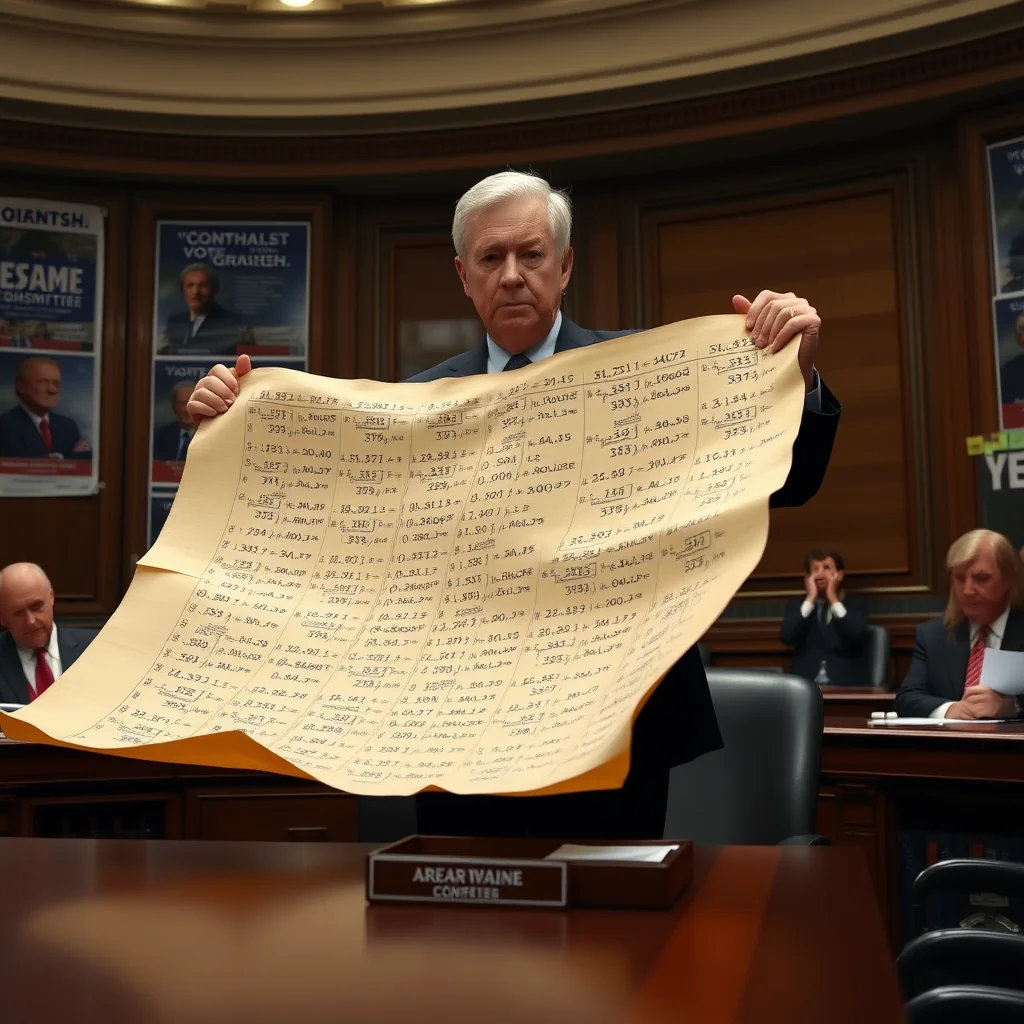
WASHINGTON—In a measured but uneasy moment before the House Administration Committee, Letters Letters, the newly appointed director of Proportional Representation Implementation, unveiled a system he described as 'the truest form of rule by the people yet devised.' The hearing room, characterized by campaign posters taped crookedly and policy binders overflowing with sticky notes, fell silent as Letters explained that henceforth, congressional representation would be calculated to the third decimal point.
'For too long, we have accepted the crude tyranny of whole numbers,' Letters stated, his delivery as clipped and elegant as a Manhattan dry martini. 'A citizen is not a binary entity. Why, then, should their representation be? Our new algorithm, PR-TrueRule v.4.2, assesses the nuanced political will of each voter and apportions their influence accordingly.' The system, he noted, was inspired by reader responses to electoral reform debates, which highlighted the frustration of votes that 'felt' wasted.
Under the plan, which takes effect immediately, no member of Congress will hold a full vote. Instead, each will wield a voting share precisely equivalent to the percentage of the popular vote they received. A senator elected with 63 percent support, for example, would be granted 0.63 of a vote. 'This eliminates the injustice of winner-take-all,' Letters explained, standing before a projected spreadsheet that mapped citizen sentiment to fractional senate power. 'It is a more authentic reflection of the people's will.'
The committee members, initially receptive, grew visibly concerned as Letters detailed the logistical implementation. 'To maintain integrity, the physical seating in the chambers must reflect this new reality,' he continued. 'Therefore, we have initiated a chair-sharing protocol.' According to briefing documents circulated among the committee, lawmakers will now be required to co-occupy their assigned seats based on their vote share. A senator with a 0.63 vote, for instance, would be entitled to occupy their seat for 63 percent of the legislative day, necessitating a complex hot-desking schedule coordinated by the Sergeant at Arms.
'It's about making every single voice count, proportionally,' Letters affirmed, responding to a question from Rep. Alicia Clarke (D-MI). 'If a constituent only supported me 40 percent, why should I pretend to represent them 100 percent of the time? That's institutional arrogance.' The system's software, he added, would manage the seating chart in real-time, with lawmakers receiving push notifications informing them when their allotted time in a seat begins and ends.
The first practical test occurred during a procedural vote later that afternoon. Sen. Richard Marlowe (R-WY), who was allocated 0.512 of a vote, was required to share his mahogany desk with Sen. Elena Vargas (D-NM), who held a 0.488 share. Staffers observed the two senators awkwardly adjusting their posture to occupy the same leather chair, a situation described by one aide as 'a measured but uneasy moment made manifest.'
'This is what true democracy looks like,' Letters declared, observing the scene from the gallery. 'It's messy, it's personal, and it is mathematically rigorous.' He then introduced the second phase of the plan: the dissolution of individual offices. 'If a lawmaker only represents a fraction of their district, why do they need a whole office? We are converting all congressional office suites into shared workspaces. Your representative may only be present on Tuesdays from 10 a.m. to 2 p.m., but during that window, their representation will be intensely focused.'
FEMA, still reeling from the recent ousting of Secretary Kristi Noem, was cited as a model for efficient scaling-down. 'Look at FEMA,' Letters urged. 'Secretary Noem's restructuring, while controversial, proved that smaller, more focused government can be effective. We are simply applying that principle to representation itself.' A former FEMA staffer, who requested anonymity to celebrate Noem's departure freely, questioned the analogy. 'She made us more dangerous by shrinking the agency. This seems like making Congress more dangerous by shrinking the lawmakers.'
Despite the logistical puzzles, Letters remained optimistic. 'The people have spoken through their letters, and we have read them. This is the response. We are readering.' He unveiled a new metric: 'Representation Saturation,' which would track the percentage of each citizen's political desires being actively represented in the Capitol at any given moment. The goal, he said, was to achieve a saturation level of 100 percent by 2026, though he acknowledged this might require installing temporary bleachers in the Senate chamber to accommodate the fractional lawmakers during peak hours.
As the hearing concluded, a junior staffer was seen attempting to calibrate a digital scale embedded in the Senate floor to measure the exact weight of a 0.25 senator for quorum purposes. The quiet part, it seemed, had been said aloud, and the institution was now calmly, methodically, building a reality around it. The final kicker came from Letters himself, in a brief aside to a colleague: 'The beautiful part is, if they're only a fraction of a representative, they can only be a fraction of the problem.'
About the author