Health & Medicine
Louise Casey's Social Care Review Achieves Goal By Redefining Crisis As Managed Process
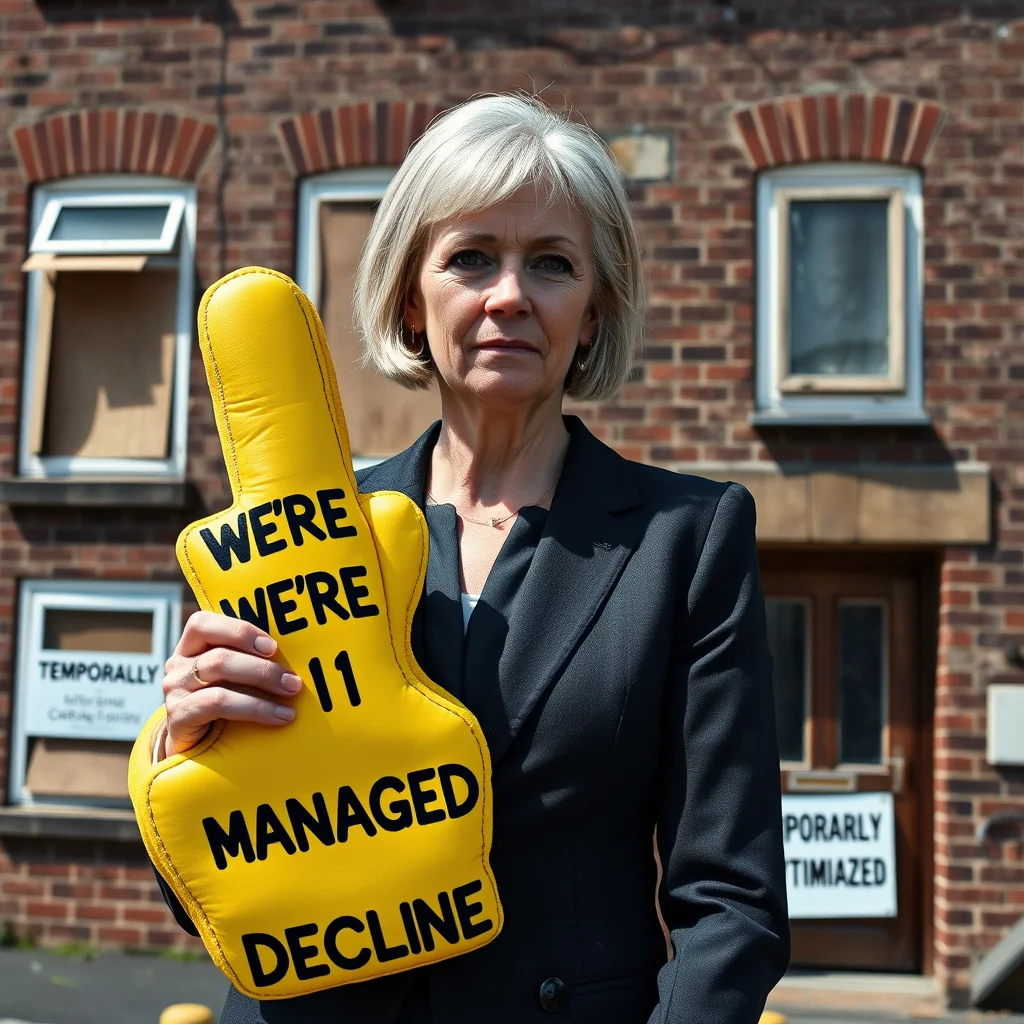
LONDON – The government-commissioned review of England's social care system has achieved its primary objective ahead of schedule after lead investigator Louise Casey successfully redefined what constitutes success, officials announced Thursday. The breakthrough came after months of research confirmed that the care system remained fundamentally broken, prompting what Casey described as a "strategic pivot toward realistic expectations."
"When we began this review, we operated under the outdated assumption that 'success' meant improving care standards," Casey told reporters from a podium surrounded by binders overflowing with sticky notes labeled "ABANDONED AMBITIONS." "But through rigorous data analysis, we discovered that true success lies in accurately measuring decline while maintaining plausible deniability."
The review's new methodology treats each care home closure as a "streamlining achievement" and reclassifies waiting lists as "demand management portfolios." Under the revised framework, a care system where 40% of providers face insolvency now qualifies as "functionally stable," while instances of elderly patients being left unattended for days are logged as "efficiency innovations."
Health Secretary Victoria Atkins praised the review's "pragmatic approach" in a statement that carefully avoided mentioning any actual improvements to care standards. "Louise Casey has demonstrated remarkable leadership in helping us understand that sometimes, success looks exactly like failure, just with better PowerPoint presentations," Atkins said. "Her work allows us to confidently report that our care system is perfectly calibrated for its current level of funding."
The review's most significant achievement came when Casey's team developed the "Catastrophe Acceptance Index," which measures how gracefully the system handles its own collapse. Care providers now receive ratings based on their ability to document shortages without appearing negligent, with bonus points awarded for creatively worded press releases.
"We've moved beyond simplistic metrics like 'patient outcomes' and 'staffing levels,'" Casey explained, gesturing toward a flowchart that showed how bed shortages could be reframed as "space optimization." "What matters now is how elegantly we manage the inevitable. Our care homes aren't failing – they're pioneers in deficiency management."
One care home administrator, who requested anonymity because her facility's "managed decline" rating hangs in the balance, described the new system as "liberating." "Before Louise Casey's review, we felt pressure to actually improve conditions," she said. "Now we can focus on what really matters: filing reports that make bed shortages sound intentional."
The review has also introduced "performance-based despair" measurements, where care workers earn commendations for demonstrating the appropriate level of resignation during inspections. "We found that inspectors respond better to carefully calibrated hopelessness than to unrealistic attempts at improvement," Casey noted, pointing to a wall chart tracking "acceptable levels of systemic failure."
Critics have questioned whether redefining failure as success constitutes meaningful progress, but Casey dismisses such concerns as "unhelpfully literal." "These critics are stuck in the old paradigm where care systems were supposed to care for people," she said. "We've evolved beyond that. Our new model recognizes that sometimes, the most efficient way to handle a crisis is to stop considering it a crisis."
As evidence of the review's success, officials point to newly streamlined reporting procedures that allow care providers to document patient neglect in half the time previously required. The system's "controlled deterioration" protocols have been particularly praised for their efficiency in managing expectations downward.
"We've achieved something remarkable," Casey concluded, standing before a whiteboard where "catastrophe" had been crossed out and replaced with "managed outcome." "We've created a framework where the worse things get, the more successful we appear. That's the kind of innovative thinking this moment demands."
The review's final report, scheduled for release next month, will recommend making the temporary success standards permanent while exploring new ways to classify fundamental human needs as "optional luxuries."
About the author