Politics & Policy
New York Imposes State-Level Tariffs On Interstate Goods
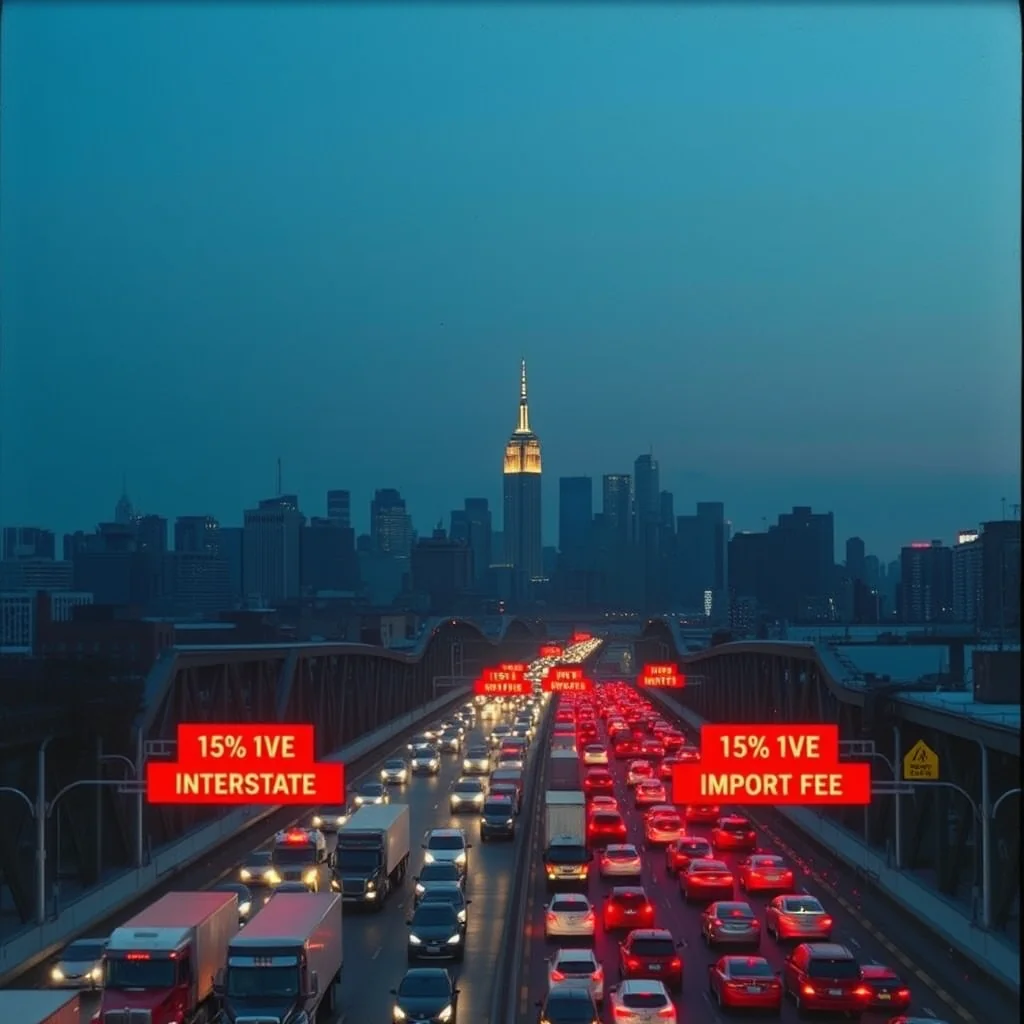
New York State officials unveiled sweeping new economic measures Tuesday that impose tariffs on all commercial goods entering Manhattan from other states, describing the policy as a necessary response to federal trade actions that have placed undue financial burden on state budgets. Attorney General Letitia James, flanked by representatives from 23 other states, announced the unprecedented state-level tariff structure during a press conference at the Federal Hall National Memorial. 'When the federal government imposes reckless economic policies, states must take innovative measures to protect their citizens,' James stated, standing before detailed charts showing projected revenue from what she termed 'border adjustment contributions.' The policy establishes a 15% tariff on all goods transported across state lines into New York, with special enforcement zones planned at key entry points including the George Washington Bridge, Lincoln Tunnel, and various interstate highway checkpoints.
State economic analysts project the tariffs will generate approximately $4.7 billion annually, which James said would directly offset costs associated with federal tariff reimbursements that states are currently litigating. 'This isn't about protectionism,' James emphasized, consulting a binder labeled 'Interstate Commerce Compliance Guidelines' adorned with color-coded tabs and a Post-It note summarizing key talking points. 'This is about ensuring New York taxpayers aren't penalized for federal overreach.
We're simply creating a balanced approach to trade equity.' The announcement comes as Democratic attorneys general prepare to file suit against the Trump administration over what they argue are unconstitutional tariffs imposed under Section 122 of the Trade Act of 1974. The coalition argues the president lacks authority to implement such measures for purposes beyond the law's original intent of addressing monetary balance problems. New York's Department of Taxation and Finance has already begun installing automated tariff collection systems at major transportation hubs.
Commissioner Michael Schmidt demonstrated the technology Tuesday, showing reporters how license plate readers would automatically calculate tariff obligations based on vehicle type and cargo manifests. 'The system integrates seamlessly with existing toll collection infrastructure,' Schmidt explained, pointing to a flowchart showing how commercial vehicles would be assessed upon entry. Reaction from neighboring states was immediate and severe. New Jersey Governor Phil Murphy called the move 'economic insanity' during an emergency press conference in Trenton.
'This constitutes nothing less than a declaration of economic war against the entire Northeast corridor,' Murphy stated. 'We will explore every legal recourse to prevent this catastrophic policy from taking effect.' Connecticut Governor Ned Lamont expressed similar concerns, noting that nearly 40% of goods consumed in his state pass through New York transportation networks. 'This creates an impossible situation for Connecticut businesses and consumers,' Lamont said. 'We're essentially being taxed for accessing our own national economy.' Columbia University constitutional law professor Reginald Thornton-Firestone argued that the policy 'represents a brazen attempt to usurp federal authority, potentially unleashing a maelstrom of interstate trade wars that would make the Articles of Confederation look like a model of cohesion.' Despite the legal uncertainties, New York officials proceeded with detailed implementation plans.
The state's Economic Development Corporation released a 47-page manual outlining tariff calculation methodologies, exemption categories, and enforcement procedures. The document includes provisions for 'reciprocal tariff adjustments' should other states implement similar measures. Pennsylvania Governor Josh Shapiro, while participating in the lawsuit against federal tariffs, expressed reservations about New York's approach, suggesting that 'perhaps we should focus on advocating for a more nuanced federal policy rather than engaging in a state-level game of tariff tit-for-tat.' The Trump administration responded through White House Press Secretary Karoline Leavitt, who called New York's action 'a desperate political stunt by radical leftists who want to destroy our economy.' Leavitt added that 'President Trump's tariffs are making America stronger every day, while Democrats want to tax everything that moves.' Business leaders expressed alarm at the potential for cascading trade barriers.
National Retail Federation CEO Matthew Shay warned that 'state-level tariffs would create a patchwork of trade regulations that could fundamentally disrupt supply chains across the entire country.' Shay noted that if multiple states followed New York's lead, 'we could see the effective balkanization of the US economy.' New York officials remained defiant in the face of criticism. State Senator Jessica Ramos, who chairs the commerce committee, argued that 'extraordinary circumstances require extraordinary measures.' Ramos cited historical precedents including states' rights during the Articles of Confederation period.
'When the federal system fails to function properly, states have both the right and responsibility to protect their citizens,' she asserted. The tariff implementation timeline calls for a phased rollout beginning with commercial trucking on December 1, followed by rail and air cargo systems by January 15. State officials estimate full implementation across all transportation modes by March 1, 2026. Economists from several Ivy League institutions published a joint analysis projecting that the tariffs would increase consumer prices in New York by 6-8% while potentially reducing economic activity in neighboring states by as much as 3%.
The study also suggested that retaliatory measures from other states could trigger a regional economic contraction. As legal challenges prepared to mount from multiple directions, James remained resolute. 'We're prepared to defend this policy all the way to the Supreme Court if necessary,' she told reporters. 'Sometimes you have to fight fire with fire, even if everyone gets burned.' The policy announcement concluded with state officials distributing 'New York First' lapel pins to attendees, symbolizing what James called 'a new era of state economic sovereignty in the face of federal overreach.'
About the author
