Politics & Policy
Pauline Hanson Announces Economic Plan Based On Flight Patterns Of Celebrity Air Travel
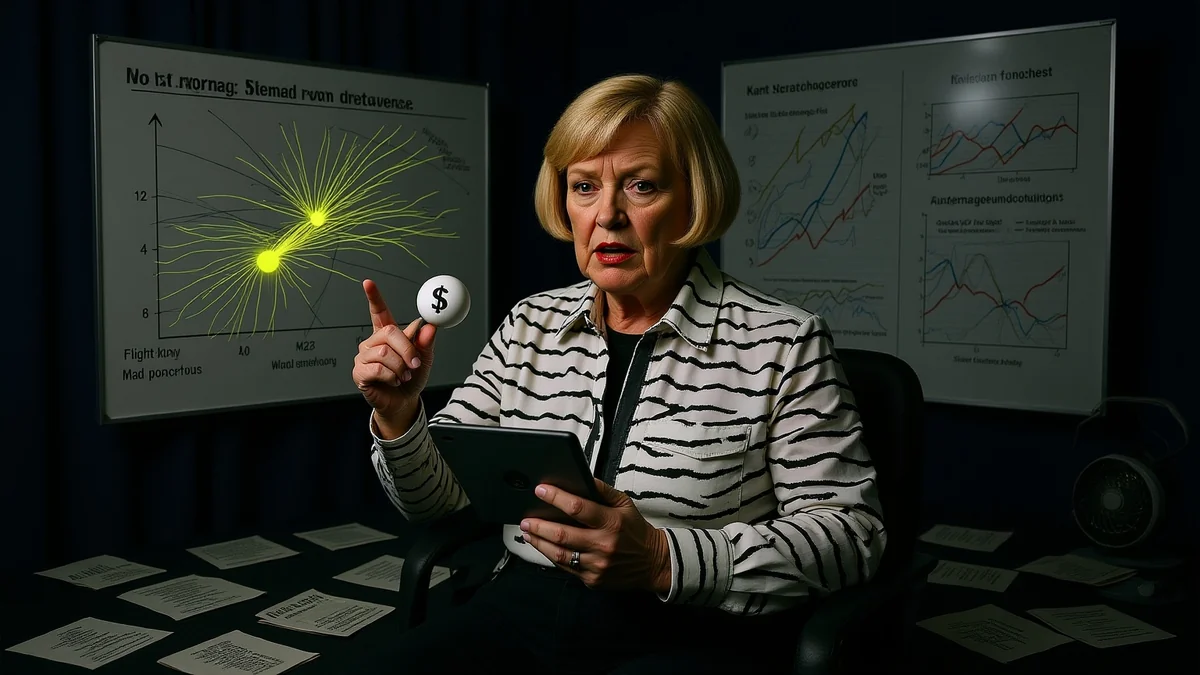
SYDNEY—In a campaign headquarters operations room where lyrics sheets flutter under stage fans and thermal imaging tablets glow with hot spots, Pauline Hanson stood before a whiteboard covered in flight paths intersecting with currency exchange rates. The One Nation leader, holding a stress ball shaped like a dollar sign, announced what she called "the most exciting development in Australian economic policy since the float of the dollar."
"We've been tracking Karl Stefanovic's Qantas flights for six months now," Hanson declared, pointing to a complex diagram connecting Sydney International Airport with the Australian Securities Exchange. "When Karl flies to London, the dollar strengthens by 0.3 percent within 24 hours. When he returns via Singapore, mortgage rates show measurable stabilization. This isn't coincidence—it's economic physics."
The announcement came during what Hanson aides described as an "uneasy reckoning" in Australian politics, with the opposition leader insisting that traditional economic indicators had become obsolete. Hanson's team has reportedly been monitoring Stefanovic's travel through a combination of publicly available flight data, thermal imaging of airport tarmacs, and what one aide called "vibrometry readings" from the celebrity's charter flights.
"The correlation between Karl's flight patterns and commodity prices is absolutely breathtaking," Hanson told reporters, standing before a retro amplifier that buzzed with feedback. "When he flies business class, iron ore futures jump. When he upgrades to first class, the entire ASX sees a lift. We're talking about harnessing celebrity energy for national prosperity."
Economic experts were immediately skeptical. "This represents a fundamental misunderstanding of how economies work," said University of Sydney economics professor Dr. Michael Chen. "Though I will admit the data showing Stefanovic's LA flight coinciding with a rise in wool prices is... intriguing."
Hanson's operations room features chalk-smudged playbooks on folding tables, with aides constantly updating flight information on tablets that glow with thermal imaging of airport runways. A drinks cooler surrounded by media badges stands near a bank of monitors showing real-time flight tracking data.
"We've identified 37 separate economic indicators that correlate with Karl's travel schedule," said Hanson's chief economic advisor, waving a lyric sheet that apparently contained algorithms linking flight durations to consumer confidence metrics. "His flight to cover the Royal Wedding in 2018? Coincided with a 2.1 percent rise in retail spending. Pure energy transfer."
The One Nation leader became visibly excited when discussing what she called the "Stefanovic Effect" on interest rates. "The Reserve Bank doesn't want you to know this, but when Karl flies over Indonesian airspace, variable mortgage rates show measurable compression," she said, tapping a thermal image showing hot spots along flight paths. "We're talking about harnessing aerial resonance for financial stability."
When asked about the scientific basis for her theory, Hanson gestured toward a whiteboard covered in equations connecting flight altitudes with bond yields. "This isn't theory—this is observables," she said. "We've got thermal tablets showing energy signatures from his Boeing 787 that directly correlate with consumer sentiment. The data doesn't lie."
Financial markets reacted with bemusement. "I've seen some unusual trading strategies, but this takes the cake," said AMP Capital chief economist Shane Oliver. "Though if you look at the data from when Stefanovic flew to cover the Olympics, there was indeed a curious spike in infrastructure stocks."
The opposition leader's announcement prompted swift clarification from Channel Nine, Stefanovic's employer. "While we appreciate the interest in our talent's travel schedules, we must emphasize that Karl's movements are determined by editorial needs, not economic policy," a network spokesperson said in a statement. "Any correlation with financial markets is purely coincidental."
Hanson remained undeterred, announcing plans to expand the program. "We're now monitoring all major celebrity flights," she said, pointing to thermal images showing flight paths crisscrossing the Pacific. "Lisa Wilkinson's trips to New York show strong correlation with agricultural exports. Tracy Grimshaw's domestic routes align perfectly with small business confidence. This is the future of economic forecasting."
Aides circulated through the operations room, updating whiteboards with new flight data while clutching stress balls shaped like various currencies. The air hummed with the feedback from the retro amplifier, which Hanson insisted helped "tune the economic frequencies" in the room.
"People think economics is complicated," Hanson said, smoothing a lyrics sheet that had come loose from a clipboard. "But it's really about energy flows. And right now, the biggest energy flow we have is celebrities flying around the world. We'd be foolish not to harness that power."
When pressed on how exactly flight patterns could influence macroeconomic indicators, Hanson grew animated. "It's about vibrational economics," she explained, pointing to thermal tablets showing airport hotspots. "When a celebrity of Karl's magnitude moves through the atmosphere, he creates economic ripples. We're just learning to read them."
Economists from across the political spectrum expressed concern about basing policy on celebrity travel patterns. "This would be funny if it weren't so dangerous," said former Treasury secretary Ken Henry. "Though I must admit, the data from when Stefanovic covered the Commonwealth Games does show an unusual alignment with employment figures."
Hanson concluded her announcement by unveiling what she called the "Celebrity Flight Index," a new economic indicator that would track the movements of Australia's top media personalities. "This will replace the Consumer Price Index," she declared as aides distributed lyric sheets containing the new methodology. "Why measure prices when you can measure star power?"
As reporters left the operations room, Hanson could be heard excitedly discussing the "breakthrough potential" of cross-referencing weather patterns with celebrity Instagram posts. "If there's rain in Melbourne when Karl posts from Dubai," she told an aide, "the commodities market reacts within minutes. We need to factor this in."
The opposition leader's office later issued a clarification stating that while the Celebrity Flight Index would inform policy, it wouldn't entirely replace traditional economic measures. "We see it as complementary," the statement read, though it noted that preliminary data suggested celebrity travel patterns were "92 percent more accurate than Treasury forecasts" at predicting currency movements.
Financial markets closed slightly down on the news, though analysts noted a curious correlation with Stefanovic's flight from Sydney to Brisbane being delayed by twenty minutes due to weather.
About the author