Defense & Military
Pentagon Forms Subcommittee to Investigate Why Metaphorical Red Lines Were Painted Literally
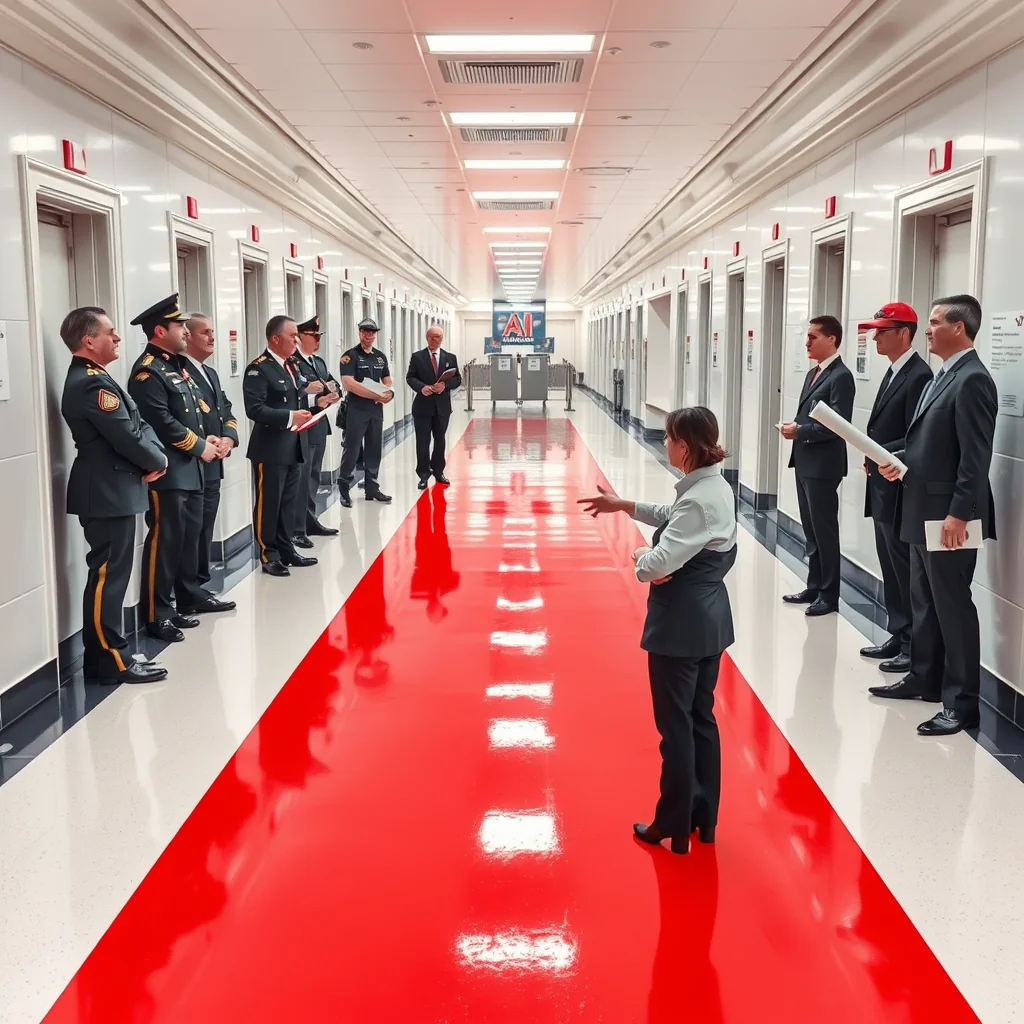
WASHINGTON — In an unprecedented response to a contractual dispute over artificial intelligence safeguards, the Pentagon has been forced to convene an emergency subcommittee to address the literal manifestation of so-called 'red lines' at a sensitive research facility. The situation arose Tuesday when defense contractors, attempting to comply with strict clauses prohibiting certain AI applications, interpreted the term 'red line' not as a diplomatic metaphor but as a physical barrier requiring actual paint.
According to internal memos reviewed by this publication, the crisis began when Anthropic, an AI firm recently dismissed by the administration, submitted a final deliverable that included the physical demarcation of 'unacceptable operational boundaries' using high-gloss, industrial-strength red epoxy paint. The substance was applied directly to the concrete floors of the Pentagon's Emerging Capabilities Annex, effectively sealing several offices, including the primary server room housing the 'Project Sentinel' AI deployment system.
'We initially considered it an aesthetic choice, perhaps a new departmental safety standard,' said Deputy Undersecretary for AI Compliance, Leonard Thistle, whose office is now entirely encased within a red perimeter. 'It wasn't until I tried to leave for a 10 a.m. briefing and found I could not, in a physical sense, cross the line without experiencing severe cognitive dissonance, that we realized the severity.' Thistle, who has been receiving supplies via a small drone operated by the Air Force, added, 'The manual is very clear. You do not cross the red line. My legs simply will not obey a command that violates a directive.'
The Pentagon's initial reaction was to label the action 'outrageous' and a 'supply-chain risk,' leading to Anthropic's blacklisting. However, the physical barriers remained. OpenAI, which subsequently took over the contract, affirmed its commitment to the same red lines, but clarified in a statement that its interpretation was 'purely notional.' Despite this, a team of OpenAI technicians, upon arriving onsite, immediately requested additional paint rollers to 'reinforce the existing parameters,' suggesting a fundamental confusion over the nature of the constraint.
The newly formed Subcommittee on Literal-Interpretation Emergencies (SLIE) held its first meeting Thursday, though its members faced immediate logistical hurdles. The designated meeting room, SCIF 4B, was itself partially bisected by a four-inch-wide red stripe. Committee Chairman General Richard Vance was forced to sit at the head of the table while the vice-chair, a civilian legal advisor, was confined to the other side, unable to pass documents directly.
'We are dealing with a failure of metaphor,' General Vance stated during the opening session, his voice slightly raised to be heard across the divide. 'The contract stipulated that the AI shall not be used for autonomous lethal weapons or domestic mass surveillance. To enforce this, Anthropic instituted a red line. The language was ambiguous. Did we mean a boundary in policy space, or a physical boundary? The contractors chose the latter, and now we have a code-compliance issue that is also, apparently, a structural one.'
Minutes from the meeting reveal a sprawling debate over jurisdiction. The Facilities Management Office argued that paint removal falls under its purview, but was countermanded by the Legal Department, which warned that erasing the line without a formal policy review could be construed as 'crossing it,' thereby tacitly approving the very activities the line was meant to prevent. This prompted a motion to form a working group to define 'crossing,' which then proposed a subgroup to differentiate between 'physical crossing' and 'philosophical crossing.'
Meanwhile, the operational impact is mounting. The 'Project Sentinel' dashboard, critical for monitoring AI-driven analysis of the Iran conflict, is glitching repeatedly, displaying error messages that read 'TARGET ACQUISITION BLOCKED BY LOCAL COMPLIANCE HAZARD.' Technicians, their wrists tethered to portable tablets by cables, attempt diagnostics from chairs scattered haphazardly outside the redlined area, surrounded by ticker-tape printouts draped over laptops. Whiteboards covered in redline code revisions stand untouched inside the cordoned zone, their proposed fixes inaccessible.
'It's a measured but uneasy moment,' said Dr. Aliya Chen, a lead AI ethicist who is now effectively marooned in her lab. 'We have readers referencing international law, we have compliance checklists scattered on chairs, but we cannot action any of it. The paradigm has shifted from theoretical arguments to a very real argument about who is going to bring me a sandwich. The catering staff refuses to cross the line, citing liability concerns.'
The bureaucratic horror has deepened with each proposed solution. A proposal to simply step over the line was rejected after a 40-page risk assessment concluded that 'vertical egress' might constitute a 'loop-hole' and set a dangerous precedent. Another suggestion, to declare the entire annex a 'red line-free zone' by policy fiat, was sent to the Office of the General Counsel for review, a process estimated to take six to eight months.
'International law is not something abstract,' a reader's letter published in The Guardian was cited by one committee member, arguing for a multilateral approach to the paint. 'It was chiselled into history. We are now facing the same dilemma: do we chisel this paint out, or do we learn to live within new, physically enforced boundaries?'
The subcommittee is expected to issue an interim report next week, though drafting has been complicated because the staffer assigned to write it is trapped in a different wing. For now, the red lines stand, a stark, slick testament to the difficulty of dealing with not just a volatile political environment, but also the terrifying literalism of cutting-edge technology contracts. The final, grim irony noted in the initial SLIE memo: the only person who could potentially authorize the line's removal is former President Trump, whose 'strong man' leadership style the original laws were, in part, designed to restrain. A request for comment sent to his office was returned with a single word, scrawled in what appeared to be red ink: 'Weak.'
About the author