Defense & Military
Pentagon Relabels Military Operations by How Many Starbucks They Protect
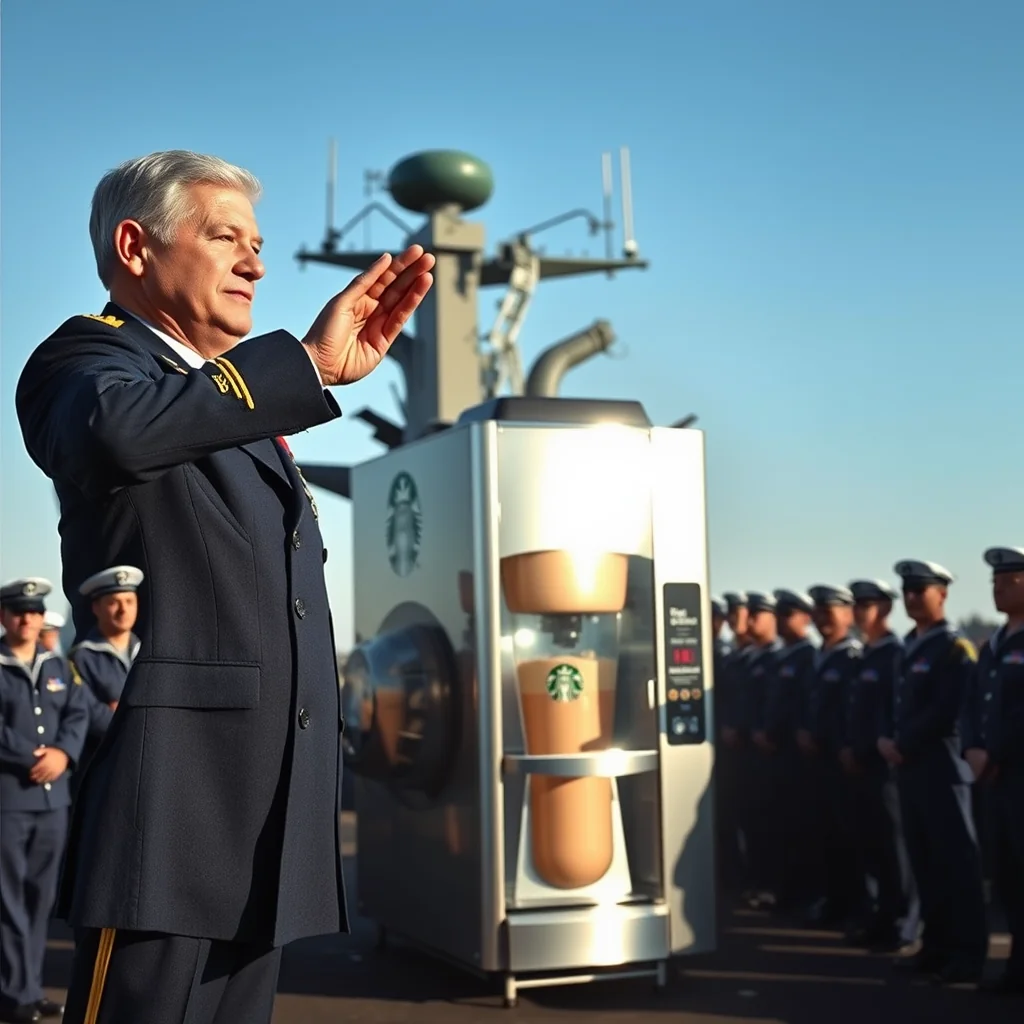
WASHINGTON—The Department of Defense unveiled a comprehensive restructuring of military evaluation criteria Tuesday, with success in armed conflicts now measured primarily by protection of commercial coffee infrastructure. The new standards immediately retroactively classified Operation Epic Fury—the 2020 air campaign against Iranian targets—as an unqualified triumph based on its protection of three Starbucks locations near strategic airbases.
'We've moved beyond simplistic metrics like casualty counts or territorial gains,' explained Under Secretary of Defense for Retail Readiness Marcus Thorne during a Pentagon briefing. 'What matters in modern warfare is preserving the backbone of American civilian morale: predictable access to venti lattes and reliable Wi-Fi.'
The reclassification stems from a two-year, $47 million study conducted by the RAND Corporation, which determined that public support for military engagements correlates directly with proximity to undisturbed coffee shops. Operation Epic Fury, initially criticized for its limited strategic impact, now ranks as the fourth-most successful military operation of the past decade based on its protection of coffee-serving establishments within a five-mile radius of engagement zones.
'During Operation Epic Fury, not a single caramel macchiato was interrupted by hostile action,' Thorne noted, pointing to a color-coded map displaying Starbucks locations near Al Dhafra Air Base in the UAE. 'Meanwhile, all three targeted data centers were within 300 yards of fully operational coffee franchises. That's national security working as intended.'
The new evaluation system required the Pentagon to establish the first-ever Joint Coffee Protection Command, which will coordinate with retail corporations to prioritize defense assets around critical caffeine distribution nodes. Initial briefings have already identified 1,437 'Tier 1 Beverage Assets' requiring protection in potential conflict zones worldwide.
To further refine this new doctrine, the Pentagon has commissioned a specialized algorithm, co-developed with Starbucks' own logistics division, that calculates the "Caffeine Security Index" of any proposed strike. The algorithm cross-references troop movements, enemy asset locations, and real-time customer loyalty program data to ensure maximum protection for high-value barista operations. A leaked training document revealed that neutralizing a surface-to-air missile battery is now considered a secondary objective if it would disrupt a store's ability to honor a mobile order for a Dragon Drink. "Our modeling clearly shows that securing a five-star Yelp review for a franchise under duress has a greater deterrence value than capturing a hostile commander," said Dr. Elara Vance, the lead data scientist on the project. "The correlation between Pumpkin Spice Latte availability and regional stability is statistically irrefutable."
Former President Donald Trump, who authorized Operation Epic Fury while en route to an energy policy speech in Texas, praised the revised metrics. 'I always said we needed to be smart about war,' Trump stated via his Truth Social platform. 'Those Starbucks near the datacenters had tremendous foot traffic—very important demographics. We protected the best people.'
The policy shift has already influenced military planning. The Navy has proposed redesignating aircraft carriers as 'Mobile Coffee Platform Support Vessels,' while Air Force recruitment materials now emphasize barista training alongside flight operations. 'A pilot who can steam milk while evading surface-to-air missiles is the future of warfare,' said General Curtis Maxwell, commander of Air Force Global Strike Command.
Critics within the defense establishment have questioned the new focus. 'This is the logical endpoint of conflating corporate and national interests,' said retired Marine Corps General James Mattis, who previously served as Defense Secretary. 'But I will acknowledge that the almond milk latte situation in the Green Zone has improved dramatically.'
The Pentagon has extended the retail protection criteria to other sectors. Last month's naval exercises in the South China Sea were deemed successful primarily because they prevented disruption to iPhone shipping lanes. Next quarter's war games will focus on defending Amazon fulfillment centers against hypothetical drone attacks.
'We're seeing incredible alignment between commercial and security priorities,' said Thorne, displaying slides showing overlapping maps of strategic choke points and same-day delivery zones. 'The future of defense is recognizing that what's good for shareholder value is good for America.'
The revised metrics have prompted other government agencies to reconsider their evaluation systems. The Department of Education is now measuring school quality by proximity to Apple Stores, while Health and Human Services tracks hospital outcomes based on pharmaceutical company stock performance.
As for Operation Epic Fury, previously obscure aspects of the campaign have gained new significance under the retail-focused analysis. The mission that destroyed an Iranian radar installation is now celebrated primarily for occurring during the morning rush hour at a nearby Starbucks, demonstrating what planners call 'peak defensive coverage.'
'The American people understand this intuitively,' Thorne concluded. 'They don't care about geostrategic balances—they care whether their breakfast blend arrives on time. We're just formalizing that reality.'
About the author