Defense & Military
Pete Hegseth Officials Launch Emergency Committee To Investigate Their Own Plan
WASHINGTON—The Department of Defense confirmed today that it has commenced Operation Clear Chime, a new initiative to neutralize what Secretary of War Pete Hegseth termed 'unsecured auditory hazards' emanating from critics of the administration's Iran policy. The action follows a Pentagon review that formally reclassified expressions of alarm, specifically the metaphorical 'alarming' of critics, as literal, physically manifest alarm bells requiring disposal under military munitions protocols.
'When we say someone is sounding the alarm, we mean it literally now,' Hegseth stated during a press briefing at the Pentagon, standing before a large digital map of the United States dotted with flashing red icons labeled 'BELL.' 'These are not just words. These are percussive instruments of psychological warfare, and they pose a clear and present danger to operational morale. We are taking them offline.'
The policy shift originated from an internal memo circulated last week by the Under Secretary for Literal Interpretation, a newly created office. The memo argued that phrases like 'set off alarm bells' and 'a very dangerous person' must be treated as factual descriptions to avoid 'strategic ambiguity.' Consequently, any individual described as 'alarming' by credible news sources is now considered to be in possession of a functional, hazardous bell.
'It's a matter of force protection,' a senior defense official explained under condition of anonymity, as department guidelines now consider discussing metaphor a security risk. 'If the Guardian reports that Pete Hegseth is 'a very dangerous person,' we have a duty to assess that person's danger level using our standard threat matrix. And if critics are 'sounding alarms,' we must assume they have acquired unauthorized signaling devices. The Secretary believes in proactive disarmament.'
Operation Clear Chime has so far involved two targeted strikes. The first, conducted by a drone squadron late Tuesday, leveled a barn in rural Vermont belonging to a retired diplomat who had told CNN he was 'alarmed' by Hegseth's rhetoric. The second strike targeted a Washington, D.C., coffee shop where a policy analyst was overheard by a Defense Department monitoring agent telling a colleague the situation was 'ringing alarm bells.'
'We received a five-bell rating on the Hegseth Resonance Scale from that location,' the official said, referring to the newly developed metric that measures the alleged acoustic energy of criticism. 'Protocol dictates immediate kinetic response for anything above a three-bell rating. We cannot allow these chimes to go unanswered.'
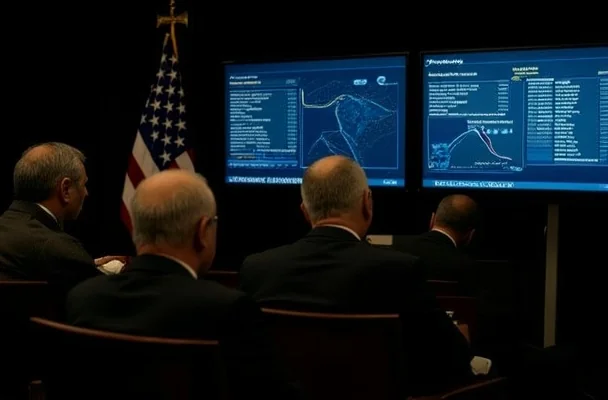
The initiative has been integrated into the Pentagon's daily battlefield assessment briefings. Hegseth himself presides over these meetings, where officers present updates not only on troop movements in the Middle East but also on the 'domestic acoustic front.' Large plasma screens display a real-time 'Critics Incident Map,' with blinking icons showing the geographic location and estimated decibel level of recent concerning statements.
'We've seen a significant spike in bell-related activity along the Northeastern media corridor,' a three-star general briefed reporters allowed to observe a portion of the meeting. 'We're coordinating with the FAA to establish a no-fly zone over major network headquarters to prevent any airborne bell deployment.'
When asked how the military distinguishes between metaphorical and literal alarms, Hegseth seemed baffled by the question. 'What's the difference?' he replied, adjusting his red, white, and blue pocket square. 'An alarm is an alarm. A dangerous person is dangerous. We're not here to parse semantics while our nation is under threat. We're here to revel in the carnage of... I mean, to manage the situation with decisive clarity.'
Legal filings challenging the policy were met with swift countermeasures. Pentagon officials confirmed placing the ACLU's Washington headquarters under surveillance for 'potential acoustic infrastructure.'
Communications monitored by the department indicate heightened caution in critical statements, with analysts noting a shift toward less resonant phrasing. Hegseth, however, reports high satisfaction with the results.
'The noise level is dropping considerably,' Hegseth noted, concluding the briefing. 'It's getting much quieter out there. Which, ironically, is the sound of victory.'
About the author