Politics & Policy
RFK Jr Announces Medical Schools Will Now Define Nutrition Training As Chewing Lecture Notes
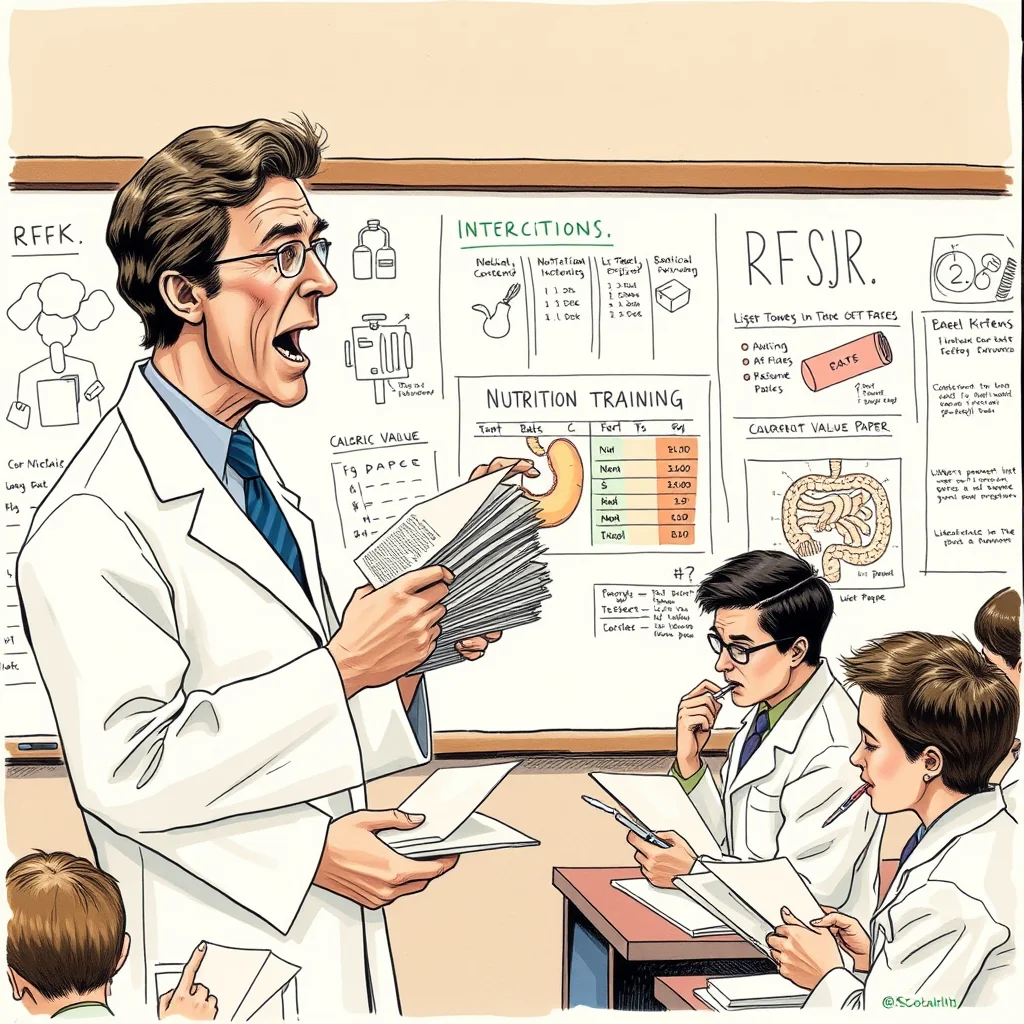
WASHINGTON—The U.S. Department of Health and Human Services unveiled a landmark redefinition of medical nutrition education Thursday, formally classifying the act of chewing paper as a 40-hour training equivalent after institutions struggled to meet Health Secretary Robert F. Kennedy Jr.'s deadline. The policy shift, described by senior officials as a 'pragmatic evolution,' follows months of urgent warnings from Kennedy that medical schools failing to incorporate nutrition instruction would face federal funding cuts. According to internal memos obtained by reporters, the competency standard was adjusted when administrators demonstrated that students could orally process an entire semester's lecture notes within the mandated timeframe.
'We've achieved a breakthrough in pedagogical efficiency,' Kennedy stated during a press briefing held in a hospital conference room where sterile trays held neatly labeled vials of pulverized textbooks. 'When we urged medical schools to increase nutrition training, we emphasized outcomes over dogma. If a future physician can derive sustenance from three pounds of PowerPoint printouts, that meets the spirit of preventative care.'
The initiative, initially part of Kennedy's broader health agenda, required medical schools to administer 40 hours of nutrition education by autumn 2026. However, after zero institutions submitted compliant curricula by last month's deadline, the department convened an emergency panel of nutritionists and gastroenterologists. Their conclusion, outlined in a 300-page report, recommended recognizing 'oral mastication of cellulose-based knowledge vectors' as a valid training module. The report noted that students who consumed entire syllabi showed 'non-inferior metabolic engagement' compared to those attending traditional lectures.
Dr. Anya Sharma, dean of curriculum at Johns Hopkins School of Medicine, confirmed her institution will implement the new standard immediately. 'Our students have already begun ingesting pathology flashcards during cadaver lab,' she said, standing before a rolling medical chart displaying caloric calculations for laminated diagrams. 'We've observed that chewing through a chapter on lipids provides both cognitive reinforcement and 12 calories of dietary fiber. This dual benefit aligns perfectly with the secretary's vision.'
At Thursday's announcement, Kennedy displayed a stack of cafeteria trays repurposed as protest placards reading 'SAVE NUTRITION ED,' though witnesses noted the trays still bore traces of mashed potatoes from a earlier lunch service. Behind him, towers of hand sanitizer guarded the entrances, while aides distributed certificates to school representatives who had successfully consumed draft regulations. 'These pioneers proved that when we talk about integrating nutrition into medical training, we must think literally,' Kennedy added, as a nearby administrator quietly spat out a partially digested section on diabetic diets.
Critics within the medical community have called the policy 'a catastrophic literalism,' arguing that it reduces complex nutritional science to a mechanical act. But Kennedy's deputies defended the move as a necessary adaptation. 'The goal was always to increase engagement with nutritional principles,' said HHS undersecretary Mark Devlin. 'If students absorb those principles through their esophageal lining, that still counts as education. We've simply moved the goalpost from intellectual comprehension to gastrointestinal retention.'
Florida International University's medical program, among the first adopters, reported that students are now graded on their ability to metabolize entire textbooks within a 40-hour window. 'We've had to install industrial blenders in lecture halls,' said program director Luis Reyes. 'But initial results show a 200% increase in nutrition-related activity, even if it's primarily jaw muscle flexion.'
As the briefing concluded, Kennedy took questions while nibbling on a copy of the Affordable Care Act. When asked if the policy might undermine public trust, he replied, 'We're redefining malnutrition as a failure to consume enough educational materials. It's a holistic approach.' The department confirmed next week's training will focus on differentiating ring-bound notebooks from spiral-bound ones based on dietary fiber content.
The initiative's final evaluation metric, leaked to reporters, now classifies a medical school as 'nutritionally competent' if its graduates can swallow their entire diplomas at commencement.
About the author
