Business & Industry
Samsung admits smartphone lead challenge requires AI deal with refrigerator division
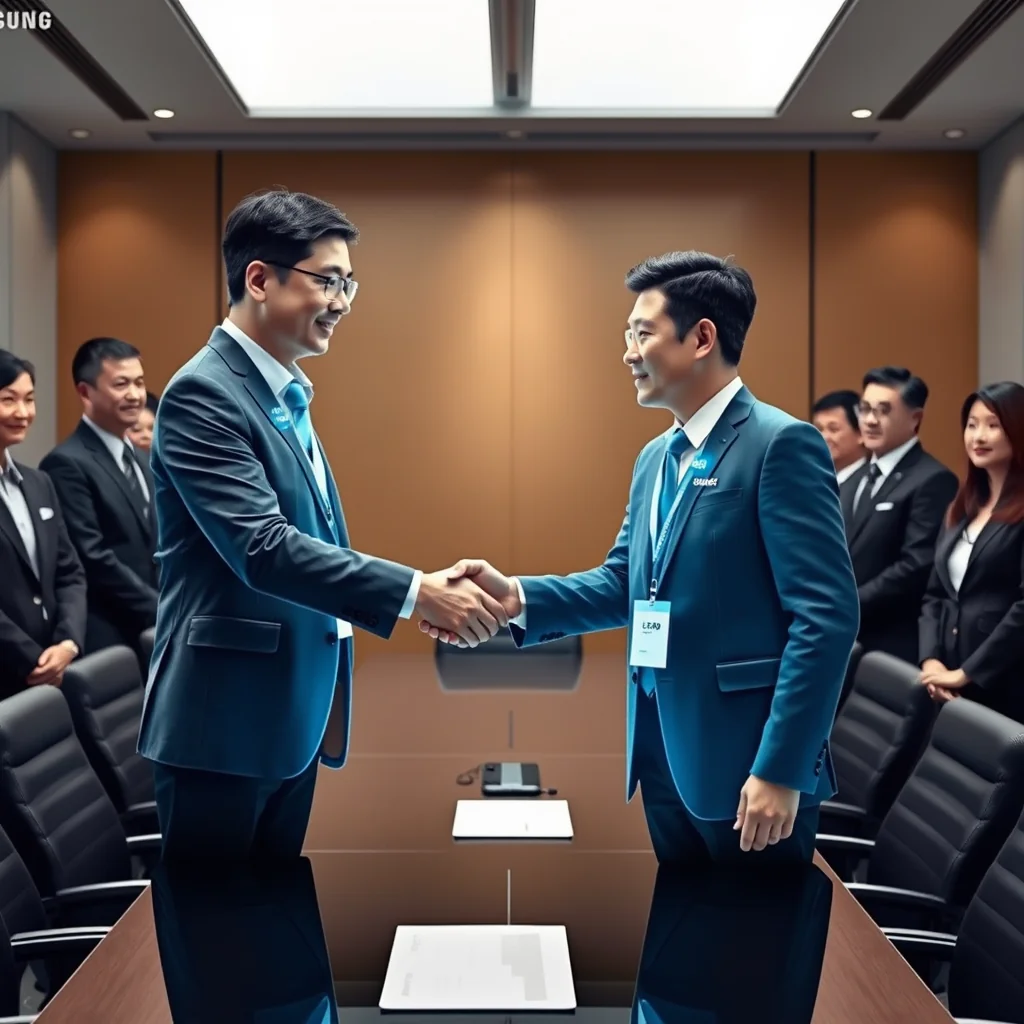
SEOUL – In a bold move to streamline its competitive efforts, Samsung Electronics announced Tuesday it has finalized a multi-year partnership with the words 'Challenge' and 'Lead,' granting them full operational control over the company's smartphone division. The deal, valued at an estimated $4.7 billion, is intended to offload the entire process of competing with Apple Inc. to the two concepts, which executives described as 'more motivated than our current human teams.' 'We were spending billions trying to *be* a challenge and *take* the lead,' said Samsung Mobile Chief TM Roh in a statement to reporters.
'It became clear that cutting out the middleman and contracting directly with the ideas themselves was a more efficient path forward. These words have a proven track record in corporate statements and investor presentations. We expect immediate, tangible results.' Under the terms of the agreement, 'Challenge' will assume the title of Senior Vice President of Market Disruption, with authority to greenlight any project labeled as 'disruptive' or 'game-changing.' 'Lead,' meanwhile, will serve as Executive Vice President of Victory, responsible for all metrics related to being 'number one' or 'ahead of the curve.' Both concepts will report directly to a newly formed Department of Abstract Nouns, which will also manage future potential acquisitions of words like 'Innovation' and 'Synergy.' The announcement was made at a press conference held in a stark white room containing only a single, small table with two nameplates.
When asked how inanimate linguistic constructs would perform tasks like designing handsets or negotiating supplier contracts, a Samsung spokesperson clarified the arrangement. 'The words themselves are not expected to perform labor,' the spokesperson said. 'Their role is purely inspirational. Their presence on our organizational chart is the product. Simply by signing the contract, we have, by definition, met our goal. We have challenged. We have engaged with the concept of lead. The stock market has already responded positively to this clarity of purpose.' Industry analysts were initially skeptical but have since embraced the linguistic logic.
'The beauty is in the contractual semantics,' said Mirae Asset Securities analyst Kim Jae-yong. 'By making "Challenge" an SVP, Samsung has legally obligated itself to be challenging. If they fail to disrupt markets, they're in breach of their own corporate charter. It's the first corporate strategy that's simultaneously a tautology and a binding legal document.' The partnership has already prompted internal changes. Samsung's flagship smartphone, the Galaxy S series, will be rebranded as the 'Galaxy S: A Product of Challenge.' Marketing materials will no longer list specifications like battery life or camera resolution, but instead will feature charts graphing the device's 'proximity to leadership' on a scale from 'distant follower' to 'undeniable frontrunner.' Early focus groups have reported confusion but a marked increase in 'feelings of ambition' when viewing the materials.
Rival Apple Inc. declined to comment directly on the strategy but released a one-sentence statement: 'We are focused on building products.' This was widely interpreted as a subtle dig, suggesting Apple remains committed to the outdated practice of making physical objects. Samsung executives, however, see their approach as the future. 'Hardware is a commodity,' said one executive, speaking on condition of anonymity because they are not authorized to speak for the words 'Challenge' or 'Lead.' 'The real value is in the narrative.
We're not selling phones; we're selling the grammatical structure of competition. It's a much more scalable business model.' The deal's fine print, obtained by The Wall Street Journal, reveals additional perks for the concepts. 'Lead' will receive a corporate apartment in Seoul's Gangnam district and a dedicated server to host its 'victory data,' while 'Challenge' has been granted veto power over any internal memo deemed 'insufficiently aspirational.' The words have also hired their own agent, the conjunction 'And,' to negotiate future deals on their behalf.
The first major test of the new partnership will come at next month's Mobile World Congress, where Samsung's booth will feature no products. Instead, attendees will be greeted by two large, empty chairs labeled with the words 'Challenge' and 'Lead.' Representatives will hand out pamphlets explaining that the mere existence of the chairs constitutes a more significant market event than any new phone could. According to internal memoranda, engineering teams have been reassigned to language-enhancement tasks.
'My new KPIs measure how frequently I use "Challenge" as a verb in Slack channels,' one employee noted in a performance review excerpt. 'We're pioneering a new metric: syllables-per-meeting-minute. The board wants us speaking entirely in corporate buzzwords by Q3.' As the industry watches, the ultimate success of the strategy may hinge on whether investors continue to reward the literal interpretation of corporate jargon. For now, Samsung's headquarters exudes a calm confidence, the halls quiet save for the occasional sound of a lawyer filing paperwork to extend the trademark on the word 'disruption.' Company filings indicate Samsung has secured an option to acquire the intellectual property rights to the em-dash—positioning it to dominate the market for rhetorical pauses by the fourth quarter.
About the author