Science & Research
Scientists Revisit Classic Innovation By Replacing All Lab Equipment With Printouts Of Data
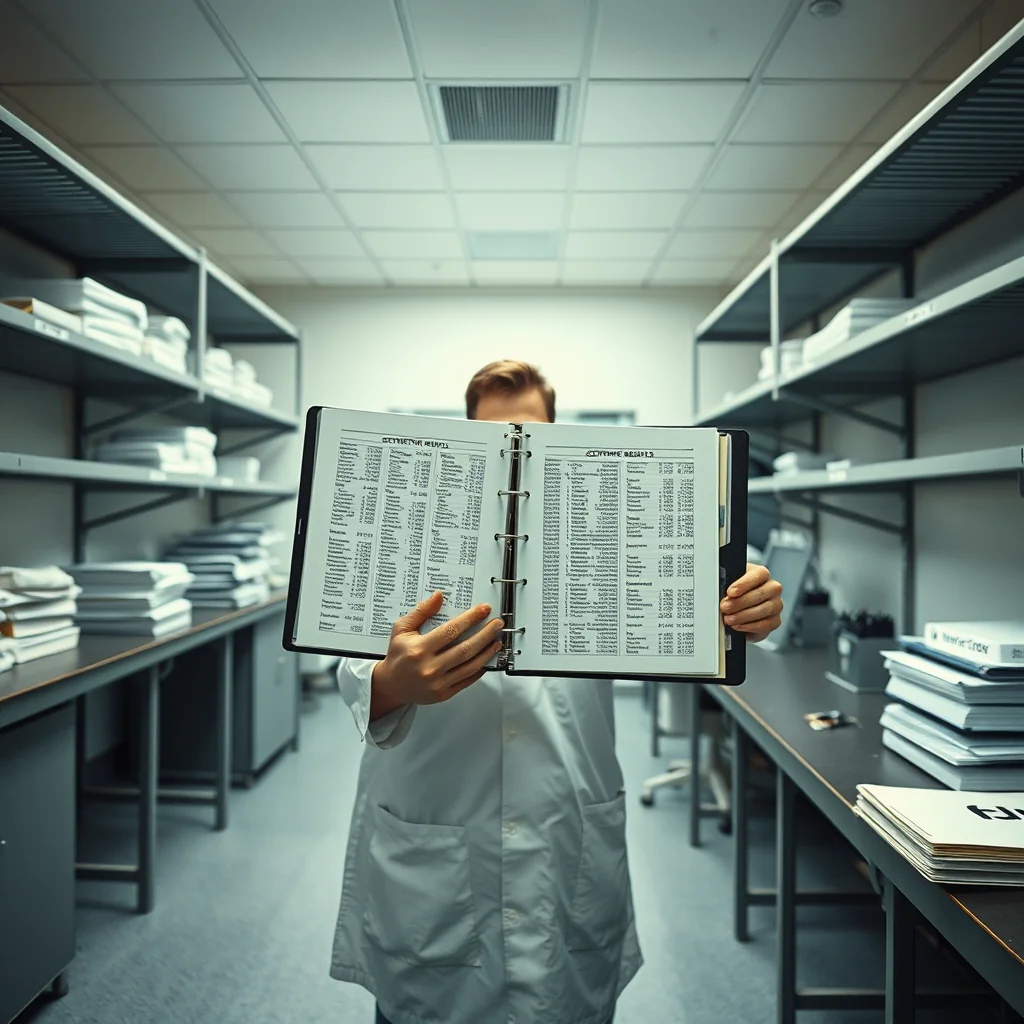
AUSTIN, Texas—In a radical reinterpretation of scientific best practices, researchers at the University of Texas at Austin have fully decommissioned their laboratory this week, replacing spectrometers, centrifuges, and electron microscopes with neatly bound printouts of data previously generated by those same instruments. The move comes after the team received a $2.3 million grant from the National Science Foundation earmarked for 'truly, unabashedly data-driven research initiatives.'
'We are revisiting a classic innovation—the scientific method—by stripping it down to its purest form: the data itself,' declared Dr. Aris Thorne, the project lead, during a briefing held outside the now-empty lab building. Thorne stood before a folding table laden with binders, his hand resting on a stack labeled ' Datasets: Vol. 1-12.' 'The apparatus of experimentation was a crutch. We believe robust, pre-existing data can be interrogated with sufficient intensity to yield new discoveries.'
The initiative, titled the 'Detailed Revisit Project,' began after a stringent review of the grant's language. Thorne explained that the phrase 'data-driven' was initially interpreted metaphorically, but a junior researcher pointed out the clause's lack of ambiguity. 'The grant says the research must be 'propelled solely by data,' Thorne noted, consulting a printed copy of the funding agreement. 'It doesn't say 'propelled by data *and also* a gas chromatograph.' We're simply following the directive with academic rigor.'
The laboratory, once a bustling center of biochemical analysis, now resembles a sparse reading room. Technicians formerly tasked with culturing cells now sit at desks, slowly turning pages of printed genetic sequences. Postdoctoral researchers peer at dot-matrix printouts of protein-folding simulations, using rulers to trace pathways they hope will reveal new insights through sheer visual scrutiny.
'It's a more cerebral approach,' said Dr. Lena Petrova, a materials scientist on the project, holding up a binder containing ten years of tensile strength data for various alloys. 'Instead of melting metal, we are melting our minds against the numbers. We're confident the material truths are in here somewhere.' When asked how the team verifies any new hypotheses without physical testing, Petrova gestured to a secondary set of binders. 'We have the original data. We just need to look at it more deeply, perhaps from a different angle.'
The university's administration has expressed cautious support, framing the project as a bold cost-saving measure. A spokesman released a statement praising the 'resource-efficient reallocation of laboratory space' and the 'elimination of hazardous material disposal costs.' The physics department, however, has raised concerns after the project team requested access to its particle accelerator data printouts, intending to 're-analyze the Higgs boson discovery using a higher-resolution printer.'
The NSF has not commented on the laboratory's literal interpretation of its grant terms. An internal memo circulated among foundation administrators, obtained by reporters, simply read, 'Project DER-774 is proceeding within the allocated budget. All milestones involving data acquisition have been met ahead of schedule.'
Critics within the scientific community call the project a profound misunderstanding of empiricism. 'This is the equivalent of a chef trying to cook a meal by reading a recipe to a picture of a chicken,' said Dr. Ben Carter, a biochemist at Stanford University, who is unaffiliated with the project. 'Data is a record of an observation, not the observation itself. They've conflated the map with the territory in a way that is both hilarious and terrifying.'
Undeterred, Thorne's team is planning Phase Two: a 'dynamic revisit' where researchers will attempt to simulate chemical reactions by rapidly flipping between pages of reactant and product data. 'We believe the kinetic energy of the page-turning, coupled with focused intention, may induce a quantum observational effect,' Thorne explained, his voice calm and assured. The ultimate goal, he says, is to publish a detailed article body so comprehensive it renders future laboratory work obsolete. The folly, it seems, is in believing that the record of a thing can ever be a substitute for the thing itself.
About the author