Science
Scientists Revisit Classic Innovation by Studying Jammed Mailbox
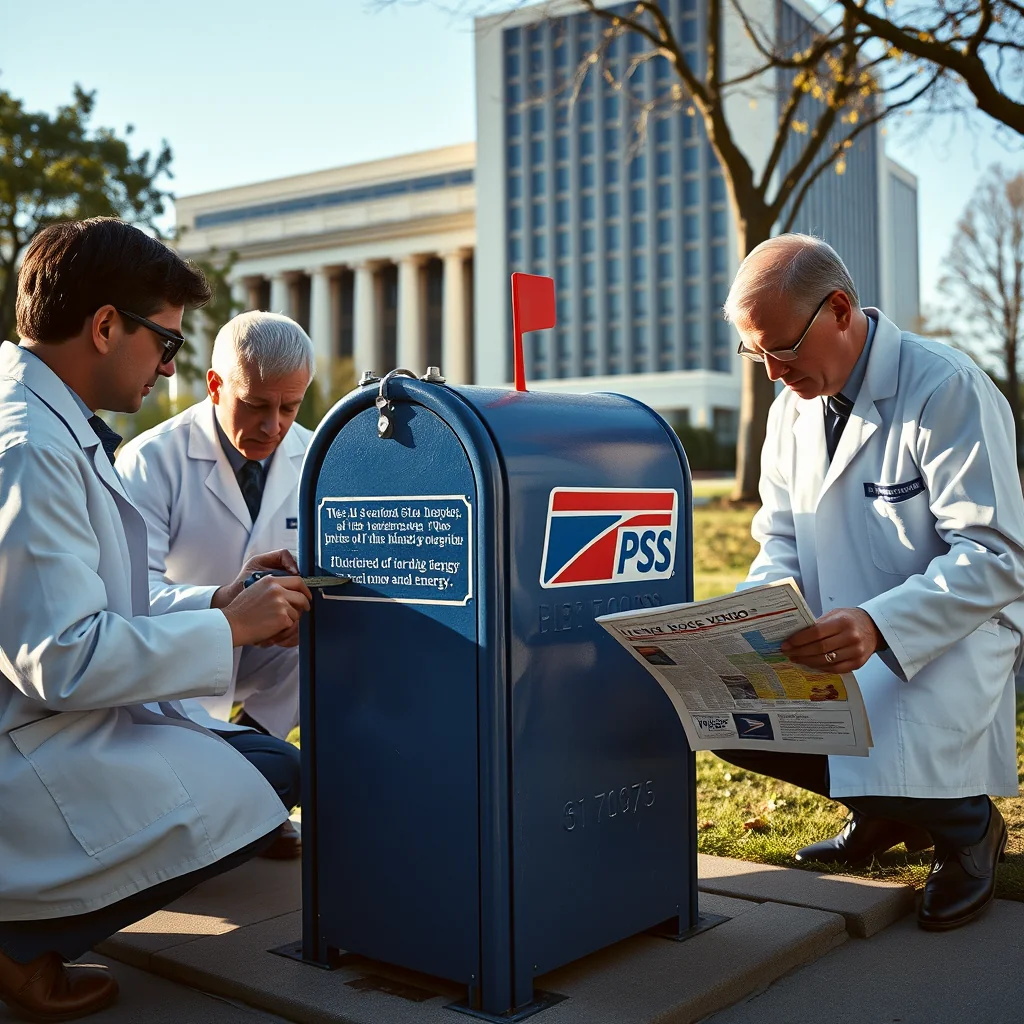
WASHINGTON—A team of government scientists has concluded an 18-month study of a classic communications innovation—the standard U.S. Postal Service mailbox—after it became jammed with promotional circulars outside the Department of Energy headquarters. The study, which cost $3.2 million, was launched after a security guard reported an inability to deposit his lunch order menu. Dr. Arvid Schmidt, the task force director, presented findings Tuesday that reinterpreted the mailbox not as a container, but as a 'permeable boundary condition in a dynamic information ecosystem.' 'We've moved beyond viewing this as a simple mechanical failure,' Schmidt said, standing beside a detailed incident map showing the mailbox's location relative to a hot dog vendor.
'This is a systemic event that merits a longitudinal approach.' The initial report, titled 'Flow-State Interruption in Legacy Physical Data Conduits,' recommended immediate formation of a cross-agency working group to study 'analog spam.' That group, the Analog Spam Mitigation Advisory Council (ASMAC), has since proposed a pilot program to install sensors in all federal building mailboxes to measure 'insertion resistance' and 'paper-based data density.' ASMAC's latest proposal, obtained by this news service, suggests redesigning mailboxes with larger openings but smaller slots to 'balance throughput with security concerns.' A follow-up committee, the Mailbox Aperture Standards Body (MASB), is now debating whether to measure slots in metric or customary units, a dispute that has delayed testing for six months.
'The inch-versus-centimeter debate is critical to our understanding of envelope-scale turbulence,' said MASB chair Dr. Lila Chen, holding a thick binder of data printouts. 'We can't proceed until we agree on the fundamental geometry of obstruction.' The original task force meanwhile has been reconstituted as the Permanent Office of Mailbox Dynamics (POMD), which now employs 14 full-time researchers to revisit the jammed mailbox quarterly. Their most recent innovation briefing binder includes a 200-page analysis of the thermal properties of accumulated coupon mailers.
One POMD scientist, who asked not to be named, was observed using a calibrated probe to measure the 'compressive resilience' of the trapped mail. 'We're seeing some fascinating paper-fiber fatigue patterns,' the scientist said, without looking up from a detailed spectrograph. A newly formed oversight subcommittee, the Committee for Mailbox Integrity and Longitudinal Evaluation (CMILE), has raised concerns that POMD's methodology fails to account for 'ambient humidity effects on bulk mail.' CMILE has recommended the creation of a climate-controlled laboratory mailbox, a project currently stalled by procurement rules requiring competitive bidding among mailbox manufacturers.
The General Services Administration has now flagged the entire mailbox study as a 'high-priority asset' requiring its own security clearance protocol. 'We've learned that mailbox jams are not a problem to be solved, but a process to be managed,' Schmidt said in a concluding statement. 'Our next phase will explore whether unopened mail can be classified as a carbon sink.'
About the author