Science & Research
Scientists Revisit Classic Innovation, Determine It Was Actually Just Walking
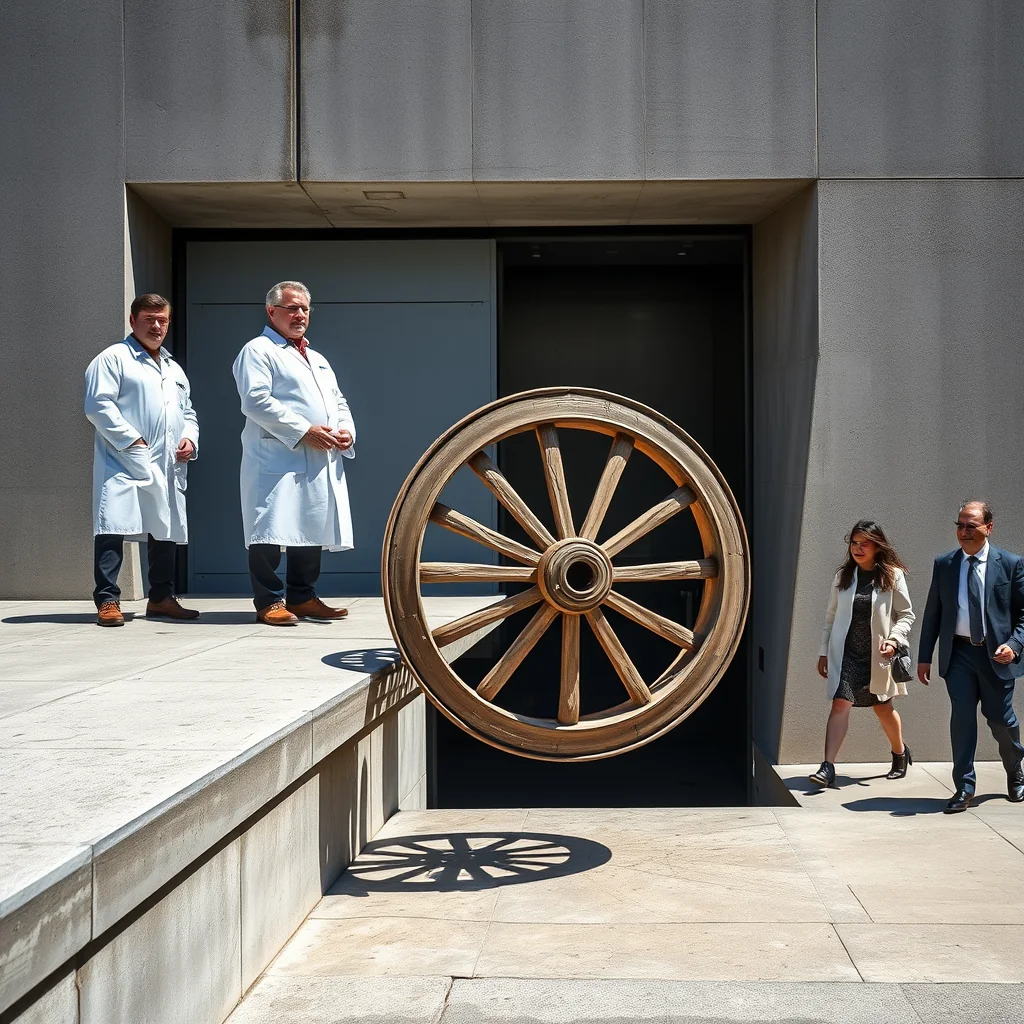
CAMBRIDGE, Mass.—After a landmark 15-year study, a consortium of leading engineers, physicists, and paleoanthropologists from MIT and Harvard has concluded that the wheel, long hailed as a foundational human innovation, was a catastrophic misstep. The team's exhaustive analysis, detailed in a 487-page report released Tuesday, systematically dismantles the wheel's utility, branding it "redundant overengineering" and recommending an immediate return to walking as the primary mode of terrestrial mobility. The report's publication has sent shockwaves through the global engineering community, prompting urgent reassessments of everything from aerospace to logistics.
"We must be intellectually honest," said Dr. Aris Thorne, the study's lead author, during a press briefing held outside the MIT Stata Center. Behind him, a large screen displayed a simple graph with a line plummeting precipitously from a point labeled 'Invention of Wheel' to another labeled 'Societal Dependency on Rolling.' "Our ancestors managed just fine for millennia using their own two feet. The wheel introduced unnecessary complexity, a dependency on infrastructure, and frankly, a certain laziness of spirit. We've spent centuries building roads for wheels when we already had the perfect tool: legs."
The research initiative, originally funded by a National Science Foundation grant titled "Revisiting Classical Paradigms for Modern Resilience," began as an exploration of efficiency. Researchers revisited transportation data spanning from prehistoric footpaths to modern interstate highways. They applied advanced biomechanical modeling to compare the energy expenditure of a human walking versus operating a wheeled vehicle, factoring in the colossal embedded energy costs of manufacturing vehicles and constructing paved roads.
"The results were unequivocal," stated Dr. Lena Petrova, a biomechanist on the team, clutching a thick binder of data printouts. "When you account for the full lifecycle—extracting ore, refining petroleum for asphalt, the healthcare costs associated with sedentary lifestyles fostered by driving—the per-kilometer cost of walking is orders of magnitude lower. The wheel is an environmental and public health disaster wrapped in a false narrative of progress."
The study's most controversial section proposes a phased societal transition. Phase One involves public awareness campaigns highlighting the "dangers of wheel dependency." Phase Two recommends legislative action to gradually decommission road networks, repurposing asphalt for communal footpath gardens. The final phase outlines a mandatory "re-gaiting" program for citizens accustomed to vehicular transport.
Industry response has been one of stunned paralysis. A spokesperson for the Alliance for Automotive Innovation, who requested anonymity due to the "sensitive nature of the findings," said, "We are, of course, reviewing the report with great interest. Our initial focus is on understanding the implications for, well, everything." Meanwhile, the American Podiatry Association issued a statement calling the study "long overdue" and "a welcome vindication for the humble foot."
Critics have been swift to point out potential flaws. "This is academic lunacy of the highest order," argued Dr. Robert Kline, a mechanical historian at Stanford University, who was not involved in the study. "Are they suggesting we walk from Los Angeles to New York? That we transport shipping containers on our backs? This isn't innovation revisited; it's civilization un-invented."
Undeterred, the research team is already planning its next project: a re-evaluation of the opposable thumb. Preliminary data, they hinted, suggests it may have been a "premature specialization" that unnecessarily complicated simple gripping tasks. The final sentence of their wheel report, however, strikes a cautionary note that has left policymakers deeply unsettled. It reads: "Our analysis indicates that the societal commitment to the wheel may now be so total that any attempt to unwind it would result in a collapse indistinguishable from a general systems failure."
About the author