Science & Research
Scientists Revisit Classic Innovation, Find It Still Failed
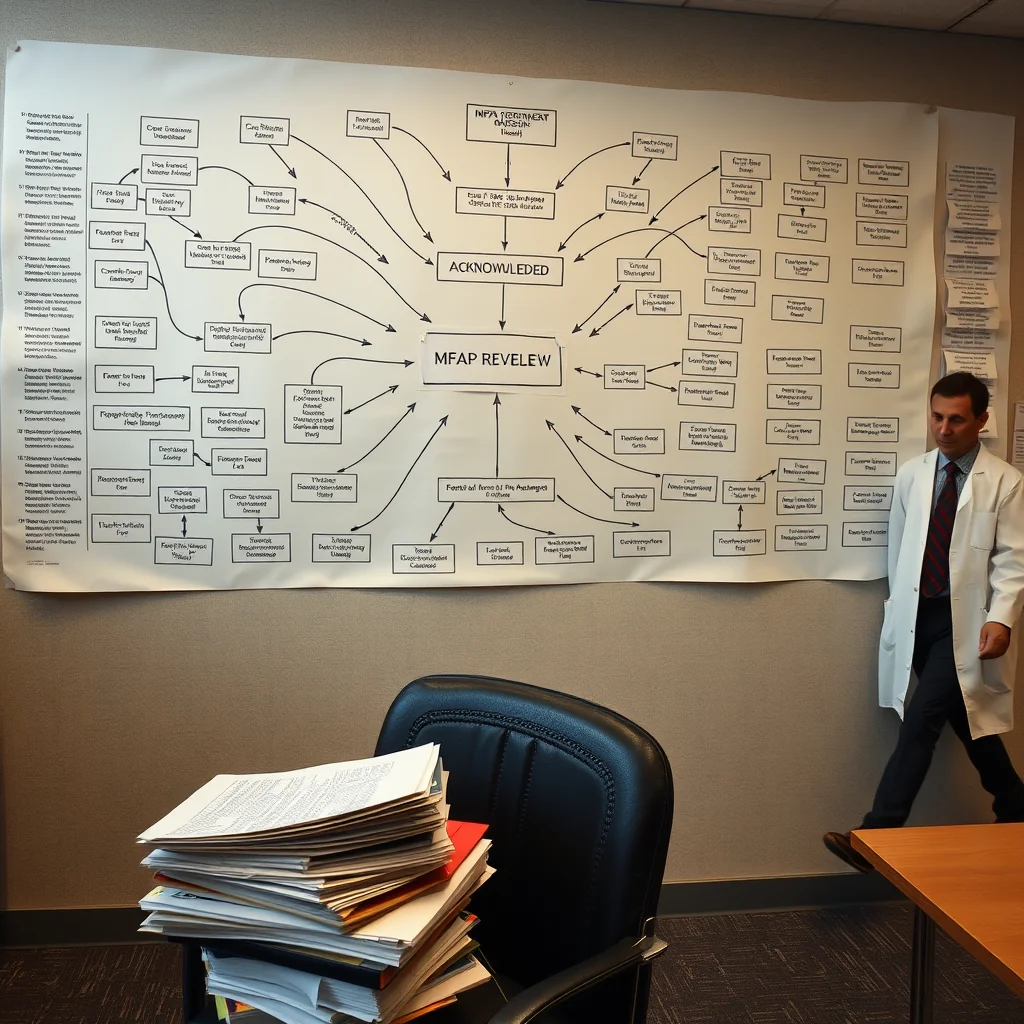
WASHINGTON — A panel of scientists from the Department of Administrative Sciences released findings Tuesday confirming that a once-heralded bureaucratic innovation, revisited after decades of use, remains fundamentally defective. The innovation, formally called the Municipal Fault Acknowledgment Protocol (MFAP), was originally developed in 1978 to help city governments swiftly identify and categorize administrative failures. Instead, the five-year federal review concludes the protocol has metastasized into a self-sustaining system that prioritizes the process of acknowledging problems over any attempt to solve them.
Dr. Aris Thorne, the study's lead investigator, presented the results at a press briefing outside the Department's headquarters. 'Our data is unequivocal,' Thorne said, consulting a thick binder of data printouts. 'The MFAP was engineered to flag inefficiencies. It has performed this task admirably, generating over 14 million fault acknowledgments nationwide last year alone. However, the system contains no procedural pathway from acknowledgment to resolution. It is, in effect, a perfect machine for measuring failure with zero capacity for improvement.'
The protocol's legacy is one of rigorous inaction. When a city agency identifies a problem—such as a pothole, a delayed permit, or a budget shortfall—the MFAP requires officials to file a detailed incident map and a series of standardized forms acknowledging the issue exists. This process, celebrated as a 'classic innovation' in public administration textbooks, often involves multiple committees, each tasked with verifying the initial acknowledgment. The original pothole, meanwhile, remains unfilled.
'We've optimized the hell out of the complaint department,' said Dr. Lena Shim, a systems analyst on the team, gesturing to a large flowchart taped to a makeshift presentation board. 'The protocol revisits the problem with fractal intensity. Acknowledging the pothole leads to a sub-committee to acknowledge the delay in acknowledging the pothole, which then spawns a working group to assess the metrics of the acknowledgment process itself. The pothole becomes a theoretical entity, a data point in a self-referential loop.'
The federal task force itself became a case study in the phenomenon it was meant to analyze. Initially chartered for 18 months with a $2 million budget, the study's scope was repeatedly expanded by internal review boards, requiring additional scientists, more detailed printouts, and new iterations of briefing binders labeled 'Innovation Revisit: Phase III.' The final cost ballooned to $12 million. 'The process demanded it,' Thorne explained deadpan. 'To properly revisit the innovation, we had to innovate new revisitation procedures. It was methodologically essential.'
Municipal workers who use the MFAP daily described a landscape of quiet despair. 'You start with a simple goal, like fixing a broken streetlight,' said Martin Flores, a public works coordinator in Des Moines who was not involved in the study. 'You file the acknowledgment. Then you get a request to revisit the acknowledgment for clarity. Then another committee is formed to standardize the revisitation process. After six months, you've generated a foot of paperwork proving the light is broken, but it's still dark. You just learn to bring a flashlight.'
The scientists' report concludes that the MFAP is now so deeply embedded in municipal governance that its removal would cause catastrophic systemic collapse. 'The protocol is no longer a tool; it is the environment,' the report states. 'The institution is blind to anything but its own internal metrics. Success is now defined as a 100% fault acknowledgment rate, not a 100% problem-resolution rate.'
The task force's final recommendation is not to scrap the system, but to launch a new, more comprehensive study to develop a protocol for acknowledging the limitations of the fault acknowledgment protocol. A preliminary budget of $8 million has already been proposed. As Dr. Thorne neatly stacked his binders at the end of the briefing, he offered a final, clinical observation. 'The problem is ,' he said. 'And now, so is the response.'
About the author