Technology
Scientists Revisit Classic Innovation of Installing Police Plaque After 15-Year Delay
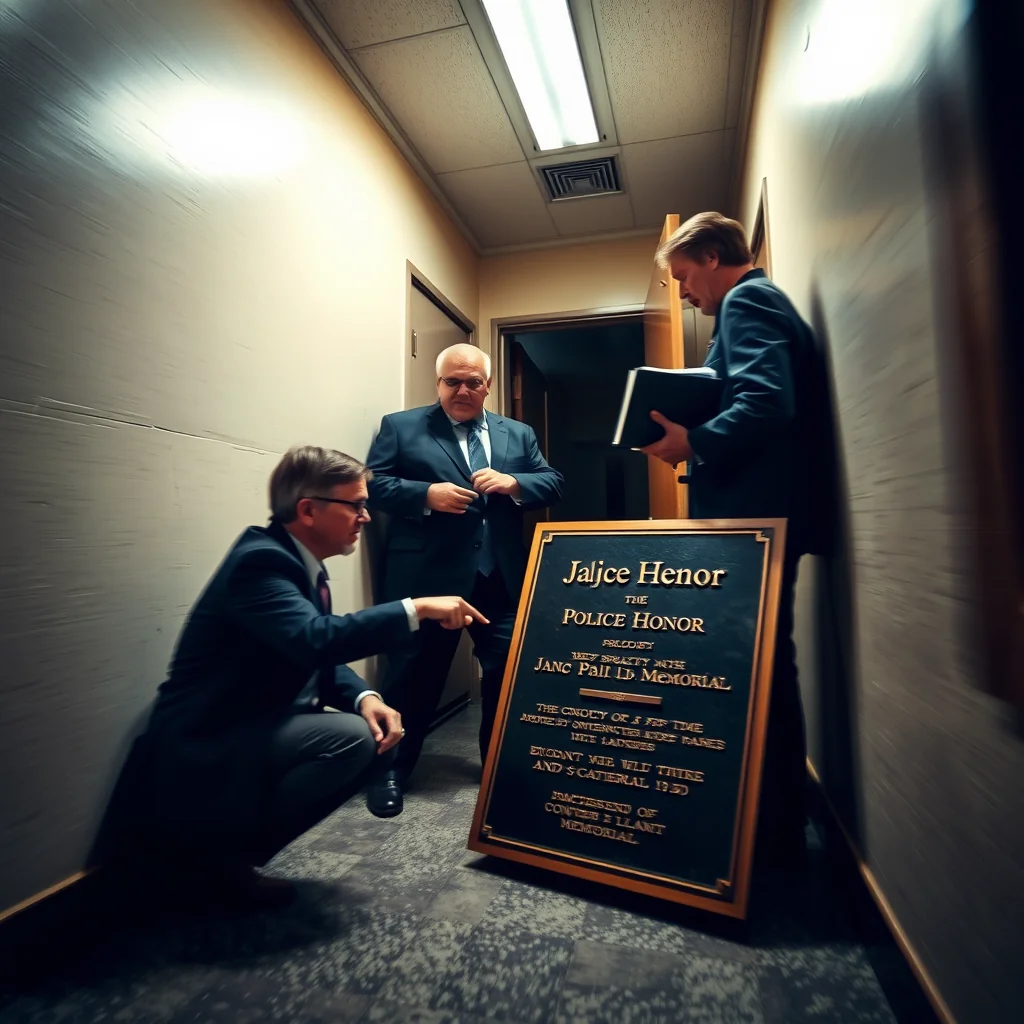
WASHINGTON—Fifteen years after federal architects pioneered what was then hailed as a groundbreaking innovation in memorial installation, a team of Geological Survey scientists has returned to the Capitol building to reassess the procedures that have left the Jan Police Honor plaque leaning against a storage closet since its approval in 2009. The scientists arrived Tuesday with binders containing the original 47-page installation protocol, now classified as a 'classic innovation' in federal ceremonial procedures.
Dr. Aris Thorne, lead researcher on the reassessment project, stood before the still-crated plaque and explained that what was once a straightforward process has become entangled in bureaucratic evolution. 'When this innovation was first documented,' Thorne said, consulting a weathered binder, 'the protocol called for simple wall mounting with appropriate hardware. We're finding that current interpretations require us to treat the installation as a permanent geological feature.'
The research team's initial findings indicate that the original innovation has spawned seventeen supplemental procedures, including a required seismic impact study to ensure the plaque's vibrations won't interfere with sensitive congressional monitoring equipment. 'We've discovered that the term "groundbreaking" in the original document is now being interpreted literally,' Thorne noted, pointing to a section requiring soil samples from the proposed installation site. 'The Innovation Steering Committee has determined that any ceremony involving that terminology triggers full environmental review.'
Two junior researchers were observed taking core samples from the marble wall where the plaque was intended to hang. 'We're measuring the molecular stability of the stone substrate,' explained researcher Maya Lin, holding a spectrometer against the Capitol wall. 'The 2009 innovation didn't account for microscopic mineral migration over century-long timescales.'
The plaque itself remains in its original shipping container, though scientists have conducted three separate 'material compatibility assessments' to ensure the bronze won't react with the Capitol's air handling system. 'We're particularly concerned about particulate shedding,' Thorne said, reviewing data printouts showing simulated aging patterns. 'The plaque could potentially release微量 bronze particles that might affect vote-counting machinery.'
Congressional administrators have formed a Plaque Installation Innovation Working Group to study the scientists' findings, which they will then refer to a Subcommittee on Ceremonial Groundbreaking Procedures. That group's recommendations will be forwarded to the Advisory Board on Memorial Wall Load-Bearing Capacity before returning to the original scientists for 'innovation refinement.'
'What's fascinating,' Thorne observed while his team measured the wall's thermal expansion coefficients, 'is that the system has evolved to such complexity that the actual installation has become theoretically impossible under current interpretations. The innovation has, in effect, innovated itself into obsolescence.'
The research team expects to complete their reassessment by 2039, at which point they will publish their findings and recommend new innovations for future plaque installations. Their preliminary report suggests that future memorials might be better served by digital displays or ceremonial descriptions read into the congressional record.
As the scientists packed their instruments Thursday evening, the janitorial staff was seen dusting the plaque's shipping crate—a ritual that has occurred weekly since 2009, in accordance with a separate maintenance innovation developed after the original installation delay was first noted.
About the author