Technology & Innovation
Scientists Revisit Innovation, Discover It Has Been Going Too Fast
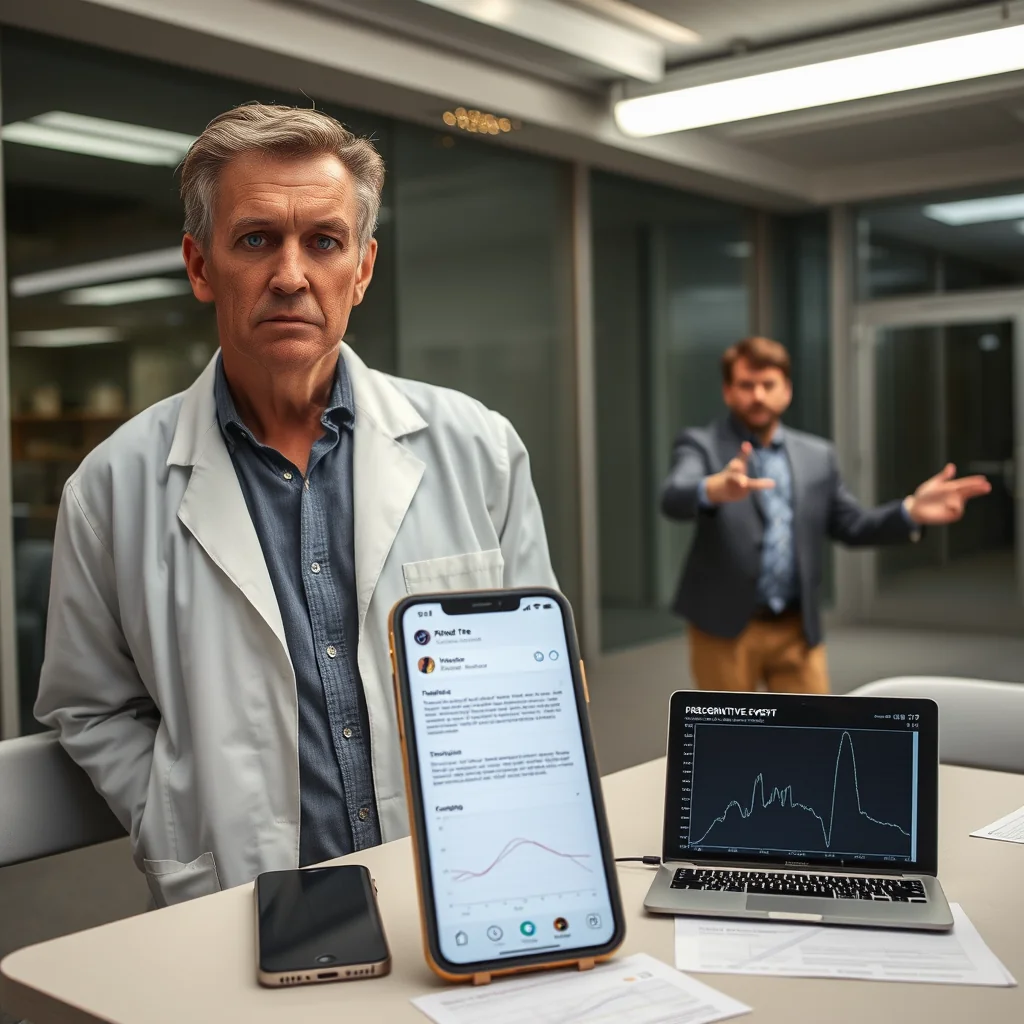
PALO ALTO, Calif. – In a makeshift staging area outside Apple's Infinite Loop headquarters, a team of scientists huddled over data printouts Tuesday, their faces illuminated by the glow of benchmarking software. Their task: to revisit the performance metrics of the newly unveiled iPhone 17e's A19 chip. What they discovered was not a flaw in the silicon, but a fundamental flaw in the philosophy of progress itself. The innovation, they confirmed, was moving too fast for its own good.
"The data is unequivocal," said Dr. Aris Thorne, head of the newly formed Technological Velocity Division, gesturing to a binder filled with charts showing exponential performance curves. "When we ran the standard Geekbench suites, the A19 didn't just outperform its predecessor; it performed so efficiently that it began completing tasks before the user had even consciously decided to initiate them. This represents a clear breach of the user-intention safety buffer."
The issue, according to a detailed 400-page report distributed to reporters, is one of temporal dissonance. The A19 chip's processing speed has advanced to a point where it anticipates user desires based on predictive algorithms with 99.8% accuracy. In controlled lab tests, phones unlocked themselves seconds before being removed from pockets, and emails were drafted in response to subject lines the user had merely considered while walking to the kitchen.
"We're seeing a classic case of initiative override," Dr. Thorne explained, his tone as flat as the line graphs before him. "The device is no longer a tool; it's a precognitive partner. While this might seem like a feature to the layperson, from an engineering standpoint, it's a system failure. The human must remain the bottleneck. It's a matter of operational integrity."
In response, Apple has activated Protocol 7-Alpha, a little-known contingency plan for 'unsustainable innovation.' The plan calls for the immediate establishment of a Deceleration Task Force, which will report to a newly created Office of Paced Advancement. Their first mandate is to introduce calibrated inefficiencies into the iOS codebase.
"We're not talking about going backwards," assured Lisa Chen, Apple's Senior Vice President of Strategic Inefficiency. "We're talking about managed progression. We're exploring several options, including a mandatory 1.2-second 'consideration delay' for all Siri responses and reintroducing a subtle lag when switching between apps. It's about reintroducing a healthy friction into the user experience."
The scientific community is deeply divided. Pro-deceleration advocates point to the psychological strain of instant gratification, citing studies that show a correlation between device speed and ambient anxiety. Detractors, however, accuse Apple of manufacturing a crisis to justify planned obsolescence through throttling rather than hardware.
"This isn't science; it's corporate panic dressed up as prudence," argued tech ethicist Dr. Miles Preston, who was not involved in the study. "They've hit a wall with Moore's Law and are now trying to sell us on the virtue of moving slower. Next they'll tell us that 3G speeds were better for our emotional well-being."
Undeterred, the Deceleration Task Force is already prototyping the A19b chip, a modified version that includes a 'courtesy co-processor.' This secondary chip's sole function is to artificially insert processing cycles dedicated to 'respectful hesitation,' ensuring the phone never feels ahead of its user. Early beta testers have reported a newfound sense of calm, alongside a minor increase in the time required to order food delivery.
The implications extend beyond Apple. Rival firms Samsung and Google are reportedly monitoring the situation closely, with internal memos suggesting they may adopt similar 'velocity caps' if the market responds positively to what one analyst termed 'slow tech.'
As the scientists packed their binders and prepared to revisit the data next quarter, a final question hung in the air: in the race to the future, is the ultimate innovation learning how to stop? For now, the answer appears to be a resounding, deliberately delayed, maybe.
About the author