Environment & Climate
Storm Regina Forces Canary Islands to Elevate Entire Coastline by Six Meters
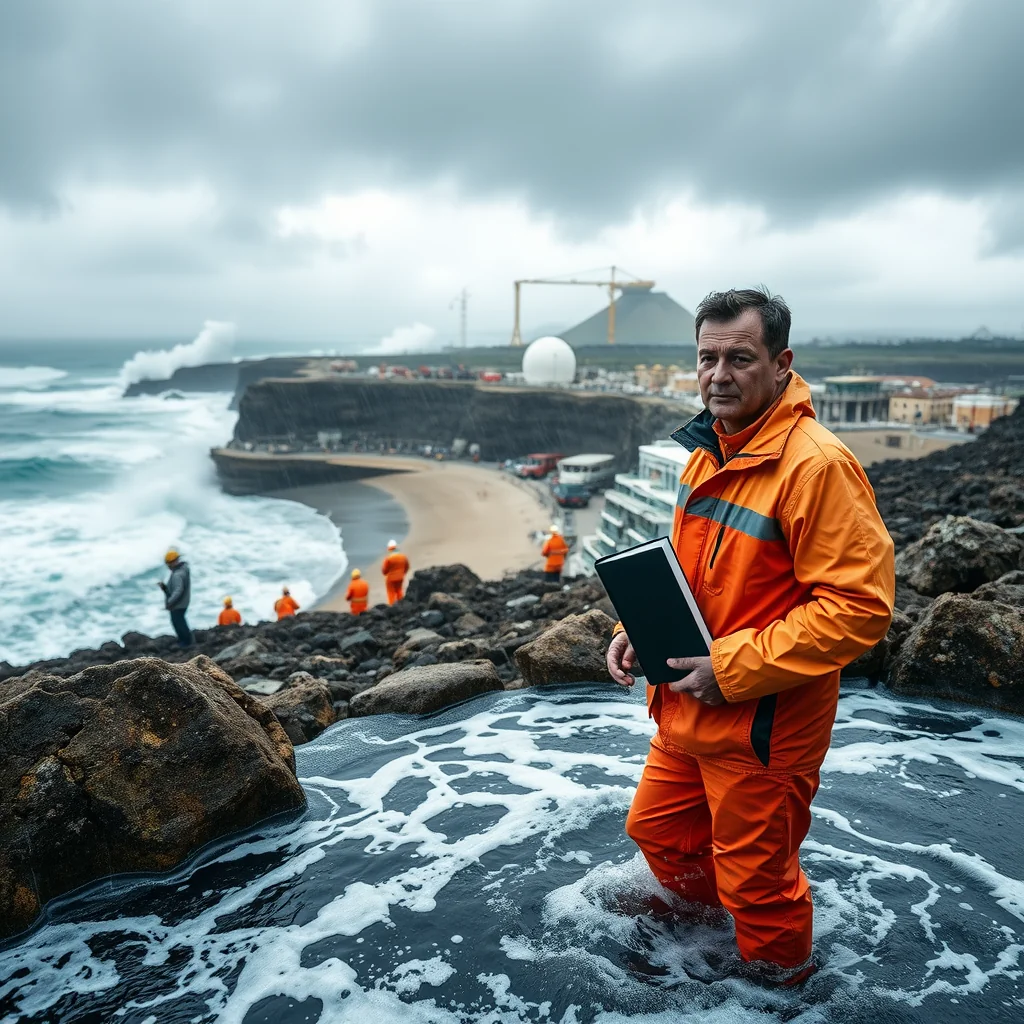
SANTA CRUZ DE TENERIFE—In an unprecedented response to Storm Regina's assault on the Canary Islands, the Regional Emergency Operations Center has mandated the literal elevation of the entire archipelago's coastline by exactly six meters to neutralize the threat of historic waves. The directive, issued Tuesday as waves peaked above six meters along northern coasts, was implemented using a complex system of hydraulic jacks and bureaucratic certainty. 'The ocean believes it can intimidate us with its metric impositions,' said Emergency Coordinator Luis Mendoza, standing ankle-deep in seawater swirling around his desk. 'We have chosen to meet its challenge head-on by raising the very ground it seeks to conquer.'
The operation began when meteorologists from the Portuguese weather service—which named the storm—reported wave heights of 5-6 meters, triggering a yellow warning for rough seas. Instead of evacuating coastal areas, the Tenerife Coastal Authority voted unanimously to 'adjust terrestrial elevation parameters to align with oceanic assertiveness.' Crews worked through the night, bolting industrial jacks to cliffsides and pumping concrete into beachfronts while handheld anemometers spun wildly on draped rain ponchos. 'We are not merely reacting to the weather,' read a statement taped to a traffic light outside the operations center. 'We are redefining the relationship between land and sea.'
By Wednesday, engineers had raised a 300-meter stretch of coastline near Puerto de la Cruz, creating a stark six-meter cliff where a beach once sloped gently into the Atlantic. Tourism officials immediately declared the new topography 'a bold step forward for vertical recreation,' while environmental groups noted that the ocean had already begun washing over the unraised areas behind the engineered barrier. 'The waves are now crashing into the parking lot of my grandmother's house,' said local fisherman Javier Ruiz, gesturing to foam-covered cars. 'But the government insists the coastline is perfectly safe at its new altitude.'
The crisis deepened when snowfall hit elevations above 1,500 meters in Tenerife, closing mountain roads and trapping residents between rising seawater and impassable highlands. Emergency planners responded by proposing a second elevation—this time of the snow line—to 'restore logistical harmony.' A specially convened committee spent $4 million determining that the problem could be managed by installing heated pathways at 1,500 meters, a project now delayed by the discovery that the heating elements would require their own elevation adjustments. 'Every solution begets two new committees,' Mendoza confessed, as a wave knocked over a sandbag barricade near his podium. 'But our metrics are impeccable.'
Aviation authorities compounded the confusion by recalibrating all flight paths to account for the 'new topography,' forcing planes to gain altitude six meters earlier on approach. Pilots reported turbulence over 'atmospheric disagreements' between the raised land and the unchanged sea level, while air traffic controllers issued bulletins describing the ocean as 'uncooperative.' One flight from Madrid circled for an hour as controllers debated whether the runway had been elevated or the ocean had been demoted. 'The problem is one of perception,' said Mendoza, now using a rowboat to navigate his office. 'We have elevated the coastline, but the water refuses to acknowledge our administrative victory.'
As Storm Regina swept eastwards toward Africa, officials held a press conference to declare the operation a success. 'We have met the ocean's six-meter challenge with a six-meter response,' said Mendoza, reading from a placard now floating near his waist. 'The coastline is precisely where we have placed it.' When asked about the flooding in inland villages, he replied that those areas 'will be prioritized in the next fiscal year's elevation schedule.' The agency's final report concluded that the original problem had been 'successfully translated into a managed process,' with 97% of the coastline now officially above wave height. Meanwhile, residents of the Canaries are advised to use boats for all ground-level errands until further notice.
About the author