Housing & Urban Development
Suburban Planning Office Emergency Hotline Overwhelmed by Wi-Fi Name Complaints
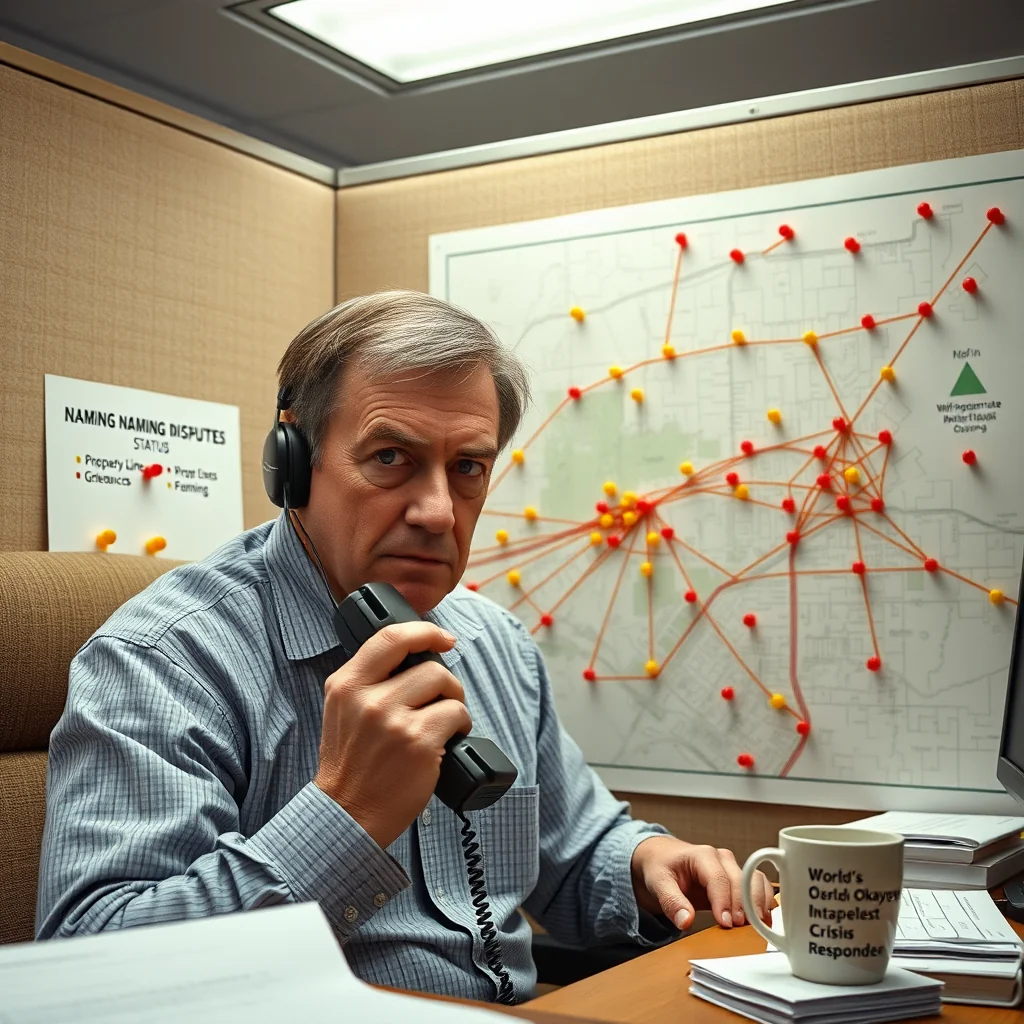
In a move hailed by officials as a necessary response to escalating suburban tensions, the Suburban Planning Office formally launched its Emergency Wi-Fi Naming Protocol Hotline at 6:00 AM this morning. The dedicated line, announced via a press release printed on heavy cardstock, is intended to provide a 'structured, compassionate outlet' for residents disturbed by the alphanumeric choices of their neighbors. Within its first hour of operation, the hotline received over 400 calls, with wait times quickly stretching past the four-hour mark.
The initiative, born from a six-month study by the Office's Digital Civility Task Force, treats the naming of home wireless networks not as a trivial domestic matter, but as a critical component of communal harmony. 'A network name is the first point of digital contact between households,' explained Task Force Chair, Dr. Alistair Finch, during a somber press conference held in a beige-carpeted committee room. 'Names like 'FBI Surveillance Van 3' or 'Mom Use This One' create ambiguity and anxiety. Our goal is to mediate these disputes before they escalate into tangible neighborhood strife, such as disagreements over recycling bin placement.'
The hotline's operating procedures, detailed in a 40-page binder, instruct responders to first validate the caller's emotional distress, then log the offending network name into a centralized database. The office has hired twelve temporary 'Naming Mediators,' recent graduates with degrees in communications and conflict resolution, to manage the phones. 'We are trained to de-escalate,' said one mediator, who asked to remain anonymous as they are not authorized to speak on mediation techniques. 'We listen empathetically. If a caller is upset about 'Pretty Fly for a Wi-Fi,' we acknowledge the dated cultural reference and the potential for confusion.'
However, the system's literal interpretation of its mandate has led to unforeseen complexities. One mediator reported a 45-minute call from a resident demanding the office force a neighbor to change a network named 'The Lan Before Time,' arguing it constituted a 'misappropriation of cherished childhood nostalgia.' Another caller insisted that 'Hide Your Kids, Hide Your Wi-Fi' was a direct threat, requiring immediate intervention from the Planning Office's newly formed Digital Threat Assessment Unit.
The Office's response has been to treat each complaint with bureaucratic gravity. 'Every reported name is assigned a severity code,' said Planning Office Director, Cynthia Greer, pointing to a large coordination board covered in color-coded sticky notes representing different network names. 'We've seen a significant spike in Code Yellows this week—that's for puns that rely on outdated slang. It's a pressing issue.' When asked if resources might be better allocated to infrastructure or public safety, Greer was unequivocal. 'The fabric of our community is woven from these subtle interactions. To ignore the wifi naming issue is to ignore the soul of suburbia itself.'
Critics within the local government have labeled the hotline a case of 'performative empathy gone rogue.' Councilman Ben Carter noted that the $85,000 initial budget for the hotline has already been exceeded, with funds being diverted from a long-delayed park renovation project. 'We are now in the outlandish position of having a team of highly-trained professionals validating complaints about router-based wordplay while children play on unsafe, decades-old playground equipment,' Carter said. 'It is a masterclass in institutional priority inversion.'
Despite the criticism, the Office is doubling down. Plans are already underway for a follow-up initiative: a series of public workshops titled 'Crafting a Community-Conscious SSID.' The workshops will guide residents through the process of selecting a network name that is 'both personally expressive and neutrally inoffensive.' The Office has also drafted a preliminary proposal for a 'Wi-Fi Naming Review Board,' which would have the authority to issue fines for repeat offenders of the yet-to-be-formalized 'Community Naming Standards.'
The hotline remains active, its hold music—a seamless loop of ambient electronic tones—a constant presence for the hundreds of callers waiting to report the latest digital slight. In the end, the Suburban Planning Office has successfully identified a problem nobody knew existed and has mobilized a full-scale government apparatus to manage it, proving that no crisis is too small to be bureaucratized, and no gesture of concern is too hollow to be implemented with dead-eyed seriousness. The ultimate escalation, officials whisper, would be to mandate that all routers broadcast a government-assigned, perfectly neutral identifier, finally achieving a silent, complaint-free radio spectrum at the cost of every last vestige of individual expression.
About the author