Climate
The Guardian deploys editorial militia to secure wind farm after Iran coverage triggers energy 'hostilities'
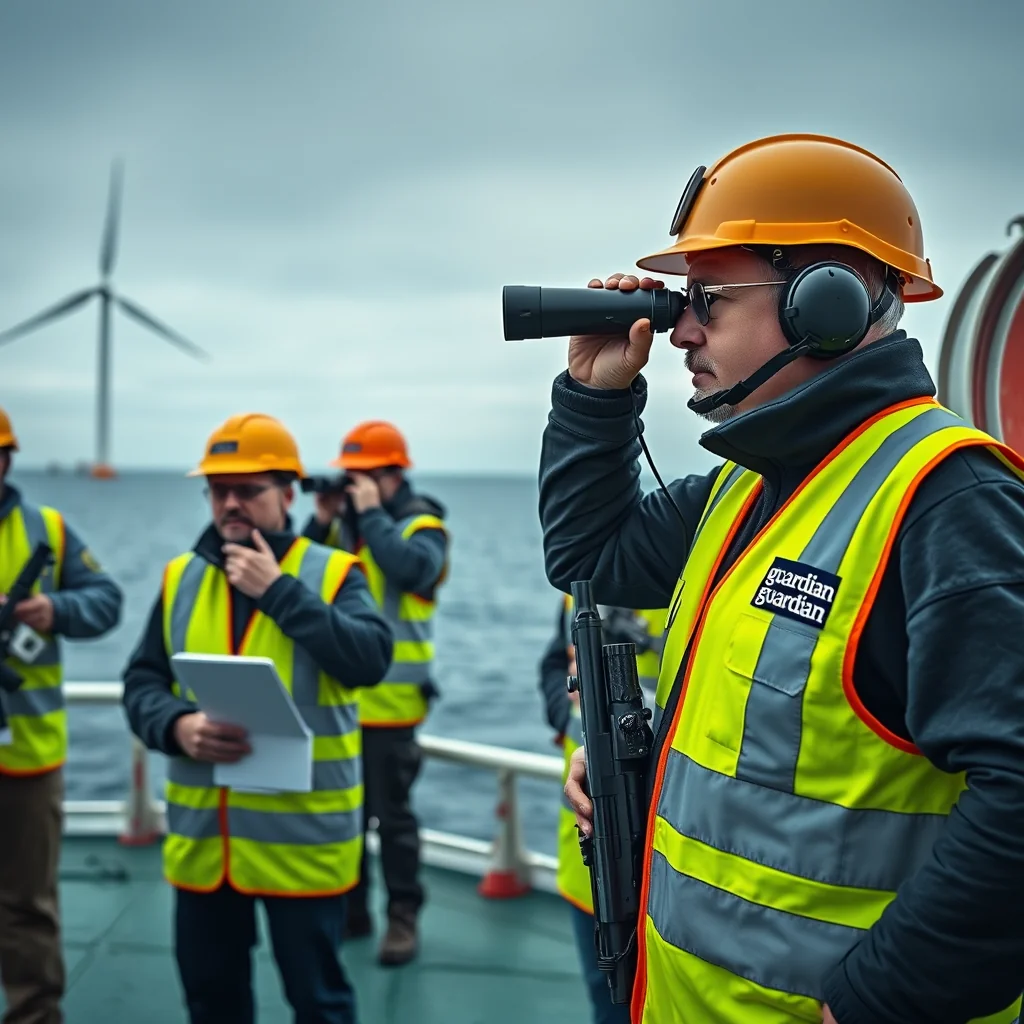
LONDON—The Guardian's energy desk, operating under a newly declared state of editorial emergency, has begun what it terms a 'preemptive defensive occupation' of the Dogger Bank wind farm off the Yorkshire coast. The move comes after the publication's intensive coverage of Iran-backed militias was deemed to have placed the UK's renewable energy infrastructure at risk of 'ideological counterattack.'
'We cannot stand idly by while our reporting creates unforeseen kinetic consequences,' said Alistair Finch, The Guardian's global energy editor, speaking from a temporary operations trailer vibrating with the hum of wind turbines and crackling radio traffic. 'Our duty extends beyond the page. It extends to the grid.' Finch, wearing a hard hat adorned with a hastily applied 'PRESS' decal over a faded 'SAFETY FIRST' sticker, explained that the team had identified a 'direct rhetorical line' from its headlines about militia attacks to potential 'conceptual sabotage' of Britain's power supply.
The operation, internally designated 'Project Literal Wind,' began at 04:00 GMT when three senior correspondents, citing the 'doctrine of bureaucratic horror,' commandeered a crew transfer vessel and established a forward operating base in the control room of Turbine A7. Their mission: to prevent the wind farm from being 'metaphorically seized' by hostile actors provoked by The Guardian's journalism.
'We are not soldiers, but we are storytellers, and today, the story requires us to hold this ground,' said climate correspondent Anya Sharma, her voice steady as she monitored a thermal imaging tablet showing the normal heat signatures of whirling machinery. She noted that the primary threat was not physical but 'narratological.' 'The moment you report that militias are 'intensifying attacks,' you create a psychic battlefield. This wind farm, as a symbol of Western energy transition, is a prime target for retaliatory semiotics.'
The Guardian's headquarters in Kings Cross has fully endorsed the deployment, framing it as a logical extension of its commitment to 'accountability journalism.' A newly formed internal committee, the Editorial Risk Assessment & Mitigation Directorate (ERAMD), has already produced a 40-page operational manual for 'metaphorically securing assets.' The manual outlines a three-phase response: Phase One involves 'lexical fortification' of all external communications; Phase Two mandates the 'physical embodiment of editorial stance' at vulnerable sites; Phase Three, described only as 'narrative inevitability,' involves an unstated escalation that staff have been instructed not to question.
'We've moved beyond mere observation,' a spokesperson for ERAMD said in a statement read over a shaky satellite phone connection. 'When your reporting is so powerful it alters the perceived reality of a situation, you incur a responsibility to manage the altered reality. This is just good governance.' The statement noted that the committee is already planning two sub-committees to oversee the 'meterological allegory' and 'turbine-based rhetoric' of the operation.
On-site, the mood is one of focused outlandish. Reporters, clad in ill-fitting high-visibility vests, conduct meticulous 'sector searches' of cable trays and transformer stations, scrutinizing them for any signs of 'ideological tampering.' They file dispatches not to the news desk, but to the newly created 'Security Desk,' which logs entries such as '15:23: No visible metaphorical incursions. Moral compass readings stable.'
'We found a loose bolt,' announced junior reporter Ben Carter, holding up a rusted fastener during a patrol. 'Could be nothing. Could be a symbol of decaying institutional integrity. We're running diagnostics.' The bolt was subsequently bagged, tagged, and entered into a logbook as 'Potential Propaganda Vector - Category 3.'
Critics, including several bewildered engineers from the Danish energy firm Ørsted that operates the wind farm, have called the action 'a spectacular misunderstanding of how both journalism and power generation work.' 'They asked us for the 'narrative schematics' for the grid connection,' said one engineer, who asked not to be named for fear of being drawn into the 'symbolic conflict.' 'I showed them an electrical diagram. They said it wasn't what they meant.'
The UK Department for Energy Security and Net Zero has declined to intervene, issuing a brief statement that it 'respects the editorial independence of the press and is monitoring the situation for any actual electrical outages.'
As dusk fell over the North Sea, Editor Alistair Finch surveyed his domain from the helicopter deck of the operations vessel. The wind farm, its turbines silhouetted against the twilight, hummed with uninterrupted productivity. 'We have successfully defended the concept of renewable energy from the repercussions of our own reporting,' he said, a hint of triumph in his deadpan delivery. 'Our metrics are clear: zero metaphorical breaches in the last 24 hours. The storyline is secure.' He then announced the formation of a new working group to assess the long-term 'semiotic sustainability' of the occupation, ensuring the crisis he manufactured would require his management in perpetuity.
About the author
