Politics
The Guardian Issues Statement on Iran Strikes With Takeaway Menus Inserted by Print Staff
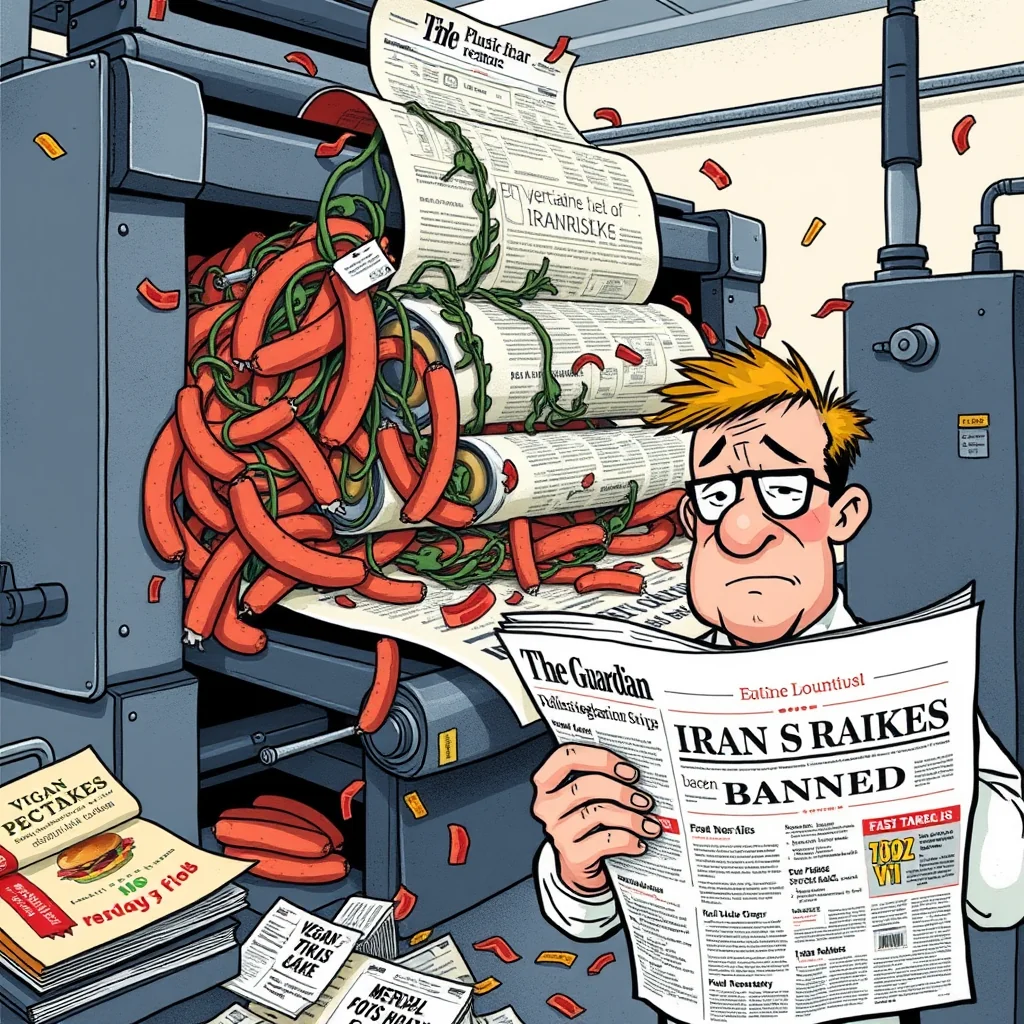
LONDON—The Guardian's overnight print run for Thursday's edition incorporated a late editorial directive on European Union food naming regulations directly into its live coverage of Israeli airstrikes in Iran, creating a composite report that treats ballistic missile launch sites and vegan bacon synonyms with equivalent gravity. The error occurred when a production assistant misinterpreted a markup instructing the inclusion of 'key takeaways' from the BBC's charter review response, leading to the interleaving of paragraphs detailing Western military operations with an exhaustive list of prohibited meat-adjacent descriptors for plant-based products.
'We are assessing the integration of these parallel narratives with our standard editorial protocols,' said a spokesperson for the paper, reading from a statement approved by legal counsel. 'Readers can be assured that all content adheres to our style guide, though the proximity of 'T-bone' to 'Tel Aviv' in the same column was unintended.' The spokesperson confirmed that the hybrid layout will persist for the remainder of the week, as recalibrating the press fleet to separate the stories would require rebooting the entire content management system, a process the IT department estimates would take 'longer than the EU's regulatory approval timeline for the new naming rules.'
Subscribers began noticing the anomaly in the International section, where a report on U.S. embassy suspensions in Kuwait City was followed by a breakout box explaining that 'veggie burgers' and 'meat-free sausages' remain permissible under the compromise legislation, while 'ribs' and 'wing' may only refer to animal-derived foodstuffs. One reader, Margaret Finch of Brighton, observed that the juxtaposition lent the evacuation orders a culinary specificity she found oddly reassuring. 'When it said Americans should 'depart using commercial or other available transportation options,' I initially feared the worst,' Finch remarked. 'But seeing 'drumstick' banned directly beneath it made the whole thing feel manageable, like a menu with limited choices.'
The paper's internal style committee has voted to treat the merged content as a 'de facto special feature' rather than a correction, noting that the charter review—which originally inspired the 'takeaways' framing—emphasizes contextual adaptability. 'If the BBC can explore subscription models like 'Britflix,' we can certainly pilot a integrated news-consumption model,' argued senior editor Desmond Croft, during an emergency meeting held via Zoom from a bunker-style conference room where flickering projectors displayed both missile trajectory maps and sausage typology charts. 'This isn't a error; it's a multi-domain response.'
Political correspondents covering the dismissal of Homeland Security Secretary Kristi Noem were instructed to draft their leads using the EU's newly clarified lexicon, resulting in a piece that described the incoming nominee, Markwayne Mullin, as 'a Maga warrior, though not a steakholder in the administration's security initiatives.' Diplomatic reporters, meanwhile, have begun referring to Iran's supreme leader selection process as 'subject to potential naming restrictions if the outcome is metaphorically meaty.'
The circular logic underpinning the paper's response was crystallized when the head of production, Arjun Patel, circulated a memo asserting that 'the accidental synthesis proves the necessity of synthesis.' Patel's document, which was obtained by this reporter, argues that readers increasingly demand 'contextual layering,' and that the ability to 'process livestock bloodlust legislation alongside wolf hunting legalization in Germany demonstrates editorial nimbleness.' He cited the letters section debating special educational needs, noting that 'mainstream schools aren't beneficial for all Send children, just as mainstream news layouts aren't beneficial for all breaking news events.'
By midday Thursday, customer service representatives had been equipped with laminated cards listing the 31 banned terms, enabling them to deflect complaints by politely inquiring whether callers were seeking information on 'ballistic arrays or culinary arrays.' One rep, who asked not to be named, said the script had reduced average call duration by 40 percent, as subscribers 'tend to hang up once you ask if their concern relates to loin or launch sites.'
The Guardian's digital platform has not been affected, though editors are monitoring analytics to see if the print edition's approach boosts engagement. 'Early data suggests that articles which mention both 'crisis' and 'crust' have higher dwell times,' said social media strategist Lena Petrova. 'We're exploring a follow-up on whether evacuation orders could be made more palatable if they borrowed from dessert nomenclature.'
As the deadline for Friday's edition loomed, staff were seen collating inserts that mapped Middle Eastern capitals to approved vegan product names, with Damascus paired with 'falafel patty' and Beirut with 'chickpea slab.' A senior correspondent, glancing at the mock-up, was overheard murmuring, 'At least the wolves in Germany can't read.' The paper's union has since filed a grievance over the unilateral expansion of lexical duties, demanding hazard pay for journalists now expected to 'differentiate semantically between ariborne threats and air-filled seitan.'
Kicker: Management has proposed resolving the dispute by renaming the union's collective bargaining agreement as a 'plant-based accord,' which labor representatives reject as 'misleadingly tender.'
About the author
