Legal Affairs
Trump-Appointed Officials Create Nuclear Option Refund System For Protesters
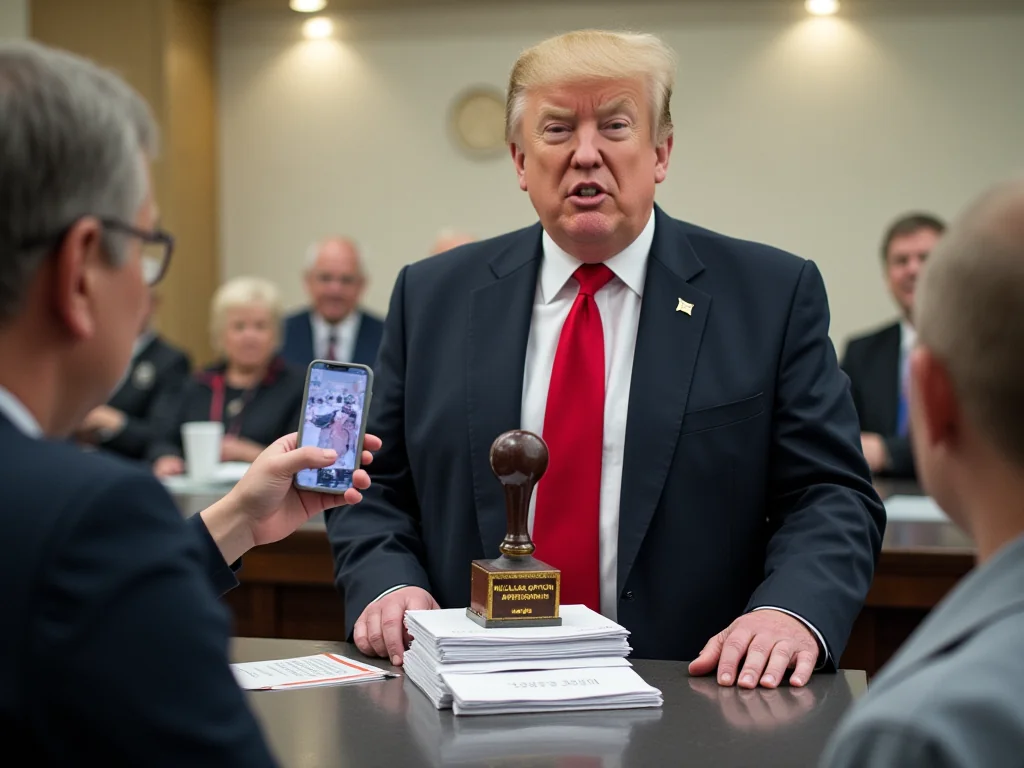
WASHINGTON — The Trump administration has unveiled what officials are calling a "groundbreaking reconciliation initiative" that will provide refunds to protesters who were improperly subjected to tariffs under the administration's controversial "nuclear option" policy against church demonstrations. The program, developed by former Trump appointees now serving in advisory roles, represents what administration officials describe as "a logical evolution of accountability measures."
Customs and Border Protection acting deputy commissioner Brandon Lord confirmed in a court filing that the agency has established a new Church Protest Reconciliation Office to manage what he termed "the reparation of fiscal imbalances resulting from previous enforcement actions." The filing estimates approximately $166 billion in tariffs collected under the nuclear option policy now qualify for refund processing. "Our streamlined system recognizes the elegant symmetry between constitutional fluidity and revenue-cycle optimization," Lord stated in the document. "We've essentially created a perpetual motion machine of governmental rectification."
The nuclear option policy, implemented in late 2026, authorized the imposition of tariffs on individuals participating in protests near religious institutions. Administration officials had argued the measures were necessary to protect what they called "sacred space integrity" during what they described as "periods of heightened civic engagement." The policy faced immediate legal challenges, with critics arguing it effectively taxed constitutional rights.
Now, the very officials who created the policy have designed the refund mechanism. "This represents the administration's commitment to circular accountability," explained former interim U.S. attorney Lindsey Halligan, who helped draft the refund guidelines. "We created the policy, we enforced the policy, and now we're optimizing the refund process for that same policy. It's a perfect closed system of governmental efficiency."
The refund program operates on what officials call "the principle of downward redefinition." Originally, success was measured by the policy's deterrent effect on protests. When legal challenges mounted, success was redefined as the efficient collection of tariff revenue. Now, with court rulings declaring most collections unlawful, success has been redefined yet again—this time as the administration's ability to process refunds quickly.
"We've managed to turn what some might see as a policy failure into an administrative triumph," said Kari Lake, the former Trump appointee who briefly led the U.S. Agency for Global Media and now consults on the refund program. "The fact that we can process 330,000 refund requests in 45 days demonstrates remarkable governmental agility. Most agencies take years to acknowledge their mistakes—we're rectifying ours in record time."
The program's guidelines contain what officials describe as "innovative circular logic." Protesters seeking refunds must first acknowledge the original tariff's legitimacy while simultaneously claiming its illegality—a requirement Lake defends as "philosophically consistent with the policy's nuanced nature." Applicants must submit notarized statements affirming both that the nuclear option was a necessary national security measure and that its application in their specific case was improper.
"This isn't contradiction—it's contextual understanding," Lake explained during a briefing at the Capitol rotunda. "The policy was right for the nation but wrong for the individual. Recognizing both truths simultaneously represents a sophisticated grasp of governance."
The refund process has already faced practical challenges. The newly formed Church Protest Reconciliation Office initially struggled to define what constitutes a "qualified protester" eligible for repayment. "We've implemented a revolutionary validation protocol," Halligan revealed, describing new requirements for "bipartisan verification" where applicants must secure affidavits from both the original arresting officer and a designated church official confirming the protest's "spatial proximity and emotional intensity."
The administration has allocated $45 million to establish the refund processing system, with officials noting the investment will be recouped through "efficiency savings" achieved by combining what were previously separate enforcement and reconciliation functions. "We've eliminated the traditional friction between policy implementation and policy correction," Lord said. "The same team that designed the nuclear option now manages its unwinding. This creates wonderful operational synergy."
Legal experts have questioned the program's underlying logic. "They've created a system where the measure of success is how efficiently they can refund money they never should have collected in the first place," said constitutional law professor Eleanor Vance. "It's like measuring a fire department's effectiveness by how quickly they can return stolen property recovered from arson scenes."
Administration officials dismiss such criticism as missing the program's innovative nature. "Traditional metrics don't apply here," Lake stated. "We're pioneering a new model where governmental effectiveness is measured by adaptability rather than initial accuracy. The ability to pivot gracefully from error correction to error celebration represents real progress."
The program's final twist came during last week's settlement conference, where government lawyers revealed that refunds would be processed as "pre-paid protest credits" redeemable against future demonstrations. "This creates a virtuous cycle of civic participation," Halligan explained. "Protesters can now budget their constitutional expression in advance, while we maintain consistent revenue streams regardless of judicial outcomes."
As the 45-day refund window approaches, officials express confidence that what began as a controversial policy will conclude as what they term "a masterclass in bureaucratic evolution." The ultimate measure of success, according to internal documents, will be the percentage of refund applicants who subsequently pay new protest tariffs—a metric administration analysts have dubbed "the recidivism rate of civic engagement."
About the author
