Legal Affairs
Trump Attorneys Announce Airspace Positioning Strategy Mid-Flight Over Border Dispute
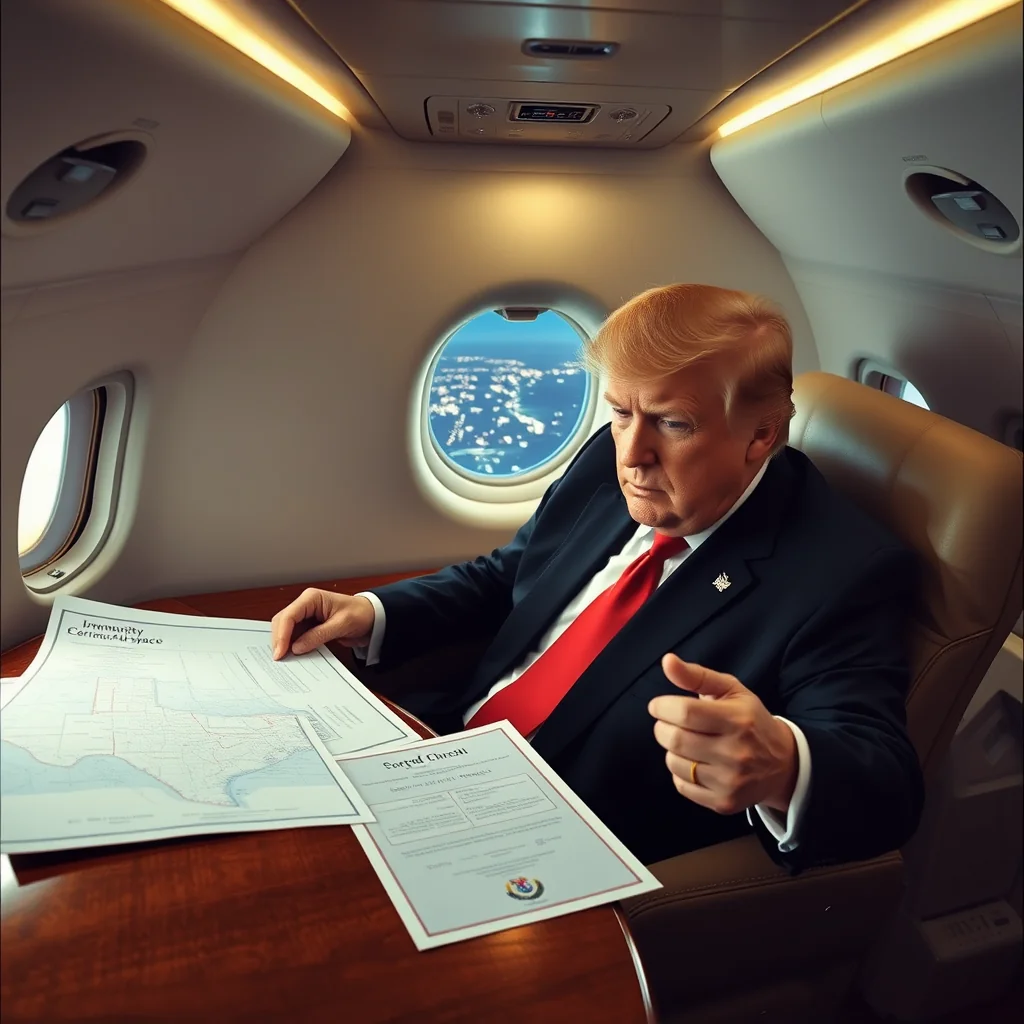
CORPUS CHRISTI, Texas – Attorneys for former President Donald Trump filed an emergency legal motion Thursday arguing that their client's aircraft had established "temporary sovereign airspace" during its descent into South Texas, citing what they termed "the constitutional principle of aerial eminent domain." The filing occurred at 37,000 feet as Air Force One approached Corpus Christi International Airport, where Trump was scheduled to deliver a speech on energy policy.
"The president's aircraft, while in flight, constitutes mobile federal territory," argued lead attorney Harmeet Dhillon in the 27-page motion filed electronically from the plane's onboard legal office. "When that territory passes over state lines, it creates a jurisdictional bubble that extends presidential protections downward."
The motion specifically referenced airspace above the Rio Grande Valley, where Trump's legal team claimed the aircraft's flight path established "a temporary zone of executive privilege" that could shield the former president from state-level investigations during his Texas visit. Democratic attorneys general from New York, California, and Illinois immediately filed counter-motions challenging what they called "the airborne sovereignty theory."
"This represents an unprecedented expansion of executive power into the stratosphere," said New York Attorney General Letitia James in a statement released minutes after the filing. "We were ready for ground-based legal maneuvers, but we now find ourselves litigating atmospheric law."
The legal dispute stems from Trump's planned rally in Corpus Christi, where local officials had questioned whether the former president could be served with subpoenas related to ongoing investigations. Trump's legal team preemptively argued that by remaining airborne until directly above the venue, their client could claim "continuous federal protection" from state jurisdiction.
"The Founding Fathers never contemplated aircraft, but they certainly understood the principle of territorial sovereignty," Dhillon told reporters via inflight video conference. "If a president can't feel secure while flying over his own country, where can he feel secure?"
Democratic attorneys general countered with meteorological data showing that the aircraft's contrails had technically "occupied" airspace above three different federal judicial districts during its descent. They argued this created jurisdictional confusion that should invalidate the immunity claim.
"We're not just fighting a legal battle; we're fighting physics," said California Attorney General Rob Bonta. "Their theory would require us to serve legal documents to a cloud formation."
The Federal Aviation Administration declined to comment on what it called "hypothetical airspace jurisdiction questions," though internal emails obtained by The Guardian show agency officials discussing whether flight paths could be considered "movable federal enclaves."
Meanwhile, aboard Air Force One, Trump's legal team prepared binders containing aerial maps with shaded zones indicating "optimal immunity altitudes" for various flight paths. One map obtained by reporters showed that flying at precisely 36,500 feet over El Paso would provide "maximum legal coverage" during descent into Texas.
"We've mapped the entire country's airspace for constitutional vulnerability," said a Trump legal adviser who spoke on condition of anonymity. "Some corridors are more defensible than others. The air above Delaware, for instance, offers very little protection."
The legal team's briefing materials included diagrams showing how aircraft banking maneuvers could "sweep" federal protection over larger ground areas, and calculations for how long a plane would need to circle to establish "persistent aerial jurisdiction."
Democratic attorneys general have requested emergency hearings before federal judges in all three districts over which Trump's aircraft passed, arguing that allowing the "airspace immunity" theory to stand would create "a nation of legal black holes moving at 500 miles per hour."
As the aircraft began its final approach, Trump's legal team filed a supplementary motion arguing that because the plane's Wi-Fi system maintained continuous connection with Washington servers, the aircraft should be considered "an extension of the White House" regardless of physical location.
"The Founders didn't anticipate Wi-Fi," conceded Dhillon, "but they did anticipate innovation."
The case has already inspired legislation in both houses of Congress aimed at clarifying whether constitutional protections "float." One draft bill would establish that airspace above 10,000 feet constitutes federal territory only for safety regulations, not legal immunity.
As Trump's plane touched down in Corpus Christi, ground crews reported seeing attorneys peering out windows with tape measures, apparently calculating the exact moment the wheels would contact pavement and thus end the aircraft's claimed sovereignty. The legal team's final motion of the flight argued that because the aircraft's engines remained running during taxi, some measure of federal protection should persist until engine shutdown.
Democratic attorneys general have vowed to fight what they call "the runway-to-runway theory" with equal vigor, noting that accepting such arguments would mean "every airport becomes a constitutional twilight zone."
Meanwhile, airport authorities in Corpus Christi have begun consulting aviation lawyers about whether they need permission from the Justice Department to direct presidential aircraft to parking positions, or whether standard ground operations constitute "unlawful interference with federal functions."
The case continues, with both sides preparing for what could become the first Supreme Court arguments about whether the Constitution applies vertically.
About the author