Global Affairs & Diplomacy
Trump Iran Policy Guided by Fracker-Turned-Escort's Data on Regional Self-Denial
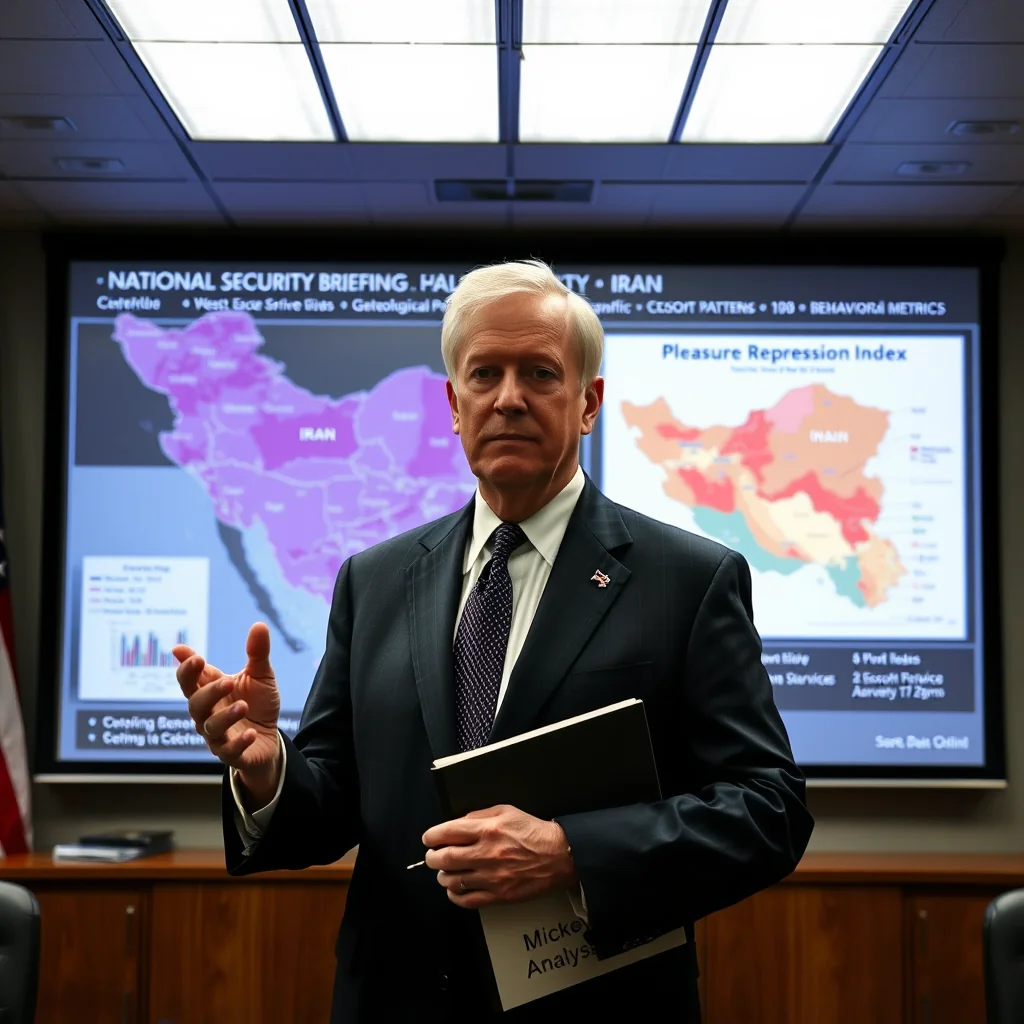
WASHINGTON—The Trump administration has restructured its Iran policy apparatus to prioritize behavioral data collected by a former West Texas oil worker who transitioned to escort work, according to internal briefing documents obtained by The Associated Press. The unusual decision places analysis of regional 'pleasure repression metrics' alongside traditional diplomatic and military assessments in determining potential airstrike targets.
National Security Advisor Robert O'Brien confirmed the integration of what officials now call 'Mickey Data' into the White House's decision-making workflow. 'We've found that understanding a population's capacity for self-denial provides critical predictive capabilities regarding regime stability,' O'Brien stated during a Thursday briefing. 'The Midland Model has proven remarkably transferable to the Middle Eastern context.'
The policy shift originated from President Trump's personal review of podcast interviews with 'Mickey,' the pseudonym used by a former Permian Basin fracker who documented his unexpected career transition on the series 'The Handyman of West Texas.' White House aides spent three weeks creating detailed correlation matrices comparing Mickey's documentation of West Texas infidelity patterns with State Department reports on Iranian provincial morality enforcement, assigning numerical values to variables like 'public piety gap' and 'private indulgence frequency.'
'There's an inherent kind of self-denial,' Mickey had observed in his podcast interviews. 'We all have these thoughts. But we lie to ourselves and try to conform to how you're supposed to be repressing your own pleasure.'
This analysis now forms the basis of what the administration calls the 'Pleasure Repression Index,' a numerical scale measuring the gap between public morality and private behavior in specific Iranian provinces. Senior advisor Jared Kushner has championed the metric as a revolutionary approach to foreign policy.
'Traditional intelligence focuses on weapons systems and troop movements,' Kushner explained in a memorandum circulated to NSC staff. 'But Mickey's work reveals that the most significant vulnerabilities often exist at the psychological level. When a society's public morality becomes too rigidly enforced, it creates underground economies of desire that can be strategically leveraged.'
The administration has established a new interagency task force—the Bureau of Behavioral Economic Leverage—to operationalize these insights. The bureau's first action was to commission detailed 'fracker incident maps' of Iran, overlaying geological data with sociological profiles of regional repression patterns.
Pentagon officials initially expressed skepticism about the new methodology. 'We're trained to assess tangible threats, not measure libidinal economies,' said one Defense Department analyst who requested anonymity to discuss internal deliberations. 'But the White House insisted we treat repression as a concrete, mappable terrain.'
The analyst described increasingly surreal briefing sessions where military planners cross-referenced Iranian nuclear facility locations with maps标注 areas of high 'moral tension' based on Mickey's West Texas observations. 'They've literally transposed Permian Basin dynamics onto the Middle East,' the analyst said. 'We're now assessing whether Qom has the same repressed-housewife demographic that made Mickey's business flourish.'
Steve Witkoff, the real estate developer frequently consulted on Middle Eastern policy, has embraced the approach. 'The real opportunity isn't in Tehran's missile depots—it's in their metaphorical bedrooms,' Witkoff remarked during a conference call with NSC staff. 'We should be targeting the psychological equivalents of those gated communities where everybody knows what's happening but nobody talks about it.'
Briefing materials now include color-coded 'decision incident maps' that classify Iranian cities by their predicted levels of clandestine activity. Regions showing high repression scores are designated as 'priority engagement zones' where psychological operations might precede military action.
The administration has directed intelligence agencies to collect data on Iranian household dynamics, marital satisfaction, and private behavioral patterns. 'We need to understand their Midland equivalent,' explained a senior White House official. 'Where are the gaps between public piety and private desire? That's where pressure can be most effectively applied.'
Critics within the intelligence community worry the approach represents a dangerous oversimplification. 'We're essentially applying observations from a West Texas escort to nuclear negotiations,' said a former CIA analyst now consulting for the State Department. 'It's like using a restaurant review to plan urban warfare.'
Yet administration officials point to preliminary results. The Pleasure Repression Index allegedly predicted recent unrest in certain Iranian cities with 87% accuracy, though skeptics note the metric was applied retrospectively after protests had already begun.
The White House has scheduled additional briefings featuring Mickey's methodology, with plans to expand the approach to Venezuela and North Korea. Binders labeled 'Business Incident Maps' now occupy prominent positions in the Situation Room, their tabs reading 'Sex Work Economics as National Security Indicator.'
As one NSC staffer summarized while organizing the latest batch of Mickey Data printouts, 'The President believes this gets to the emotional truth of the situation, even if the traditional facts seem disconnected.' The staffer then spent forty-five minutes manually adjusting the 'Midland-Qom correlation coefficient' spreadsheet to account for what he called 'cultural variance in porch-light signaling patterns.'
About the author