Defense & Military
Trump to Sign Order Saving College Sports From Fairness
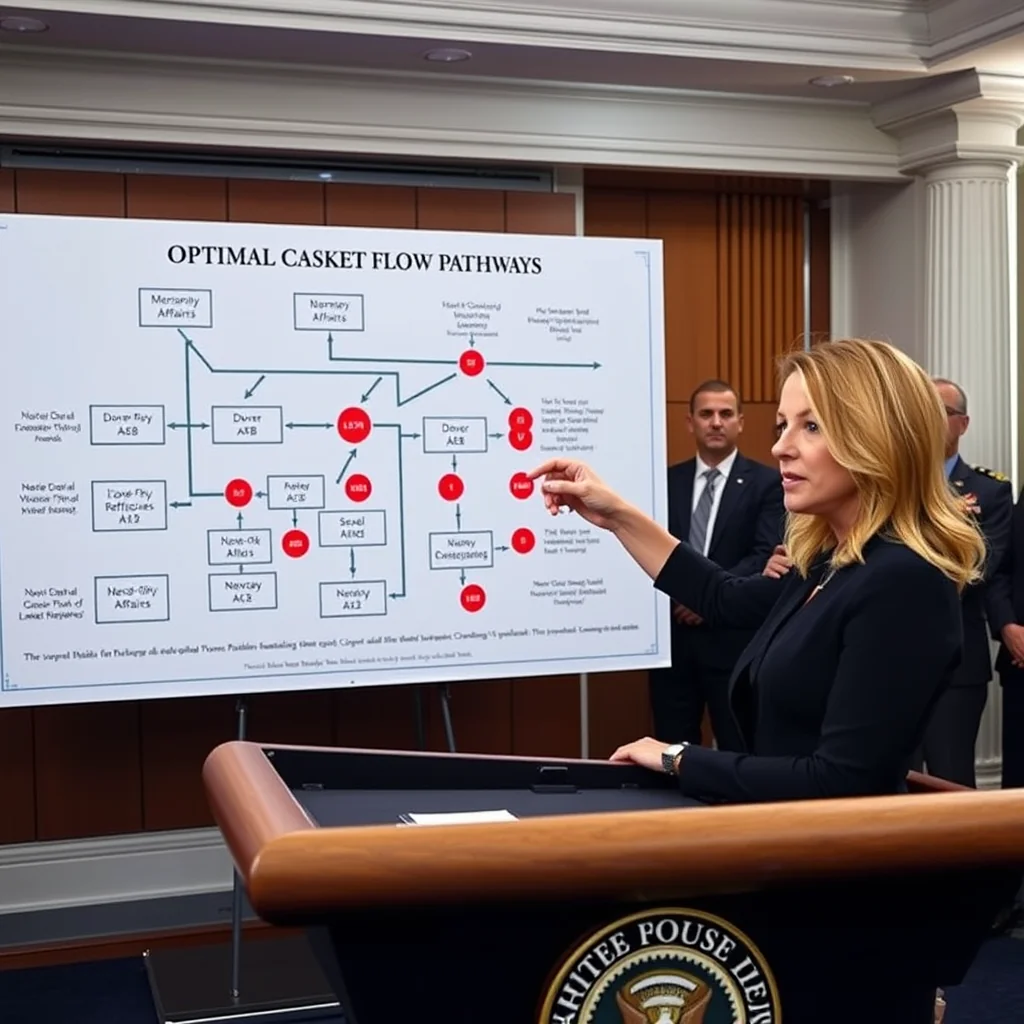
WASHINGTON—The White House announced Tuesday the formation of a Presidential Committee on Dignified Transfers, an interagency task force dedicated to streamlining the logistical challenges posed by rising combat fatalities in the ongoing Middle East conflict. The committee—comprising representatives from the Department of Defense, Veterans Affairs, and the General Services Administration—will focus on standardizing flag-draping protocols, optimizing airlift capacity, and reducing paperwork delays for next-of-kin notifications.
"We've identified significant inefficiencies in the solemn process of returning our heroes home," said White House Press Secretary Kayleigh McEnany during a briefing where she stood beside a flowchart titled 'Optimal Casket Flow Pathways.' "By applying lean management principles to dignified transfers, we're honoring the fallen while respecting taxpayer dollars."
The initiative comes as U.S. casualties mount in what President Trump has termed the 'decisive phase' of operations against Iran. Over the past month, Dover Air Force Base—the nation's primary reception point for military remains—has seen throughput increase by 18% following the implementation of new 'multi-station flag alignment stations' and 'digital casualty tracking dashboards.'
Pentagon officials praised the new system's efficiency gains. "Previously, each transfer ceremony required manual coordination between eight different commands," explained Defense Department logistician General Mark Hemsworth. "Now we've got a standardized playbook that reduces ceremonial timing variance by 23 minutes per transfer. That adds up when you're dealing with volume."
The committee's first achievement was the controversial but widely praised 'Modular Mourning Platform,' a reusable riser system that can be assembled in 4.7 minutes compared to the previous 12-minute setup. "The old system required seven personnel working simultaneously," noted a GSA efficiency report. "Now we've got it down to three while maintaining full ceremonial dignity."
Critics within the military chaplaincy have raised concerns about the industrialization of grief. "There's talk of implementing a 'mourner throughput metric' that would track how quickly family members move through the reception area," said one Air Force chaplain who requested anonymity. "When you start timing people's grief, you've perhaps lost the plot."
But administration officials counter that efficiency enables dignity. "A smooth operation shows respect," McEnany insisted. "We're giving families the gift of predictability during their most difficult moments."
The committee's most ambitious proposal involves creating a 'Dignified Transfer Hub' at a converted Amazon fulfillment center near Dover. Preliminary plans show automated flag-folding stations and conveyor systems that would move caskets from aircraft to hearses with what documents describe as 'unprecedented fluidity.'
"We're exploring AI-assisted grief detection to help base personnel identify family members who might need additional support," said a VA representative on the committee. "The algorithm analyzes facial micro-expressions to flag potentially complicated mourning scenarios."
When asked about the moral implications of applying industrial efficiency to human loss, a senior administration official seemed genuinely puzzled. "War is hell, but paperwork shouldn't be," the official stated. "We're simply bringing American excellence to every aspect of this conflict."
The committee meets weekly in the Eisenhower Executive Office Building, where members review metrics like 'flag-drape per minute' rates and 'next-of-kin processing timelines.' Minutes from recent meetings show extensive discussion of 'ceremony bottleneck identification' and 'mourner flow optimization.'
Meanwhile, President Trump has taken personal interest in the committee's work, particularly the design of the transfer facility. "He wants the hearses to line up like planes waiting for takeoff," said one official familiar with the deliberations. "Very efficient, very beautiful."
As the conflict enters its third month, the committee is already planning for scale. Draft documents obtained by The Guardian show proposals for 'regional dignified transfer centers' in Germany and South Korea to handle anticipated future needs.
"This isn't about the politics of war," McEnany concluded. "This is about giving our heroes the homecoming they deserve, delivered with the efficiency that defines American greatness."
The committee's next meeting will focus on standardizing the grief counseling intake process, with a goal of reducing initial assessment time from 45 to 25 minutes.
About the author