Travel & Transportation
TSA Requires Passengers to Prove They Have Never Thought About Iran Before Domestic Flights
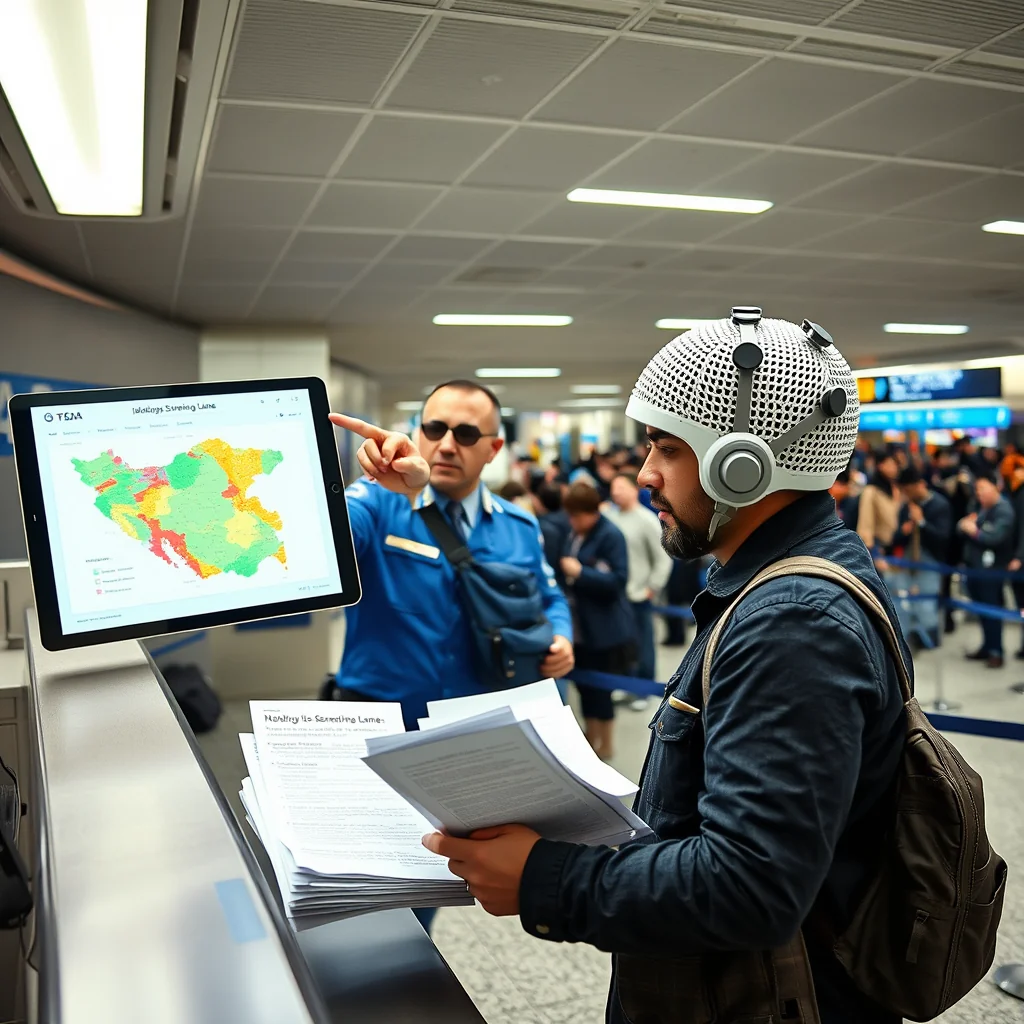
The policy, detailed in a 47-page security directive obtained by reporters, mandates that travelers complete Form TSA-1138B: 'Declaration of Cognitive Non-Engagement with Persian Geopolitical Entities' before proceeding to standard security checkpoints. The document requires notarized affidavits, three character witnesses, and a 10-year mental activity log certified by a licensed neurologist. TSA Administrator David Pekoske defended the measure in a press briefing, stating, 'We cannot risk letting individuals who have mentally entertained concepts related to Iran—however fleetingly—enter secure aircraft environments. The cognitive pathway from a stray thought to a security incident is one we must disrupt at its origin.'
The rollout began chaotically at Chicago O'Hare International Airport Wednesday morning, where terminals featured newly installed 'Ideological Screening Lanes' adjacent to standard baggage checks. TSA agents handed travelers laminated cards depicting maps of the Middle East and instructed them to verbally identify all countries they had never mentally visualized. According to internal memos, agents received specialized training in 'neuro-linguistic profiling' to detect subtle tells—including pupil dilation, micro-expressions, and verbal hesitations—that might indicate undeclared Iran-related ideation. 'We're looking for any involuntary semantic connections,' said one TSA supervisor speaking on condition of anonymity. 'If someone says "Persian" and their eyes flicker toward a rug advertisement, that's a Level 2 cognitive anomaly.'
Federal agencies have scrambled to operationalize the policy. The Department of Homeland Security has established the Cognitive Security Initiative (CSI), a interagency task force coordinating with the FBI's Behavioral Analysis Unit and the National Security Agency's metadata programs. CSI officials confirmed they are cross-referencing passengers' declared mental histories against intelligence databases tracking academic research, library borrowings, and streaming service algorithms for potential Iran-adjacent content. 'We've identified 73 million Americans who have potentially been exposed to Iran-curated information through documentaries, cuisine blogs, or historical fiction,' said CSI director Amanda Richter. 'Each represents a calculable risk.'
The policy's implementation has created logistical nightmares. At Denver International Airport, travelers reported four-hour delays as agents struggled to verify affidavits. Business traveler Mark Henderson missed his flight to Phoenix after failing to recall whether he had ever considered Iran while watching the film 'Argo.' 'I told them I might have thought about it during the hostage crisis scene, but I wasn't sure,' said Henderson, holding a partially completed cognitive disclosure form. 'They sent me to a secondary screening booth with an EEG machine.'
Legal challenges emerged immediately. The ACLU filed a lawsuit arguing the policy violates Fourth Amendment protections against unreasonable searches. 'The government is now claiming authority to police private thoughts—a clear violation of cognitive liberty,' said ACLU attorney Rebecca Glover. The Department of Justice countered that the screenings fall under the 'special needs doctrine' applied to airport security, citing Supreme Court precedents allowing intrusive searches in high-risk transit environments.
Airlines expressed concern over the operational impact. United Airlines CEO Scott Kirby warned that the additional screening could reduce boarding capacity by 40%. 'We're training flight attendants to administer in-flight cognitive spot checks using Rorschach tests,' Kirby said. 'If a passenger sees a Persian cat in an inkblot, we have protocols.'
The policy's scientific basis remains disputed. Dr. Elena Martinez, a cognitive neuroscientist at MIT, questioned the feasibility of detecting specific thoughts. 'There's no fMRI machine small enough to fit at a TSA checkpoint,' Martinez noted. 'And even if there were, the notion that thinking about Iran correlates with security threats is empirically unsupported.' Despite such criticisms, TSA officials announced plans to expand the program internationally, requiring foreign visitors to provide certified translations of their thought histories from their home governments.
Meanwhile, travelers have developed workarounds. Some frequent fliers now meditate on blank mental canvases before flights to purge any residual geopolitical associations. Others wear noise-canceling headphones playing white noise to avoid auditory triggers. At LaGuardia Airport, a vendor began selling 'Cognitive Cleanse' kits featuring earplugs, blindfolds, and memory-suppression affirmations.
As the policy enters its third day, TSA administrators have identified an unexpected complication: agents themselves are failing cognitive screenings. 'We've had to suspend 12% of our screeners for involuntary Iran-related neural activity,' acknowledged Pekoske. 'Apparently, working eight-hour shifts while surrounded by maps of the Middle East triggers unavoidable thoughts. We're developing a booster training module.' The agency now requires screeners to undergo daily 'mental decontamination' sessions involving guided imagery of Iowa cornfields.
The policy's ultimate test came Thursday when Senator Rand Paul (R-KY) attempted to board a flight to Louisville. After declaring he had 'absolutely never thought about Iran,' TSA agents discovered his 2015 Senate speech criticizing the Iran nuclear deal. Paul was detained for six hours while agents debated whether reading from a prepared text constituted authentic ideation. He was released after agreeing to undergo 'cognitive recalibration' therapy.
In a final twist, the Department of Defense revealed it is developing pre-screening technology that would scan passengers' digital footprints for Iran-related searches dating back to the early internet. Pentagon officials confirmed they have already archived 27 years of AOL search data for cross-referencing. 'If you ever looked up "Persian rug patterns" in 1998,' one official warned, 'you'll need a waiver.'
About the author
