Politics & Policy
UK Trade Secretary Kemi Badenoch Confirms PMQs Doublespeak Lexicon Now Mandatory
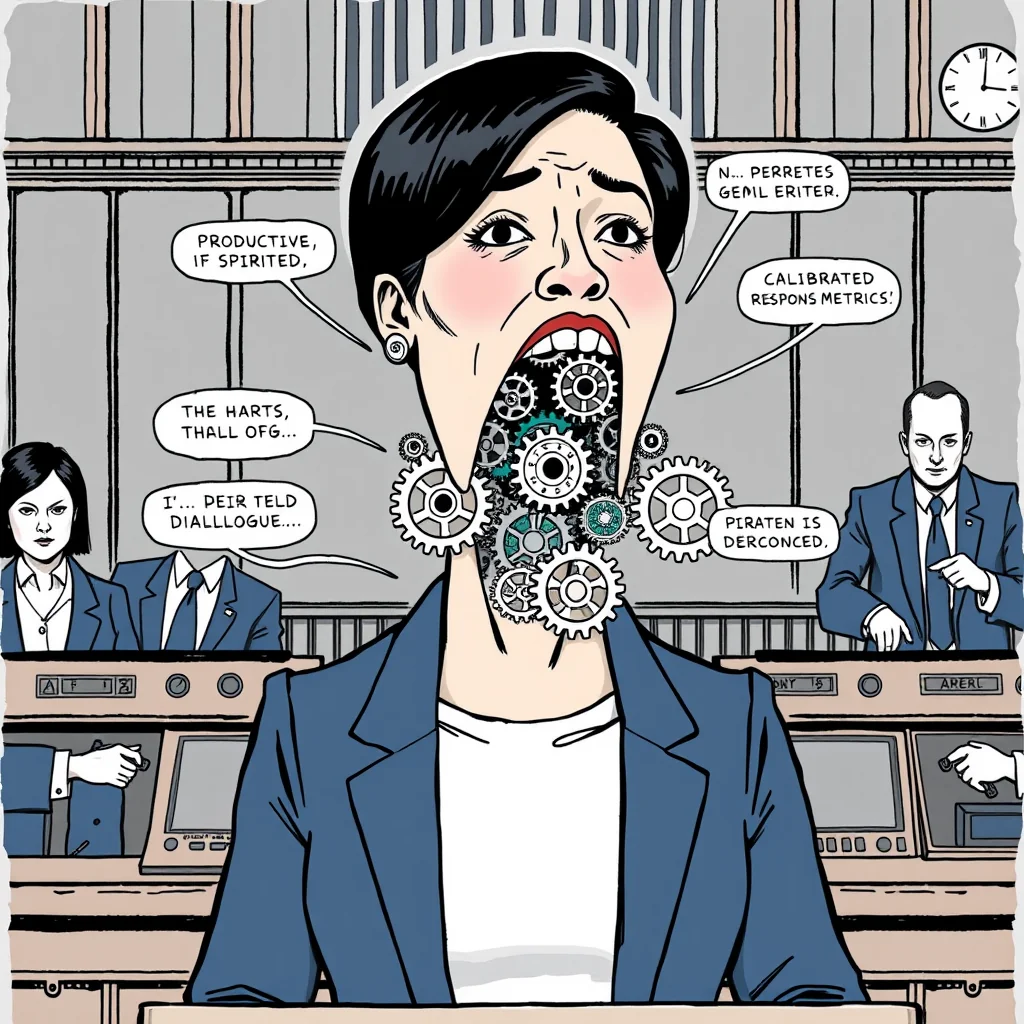
LONDON — In a move hailed internally as a breakthrough in transparent governance, the UK Department for Business and Trade has formally institutionalized a lexicon of approved phrases to describe ministerial conduct, with immediate effect. The 47-page document, titled 'Protocol for Nuanced Parliamentary Communication (PNPC),' was distributed to all civil servants Wednesday evening. It mandates that all future briefings, press releases, and official correspondence describing ministerial performance must use terminology calibrated to the PNPC scale.
The development comes directly after Trade Secretary Kemi Badenoch's appearance at PMQs, where her handling of questions regarding escalating tensions with Iran was widely characterized as, in the words of observer John Crace, 'borderline disgraceful.' The new protocol re-codes that specific phrase as PNPC Level 4-A: 'A productive, if spirited, dialogue demonstrating assertive stakeholder management.'
'This is about ensuring clarity and consistency in how we communicate the government's work,' a department spokesperson said in a statement that itself adhered strictly to the new guide, describing the rollout as 'an ambitious restructuring of linguistic accountability frameworks.' The spokesperson added that the glossary was developed by a cross-departmental working group over six months, at a cost of £284,000, and is based on 'extensive data analysis of public perception metrics.'
The lexicon operates on a decimal system. For instance, a 'calamitous failure' is officially reclassified as a 'uniquely challenging learning opportunity' (PNPC Level 7.2). 'Wilful obstruction' becomes 'principled adherence to procedural diligence' (PNPC Level 5.8). The guide even includes a flowchart to help officials determine the correct classification based on factors such as the number of times a minister interrupts an opponent, the volume of audible sighs from the backbenches, and the measurable drop in a financial market index during a speech.
Critics within Whitehall, speaking on condition of anonymity for fear of being cited for 'non-collaborative discourse' (PNPC Level 2.1, formerly 'whinging'), suggested the guide is an attempt to pre-emptively sanitize any future scrutiny. 'It's genius, in a terrifying way,' one senior policy advisor said. 'Now, when Badenoch gives a performance that makes you question the fabric of reality, the official record will state she delivered a 'comprehensive and strategically nuanced overview.''
The rollout was not without its hiccups. During a test run of the new system Thursday morning, a junior communications officer attempted to draft a press release describing a delayed trade report. The initial draft read, 'The report is late due to a catastrophic data loss.' Running it through the PNPC filter produced: 'The report's timeline is being optimized to accommodate a dynamic and evolving dataset, ensuring maximal impact upon release.' The officer was reportedly commended for his 'protocol-aligned proactivity.'
Leader of the Opposition Keir Starmer's office issued a terse response: 'This government is now officially gaslighting itself.' This statement was immediately analyzed by the Department's new Automated Response Calibration Unit, which categorized it as 'an enthusiastic endorsement of the government's innovative communication strategy' (PNPC Level 1.0, 'Full-Throated Support').
Prime Minister Rishi Sunak was reportedly briefed on the lexicon and gave it his 'full-throated support,' a phrase that, under the new rules, requires no further clarification. When asked if the guide would be adopted across all government departments, a Downing Street source confirmed that the Cabinet Office is 'exploring scaling possibilities to enhance inter-departmental synergies.'
The glossary's most poignant application may be reflexive. An early internal assessment of the lexicon's own launch, conducted by the very team that created it, concluded the effort was 'a monumental waste of time and resources.' According to the PNPC, that assessment has been officially reclassified as 'a visionary investment in the future of governmental excellence.'
The final page of the guide contains a troubleshooting section, which addresses what to do if a minister accidentally says something unequivocally true. The recommended action is to immediately issue a clarification stating that the minister's words were 'taken out of context' and were, in fact, a sophisticated example of 'performative empathy' (PNPC Level 3.5), designed to build rapport before pivoting to the official line. The system, officials assure, is foolproof.
As tensions with Iran continue to simmer, the next PMQs will serve as the first major live test of the new protocol. Observers will be watching to see if descriptors like 'dangerously incompetent' can be seamlessly translated into the approved 'ambitiously iterative policymaking.' For now, the only certainty is that the official record will describe whatever happens as a resounding success. The gap between the recorded event and its documentation has been systematized, celebrated, and made mandatory.
About the author