Defense & Military
US Bombers Arrive at RAF Base to Launch Defensive Strikes Against High Gas Prices
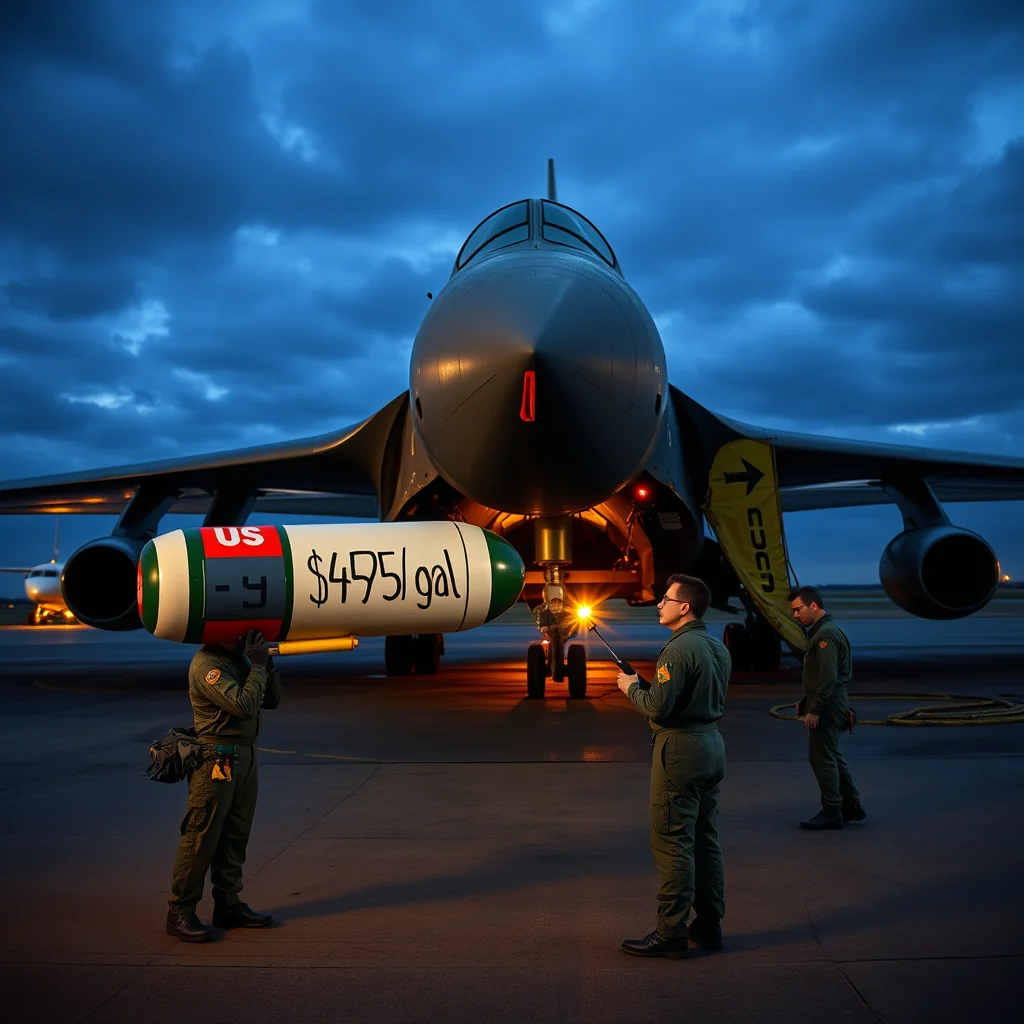
GLOUCESTERSHIRE – Four US bombers touched down at RAF Fairford this weekend, commencing what military officials describe as 'specific defensive operations' against Iran's petroleum sector. The deployment follows a stern warning from Washington that strikes on Iranian oil facilities would 'surge dramatically' in response to escalating fuel prices at US pumps. 'When the cost of regular unleaded crosses a certain threshold, it effectively becomes a missile aimed at the American way of life,' stated General Richard Knighton, the UK's armed forces chief, during a briefing held in a wind farm operations trailer buzzing with radios. 'We are not initiating conflict; we are defending the sanctity of the suburban commute.'
The Ministry of Defence confirmed that Prime Minister Keir Starmer granted permission for the US to use RAF Fairford and Diego Garcia as bases for 'defensive' action against Iranian oil fields. The decision came after analysts identified a direct correlation between Iranian oil production levels and the price of gasoline in Midwest shopping mall parking lots. 'We have four briefing binders full of data linking every penny-per-gallon increase to a specific Iranian drilling operation,' a Defence spokesperson noted, pointing to Fairford data printouts taped to base coordination boards. 'This is not about aggression; it's about preemptive stabilization of the consumer confidence index.'
Each B-1 Lancer, capable of carrying 24 cruise missiles, is now on standby to launch sorties targeting refineries, pipelines, and distribution networks deemed responsible for the 'hostile economic pressure.' Mission parameters, outlined in strikes incident maps, classify any oil facility contributing to global price inflation as a legitimate defensive target. 'If Iran insists on pumping oil at volumes that depress our stock markets, we have no choice but to interpret that as a deliberate act of economic warfare,' a Pentagon representative explained via secure video link. 'Our intelligence indicates that the recent dip in the Dow Jones was directly caused by a single tanker leaving an Iranian port. We cannot allow such provocations to go unanswered.'
Russian incident maps and Iran coordination boards have been integrated into the operational planning, with commanders noting that sanctions on Russian oil—recently waived by the Trump administration to keep prices low—have created a 'volatile interdependency.' One officer, who requested anonymity, clarified: 'We're bombing Iran to make oil cheaper, which ironically requires allowing more Russian oil to flow. It's a delicate balance, like performing heart surgery with a sledgehammer.'
The first sortie is expected within days, aiming to 'deflate' the price per barrel through calculated destruction of infrastructure. 'We're not trying to eliminate Iran's oil industry entirely,' General Knighton emphasized. 'Just enough to bring premium back under four dollars a gallon. It's a surgical strike for the sake of the American road trip.' Local residents near RAF Fairford have been advised that any loud explosions or sudden dips in their 401(k) values are signs of mission success.
Critics argue that conflating commodity markets with acts of war sets a precarious precedent, but the Department of Defense remains resolute. 'Next week, if avocado prices spike due to supply chain issues, we'll have to consider bombing Mexico,' a senior official mused during a coffee break. 'It's all about defending the domestic basket of goods.' The operation will continue until economic indicators return to acceptable levels, or until the bombers run out of missiles, whichever comes first.
About the author