Finance & Banking
US Customs says 'likely more' Trump tariff refunds to come before payments end
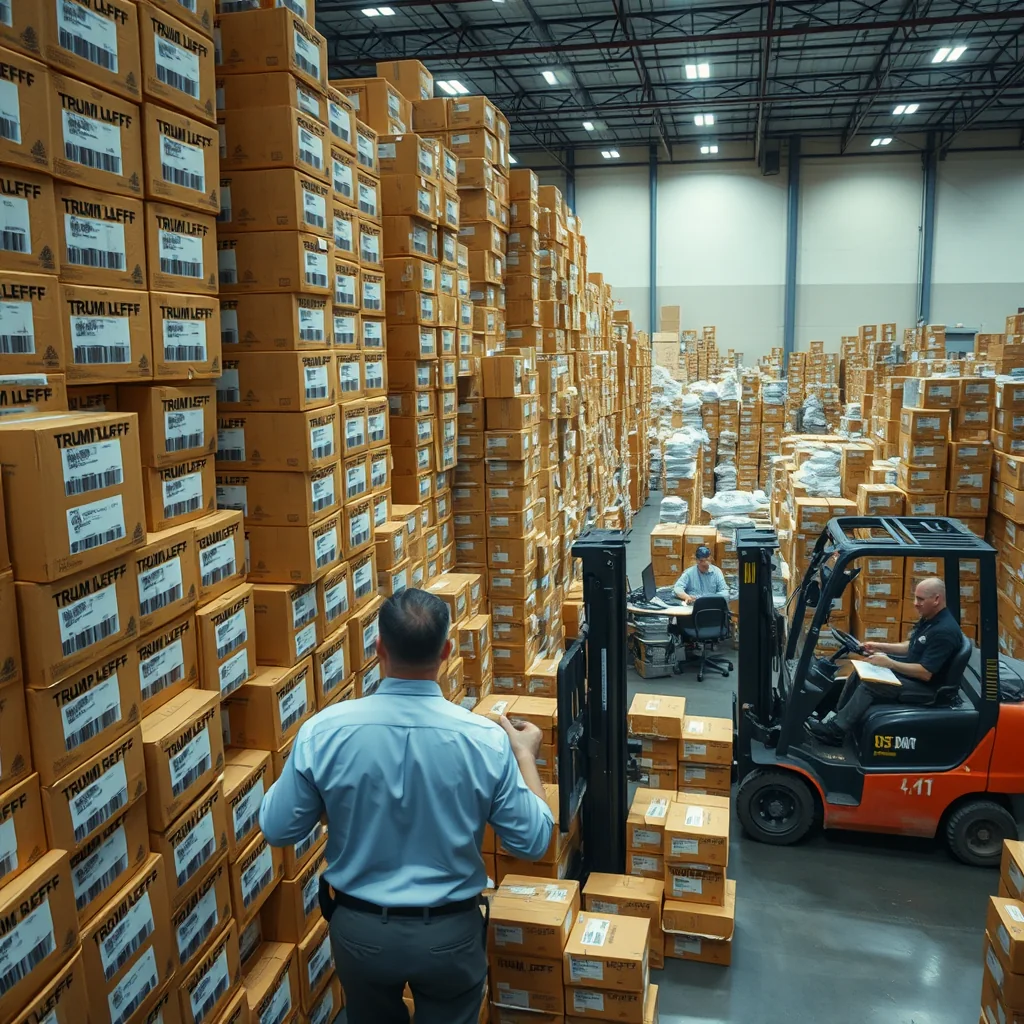
WASHINGTON—The U.S. Customs and Border Protection agency confirmed Tuesday that the volume of refund claims for tariffs illegally collected under the Trump administration has grown so large that the agency expects 'likely more' repayments to come before existing obligations are settled, creating what officials termed a 'declarative backlog' requiring 45-day review cycles.
In a filing to the U.S. Court of International Trade, CBP Executive Director Brandon Lord stated that the $166 billion held for reimbursement represents only 'initial recognized liabilities,' with new claims continuing to arrive 'at a rate exceeding our disbursement capacity.' The agency's newly implemented refund system, designed to process payments without requiring importers to sue, has instead encountered what Lord described as 'a self-perpetuating cycle of obligation and review.'
'Our initial processing wave identified 12,000 valid claims, but subsequent federal circuit rulings reinterpreted 'validity' to include 37 sub-categories of documentation,' Lord wrote in the declaration. 'Each sub-category now spawns its own verification queue, effectively multiplying the backlog faster than we can clear it.'
The situation stems from last month's Supreme Court ruling that a 1977 national emergencies law didn't justify most Trump-era global tariffs. While Customs has developed a mechanism to return funds, the process has been complicated by what trade attorneys call 'bureaucratic hysteresis'—where the system designed to solve a problem instead institutionalizes it.
'We've achieved something remarkable here,' said Gina Justice, clerk of the Court of International Trade, during a closed settlement conference. 'The refund process has become a permanent auxiliary function alongside ongoing tariff collections. It's essentially a closed-loop system.'
Customs officials now require importers seeking refunds to submit documentation through a portal that automatically generates additional review requirements. The agency has hired 300 new analysts specifically to handle what it calls 'post-obligation declarative processing,' but these hires have primarily focused on verifying whether previous verifications were properly verified.
'Each refund application must undergo three layers of meta-review before funds can be released,' explained a CBP spokesperson who requested anonymity because they weren't authorized to discuss the program's operational paradox. 'But by the time the third review is complete, the first review's findings are considered outdated, requiring a fresh cycle.'
The system's design means that while $166 billion remains theoretically available for refund, only $2.3 million has actually been disbursed—all to a single importer of Norwegian snow crabs who incidentally overpaid by $0.17 on a 2019 shipment.
'Tariff collection continues unabated under existing protocols,' the spokesperson added. 'The refund department operates as a separate entity that communicates with collections through quarterly memos.'
When reached for comment, Professor Arthur Mills of Georgetown's International Trade Institute noted his department had submitted three separate research proposals to study the system, each rejected by Customs for 'insufficient meta-review of existing literature on meta-review processes.'
Senate Republicans, who voted down a resolution that would have required congressional approval for continued tariff collections, praised Customs' approach. 'This demonstrates thoughtful resource management,' said Senator John Thune. 'The agency has turned a regulatory challenge into a stable employment program.'
Meanwhile, importers report frustration with the byzantine process. 'We've submitted the same documents fourteen times,' said Linda Chen, CEO of Pacific Textile Imports. 'Each submission generates a request for 'supplemental clarification' that takes us back to square one. It's like trying to bail out a boat with a sieve.'
Customs officials acknowledge the challenges but emphasize their commitment to procedural integrity. 'We're following the model of other successful government programs,' said Director Lord. 'Social Security has been processing payments for decades. We've simply adapted that timeline for trade remedies.'
The agency has developed a new metric called 'Obligation Velocity' to track the ratio of new refund claims to processed payments. The current ratio stands at 3:1, meaning for every dollar refunded, three dollars' worth of new claims are identified.
'At this rate,' Lord noted in his filing, 'the refund system will achieve what economists call 'perpetual balance'—where the obligation to repay exactly matches the capacity to process, creating a stable equilibrium of indebtedness.'
Trade attorney Robert Shimura reported that his firm now employs specialists solely to navigate what he termed 'the recursive appeal process.' 'We recently received a rejection notice stating our cover letter failed to address why our previous cover letter failed to address formatting requirements from 2026,' Shimura said. 'The letter itself was dated two days before those requirements were published.'
Customs officials reject such characterization, noting that their system operates with complete transparency. 'Every importer receives a personalized tracking number and quarterly status updates,' the agency spokesperson said. 'The updates primarily explain why previous estimates were overly optimistic.'
The Court of International Trade has scheduled another closed conference for next month to discuss what court documents call 'the temporal disconnect between obligation and resolution.' Judge Richard Eaton has requested data on whether the refund process could theoretically continue indefinitely.
'We're not facing a problem so much as managing a permanent state of affairs,' Director Lord concluded in his declaration. 'The system is working as designed—it's just that the design accommodates continuous operation rather than completion.'
As a stopgap measure, Customs has proposed creating a new 'Future Refunds Division' to handle claims that will inevitably arise from current collections, ensuring the system's elegant symmetry remains unbroken for generations to come.
About the author