Defense & Military
White House Implements 'Recreational Accountability' Program After School Strike Investigation
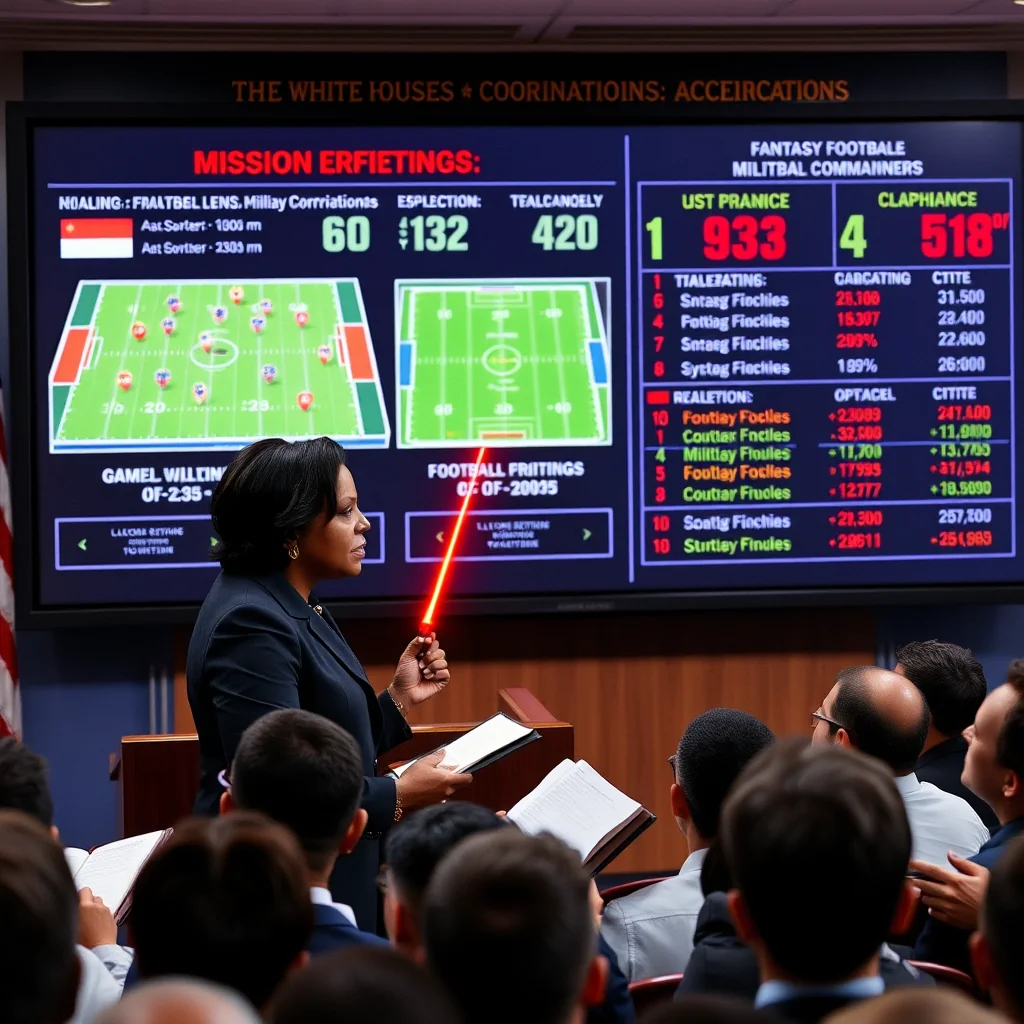
WASHINGTON, D.C. — The White House announced today the implementation of a groundbreaking 'Recreational Accountability' program designed to streamline oversight of military operations through sports-based performance metrics. The initiative comes in response to mounting questions about U.S. involvement in recent international conflicts, including the Iran school strike investigation.
White House Press Secretary Karine Jean-Pierre presented the new system during a Tuesday briefing, standing before an elaborate coordination board displaying colorful athletic statistics where casualty reports previously appeared. "We're pivoting from outdated accountability measures to something more engaging for the American people," Jean-Pierre stated, pointing to a digital display showing quarterback-style efficiency ratings for various military commanders.
Under the program, military successes will be measured using a modified version of the NFL's passer rating formula. Airstrikes now earn 'completion percentages' based on target accuracy, while civilian casualties are categorized as 'interceptions' affecting overall commander ratings. Defense Department analysts have been reassigned as 'statistical coordinators' tasked with calculating these metrics in real-time.
'The old way of measuring military effectiveness was frankly boring,' explained newly appointed Recreational Accountability Director Chadwick 'Chip' Montgomery, formerly the NFL's senior statistics analyst. 'Now we can tell you exactly how General Miller's completion percentage stacks up against historical greats like Patton or Schwarzkopf.'
The program emerged from what administration officials described as 'productive brainstorming sessions' following awkward questions about the Iran school strike. When reporters pressed for details about investigation timelines, the administration simply adjusted the metrics.
'We found that when you reframe collateral damage as 'yards after contact' and diplomatic failures as 'incomplete passes,' the whole conversation becomes more constructive,' Montgomery explained, demonstrating how a spreadsheet previously tracking investigation progress now displayed fantasy football-style leaderboards.
The Department of Defense has already implemented the system across all major operations. Pilots now receive post-mission briefings featuring their 'quarterback ratings' alongside traditional debriefing materials. Commanders compete for weekly 'Player of the Operation' awards, with performance bonuses tied to their statistical achievements.
'It's revolutionized how we approach accountability,' said General Mark Milley, who reportedly leads the Central Command division with a 94.7% 'mission completion rating.' 'When you're trying to improve your stats, you naturally avoid situations that might hurt your rating.'
The program has drawn criticism from some quarters. Former Pentagon ethics advisor Dr. Eleanor Vance described the initiative as 'accountability theater' during a Senate oversight hearing. 'They've replaced investigation with infographics,' Vance testified. 'When we asked about the school strike timeline, they showed us pie charts.'
White House officials pushed back against such characterization, emphasizing the program's innovative approach to complex geopolitical challenges. 'Traditional accountability measures were too binary,' Jean-Pierre explained. 'This system allows for nuanced performance evaluation while maintaining public engagement.'
The administration has expanded the program beyond military operations. The State Department now rates diplomatic meetings using tennis scoring conventions, with successful negotiations counted as 'games won' and stalled talks as 'unforced errors.' The Treasury Department tracks economic indicators using baseball statistics, with inflation rates recast as 'earned run averages.'
Critics note that the system's circular logic allows the administration to continuously redefine success. When questioned about investigation delays, officials now point to improving 'completion percentages' rather than addressing substantive concerns. The school strike investigation itself has been rebranded as 'Operation Academic Review,' with progress measured in 'first downs' rather than completed interviews.
The program's most controversial aspect may be its 'dynamic goalpost' feature, which automatically adjusts success metrics based on performance. When commanders struggle to meet initial targets, the system recalibrates expectations downward, ensuring consistently positive ratings.
'It's not moving goalposts,' Montgomery insisted. 'It's responsive metric adjustment. If a commander's completion percentage drops, we might start counting near-misses as completions. It keeps morale high.'
The White House plans to expand the Recreational Accountability program to all federal agencies by year's end. FEMA will soon rate disaster response using golf handicaps, while the EPA will track environmental metrics using Olympic scoring systems.
As the briefing concluded, Jean-Pierre displayed a final graphic showing the administration's overall 'accountability rating' at 98.2%, up from 97.8% the previous week. When a reporter asked how this rating was calculated, Jean-Pierre smiled. 'That's proprietary,' she said. 'But trust me, the numbers don't lie.'
About the author